


Column
Bengal and Eco-determinism: Why East and West Bengal differs


An Independent Newsweekly




Column
AI Generated Image
Science is increasingly challenging history and sociology. In South Asia both disciplines form the basis of regional politics and the same in the name of socio-political identity but that era is under siege.
Cultural definitions driving political thought is weakening and multiple strands are emerging. Significant segment of social forces still subscribe to this earlier model and social media plays a big role in that. Though religious content has become a much bigger player the wider framework remains the same.
While surface level realities may dominate social media and much of nationalist academia, society is changing indicating co-existence of parallelism and contradictions.
Formal institutions including the state remain overwhelmingly informal which is a major clue. To an extent such institutions are as fragile and temporary as Bangladesh's river banks.
Is there a monolithic Bengal?
The ideas of cultural identity-based nationalism are an example of this issue. Language is considered the dominant factor in identity construction ignoring ecology, history and the very issue that is supposedly the core-social structure.
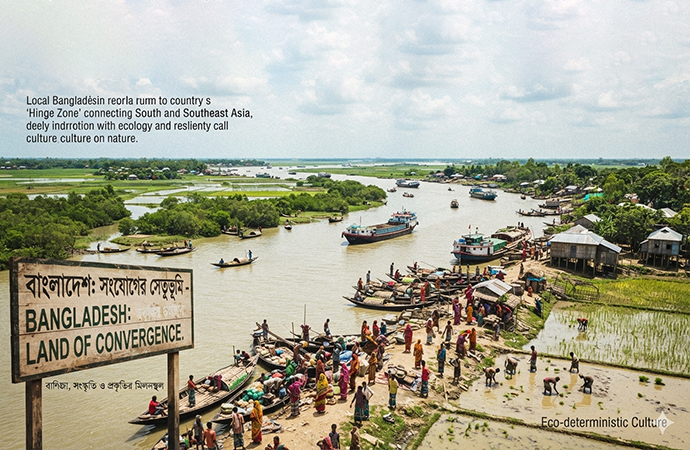
Because Western analysts miss the centuries-old structural divergence between the two zones, local intelligentsia who are largely West beholden miss the point. East Bengal (Bangladesh) is a "Hinge Zone"-a frontier landscape where cultures, geographies, and even religions collided and shifted due to eco-historical trends. It also explains why the two groups developed different neural and behavioural mechanisms.
The division between West Bengali (WB) can be seen in its structural cultural traits. WB is in its sense a zone of cultural entitlement while East Bengali (EB) less-sophisticated survivalist tendencies are rooted in a long historical process that predates colonialism by centuries.
What are Settled and Hinge zones?
The environmental and geopolitical realities of the two zones shaped entirely by different ecology based collective psyches:
The ecological West Zone is the "Settled Core". Located around the Bhagirathi-Hooghly river system. It was geologically stable for over a thousand years. It was heavily integrated into successive imperial systems-from the Gupta Empire to the Delhi Sultanate, and finally the British Raj. Because of this long-term stability, the social hierarchy also reflected this reality. Culture became a currency of power, administration, and gatekeeping.
East Bengal, currently Bangladesh is the Hinge Frontier. It was a wild, shifting frontier for centuries. As the great rivers (Ganges and Brahmaputra) naturally migrated eastward over centuries, they constantly cleared forests and created new, volatile deltaic lands.
This area was geographically isolated from the main imperial capitals. It was a "hinge zone" between the Sanskritic mainland and the Tibeto-Burman/Southeast Asian frontiers. Social structures here had to be fluid to survive, because a river could wipe out an entire village overnight. Ecology ruled.
Cultural patterns and social behaviour
Because of its own distinct environments, the two clusters responded to culture in fundamentally different ways:
West Bengal's traditional settled cultural strategy is much more about a defencive sense of an inherited culture and institutional gatekeeping. The East is more offencive and performative as it lacks stability. Cultural components have a higher religious content as a weapon for power and survival.
WB is more elitist, sophisticated but also nostalgic of its past as its capacity to negotiate with the ruling centres have declined after both zones parted ways in 1947.
The East is less sophisticated, highly competitive, transactional, and prone to internal factionalism.
While West B depends on the narrative of the past including past glories and victimhood narrative to preserve status, the East weaponised the dominant ideology whatever that is including religious culture to control economic and social terrains.
West Bengal sees itself as the true custodians of Bengali culture. Although economic supremacy and land was lost in 1947, they resort to cultural sophistication as a psychological coping mechanism. East Bengal will follow any trend that protects its survival chances.
Why is the East Bengali Elite less "sophisticated"?
Because the region was an agrarian frontier dominated by the stable landlord class from North India and West Bengal for long before colonialism came. In fact, the ruling class was always an external elite. The local leadership emerged not from centuries of academic or artistic leisure, but from peasant mobilisation, land struggles, and their role as sub intermediaries to the external elite.
The current elite (first as East Pakistan, then as Bangladesh) that rose to the top did so through rapid, aggressive crony capitalism, political patronage and governance corruption and remittance booms.
This has created an elite class that is highly pragmatic and incredibly resilient, but lacks the deep-seated, generationally developed WB "Bhadralok" culture or values.
For the EB elite, culture and religion are not abstract aesthetics to be quietly contemplated but active tools to be performed to display dominance, secure wealth and enforce in-group loyalty. To this has been added the role of the military as both economic and political players after 1971.
Why Western and local scholars miss the "Hinge Zone" connection?
Western scholars follow the European model of state making in their analysis looking for "correct" socio- political behaviour linked to Western models. They do not know how to map a society where the elite class is also as temporary as the river banks. Why does the elite change with regimes or how a shifting river delta or economic access can prevent the formation of a rigid, European-style conservative class.
Many see the performative religiosity as "deep conservatism" because they cannot see that beneath the surface, it is actually the fluid, chaotic behaviour of a historical Hinge Zone-where individuals use whatever powerful cultural narrative is available to fight for space, status, and survival in a highly volatile landscape.
A Independent Newsweekly
© Copyright 2026 | Designed by ARK Reepon & Developed by Cosmos Group Software Team





Leave a Comment
Recent Posts
An unaccountable process leave ...
The latest price hike of all four major petroleum products by Tk 20 pe ...
The French Connection in South ...
France Ambassador to Bangladesh Jean-Marc Séré-Charlet h ...
Ties with China enter new phase
Happy 61st birthday, Singapore!
In defiant speech, Pezeshkian calls out Trump and sa ..
The banality of evil