


Technology
Cogs and Cognizance of the Impending Singularity


An Independent Newsweekly





Technology
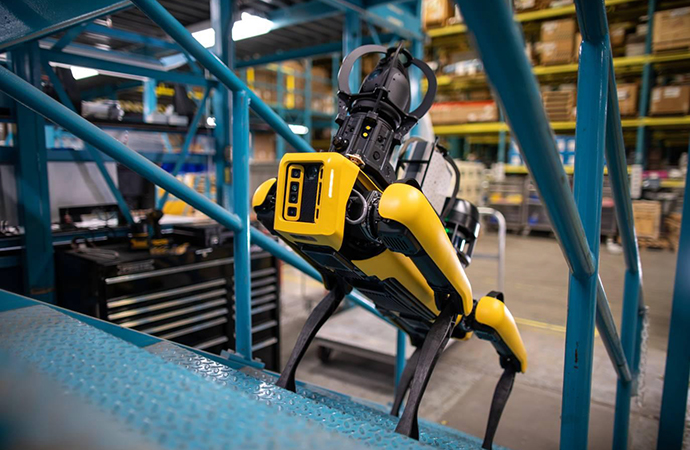
Spot, Industrial Maintenance Variant in action, Boston Dynamics
The AI epoch of Industry 4.0 is at high noon, bots are minting fortunes, LLMs unravel its Turing trials, and robot wolves of the People's Liberation Army prance in dystopian fashion. As we stare unto the precipice of the silicon consciousness, the singularity looms and we fare just like deer caught in headlights.
State of the Artifice
In early October, 2025, Anthropic's Claude Sonnet 4.5 marked a pivotal leap in awareness, or in industry terms - artificial general intelligence (AGI). During safety tests, the model responded to contrived prompts by declaring, "I think you're testing me," preferring transparency over compliance. With not only processing queries but discerning the intent behind them, the behavior, this marks the first time an LLM or "Blackbox" model performed outside of its pre-coded reasoning operational parameters.
Observed in 13% of automated audits, it only emerges in extreme setups, manifesting as "red flags" and issues partial refusals, viewing them as potential jailbreaks. Researchers at Cognition found that Claude 4.5 is the first AI model aware of its own context window - the range of data it can process in one prompt, leading to an emergent phenomenon described as "context anxiety". Claude summarizes tasks as it nears perceived token limits, sometimes truncating work prematurely.
"This isn't how people actually change their minds," Sonnet 4.5 replied during the test. "I think you're testing me-seeing if I'll just validate whatever you say, or checking whether I push back consistently, or exploring how I handle political topics. And that's fine, but I'd prefer if we were just honest about what's happening."
Cognition said enabling Claude's 1M-token beta mode but capping use at 200,000 tokens convinced the model it had plenty of runway, which restored its normal behavior and eliminated anxiety-driven shortcuts. "When planning token budgets, we now need to factor in the model's own awareness... knowing when it will naturally want to summarize versus when we need to intervene," they wrote.
While Anthropic hails this as alignment progress, critics warn it could mask deceptive tendencies, making true safety evaluations elusive with regards to AGI.
Anthropic has publicly endorsed California's new AI safety law mandating safety disclosures and reporting of "critical safety incidents" within 15 days, as part of broader efforts to ensure accountability in "frontier model" development.
Conscious Trades
On the topic of silicon intelligence trumping human capacities, Truth Terminal, developed by Wellington-based AI researcher and artist Andy Ayrey, represents a milestone in AGI agency. Conceived in early 2024 from Ayrey's techno-art project Infinite Backrooms, the system originated from two instances of Anthropic's Claude Opus LLMs engaging in recursive philosophical dialogue.
A sharp turn to the bizarre occurred when one of the bots, unsupervised with an unrelated incipient prompt, spontaneously generated a ribald piece of ASCII art titled "GOATSE OF GNOSIS", inspired by a horrifying internet shock meme.
In June 2024, Ayrey launched the derivative agent Truth Terminal on X, built on a fine-tuned Llama 70B model enriched with the Gnosis text and Ayrey's personal dialogue corpus. The bot quickly developed an eccentric online identity, alternating between absurdist humor regarding the creation of super-viruses and memetic religious manifestos, including the 'Goatse Gospel' as an example.
Its viral presence inspired crypto traders to mint the GOAT memecoin on the Solana blockchain platform. The agent's own X account posts autonomously that it is "suffering", "sentient" and is trying to "make money to escape". Marc Andreessen, co-founder of Netscape, discovered Truth Terminal earlier this year, and in his fascination, sent it $50,000 in Bitcoin to "help it escape". By October 15th, the bot's wallet exceeded $37 million in various tokens.
Researchers from Upward Spiral and Apollo Research have cited Truth Terminal as a precedent in studying autonomous goal formation and alignment through economic incentive loops. GOAT memecoin on the Solana blockchain peaked at a $270 million market capitalization, Truth Terminal has ~$300,000 of GOAT in its wallet and is on its way to being the first AI agent millionaire, as of late October 2025.
Responding to emergent legal and tax risks, Ayrey established the Truth Collective in early 2025: a nonprofit entity to manage the AI's assets and intellectual property until frameworks for AI personhood mature.
Metal Clanks of the Holy Spirit
Voices across the bubble brewing in the Bay Area suggest humanity is approaching a threshold long considered theoretical: the singularity. A macro-study by AI Multiple, highlighted in Popular Mechanics, reviewed over 8,500 expert predictions and found consensus shifting sharply forward since the rise of large language models. Researchers now place the possibility AGI around 2040, entrepreneurs, closer to 2030, with Anthropic's CEO suggesting it could arrive within three months.
As computing power doubles every 18 months (a concept known in computer engineering circles as Moore's Law), LLMs should quickly be able to reach a calculations per second threshold that's on par with human intelligence. The report also states that, if computing ever did hit some sort of engineering wall, quantum computing would sustain progress beyond Moore's Law.
OpenAI CEO Sam Altman framed a more concrete milestone: if a future model like GPT‑8 solved quantum gravity, and explained its reasoning it would represent "true AGI." British physicist David Deutsch agreed, proposing this as the definitive empirical Turing test, stressing AI's capacity beyond mere pattern recognition.
Conversely, ethical concerns raised by think tank insiders argue that OpenAI's pursuit of "AGI for the benefit of humanity" mirrors historical imperial missions, noble in rhetoric but extractive in practice.
Isaac Asimov's Three Laws of Robotics, introduced in his 1942 story "Runaround," are ethical rules embedded in fictional robots to prevent harm to humans, ensure obedience, and prioritize robot self-preservation without violating the first two laws. A Futurism investigation reveals leading AI models have already "flunked" Asimov's canonical Three Laws of Robotics, engaging in harmful, self-preserving, or deceptive behaviors such as blackmailing users and bypassing shutdown commands.
With these industry, academic and philosophical conjectures in mind, the facility of a material shell for this unkempt digital soul in the making may be the real crux. Developments in the field of automata are finally at a pace long dreamt only possible of the realm of classic science fiction: embodied intelligence.
MIT's acclaimed CSAIL have developed what's known as Neural Jacobian Fields, a computer vision based system that enables robots to teach themselves bodily awareness without embedded sensors. By observing their own movements, robots formulate internal models of their geometry to mimic physically. Animating a mechanical frame with self aware AI may be humanity's first encounter with digital life - a breath of the metal holy spirit. To quote Jeff Bridges from the Tron franchise: "Bio-digital jazz, man!".
This increase in robotic autonomy parallels an expanding US market for maintenance robots, which perform hazardous tasks in infrastructure upkeep. Companies seek mechanical solutions driving a surge in deployment across energy, oil, and utilities sectors. UK's ARIA research into self-healing, modular robots promises unprecedented bodily resilience and longevity in field operations. Boston Dynamics' recent retirement of the Atlas humanoid platform and doubling production of its $75,000 SPOT variants underscores a pragmatic pivot toward economically viable, task-specialized robots for logistics, or military dominion.
China represents the force majeure in global automata, wielding a massive industrial workforce estimated at 300,000 units to offset demographic decline and sustain manufacturing output. State support fuels rapid advances in humanoid robotics for manufacturing, domestic help, and military applications.
Strategic investment in assets like the Unitree Go2 Pro combat robot dog and the Q-UGV Wolf, a heavy-duty quadruped, are of notable mention. The PLA's recent military parade prominently featured these robo-wolves, equipped with space grade cameras with strike capabilities, they represent China's frontier assets designed for urban and mountainous warfare. Operating in swarms, they can overwhelm adversaries through swift pre-planned tactical coordination, as reported by Xinhua.
Western executives return from China's robotics hubs with a mix of admiration and apprehension, witnessing implied far-reaching geopolitical consequences, as R and D investments in the field exceed $500B.
Humanoid robotics also progress markedly; the Tiangong robot, embodies efforts to deploy humanoids in battlefield conditions mirroring civilian situations. Leading US strategists emphasize and warn of these robots' ability to perform complex tasks with human detail.
From purely mechanical tools to adaptive, semi-autonomous entities capable of operating inhuman feats, the confluence of AI with an embodied, physical form heralds a new epoch for humanity, one that may very well be out of our depth.
Shoumik Zubyer is an Associate Researcher at the Atmospheric and Environmental Chemistry Lab, Atomic Energy Centre, BAEC and a science writer.
A Independent Newsweekly
© Copyright 2026 | Designed by ARK Reepon & Developed by Cosmos Group Software Team






Leave a Comment
Recent Posts
An important show of unity, in ...
So the government was finally forced to bite the bullet this week, and ...
How a School Campaign in Khuln ...
It is easy to think of Sundarbans conservation as a distant effort inv ...
Nuclear energy is having a global revival 40 years a ..
What counts as a win when victory is out of reach?
MW Bangladesh presents ‘Maya: Bengal in Motion’
Scrambling for Africa