


Column
Angel of History


An Independent Newsweekly





Column
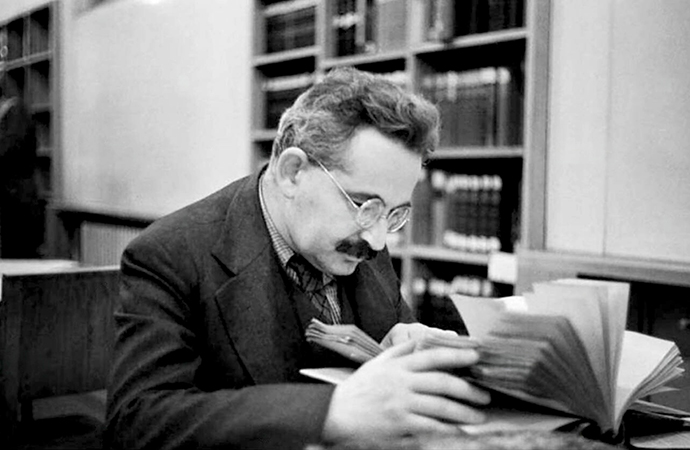
Walter Benjamin. Photo: Collected
The struggle for the future in Bangladesh, as elsewhere in the world, reminds me of vanished times that keep reinventing themselves. The struggle makes me think of an earlier me.
It was mesmerising in 1974 to encounter Walter Benjamin in the Seminar Library of the English Department of Presidency College, Kolkata. It was not a physical meeting, of course. The German Jew had committed suicide in 1940, at the age of 48, during the Nazi onslaught on Europe. I had been born in 1957. But Benjamin's books had outlived him. They introduced me, a Bengali Muslim, to a kindred spirit in 1974. What was interesting was that my college's union was then under the political sway of the Chhatra Parishad, the students' wing of the ruling Congress Party whose young members had fought tooth and nail with leftists during the just-contained Naxalite movement. Yet, Benjamin's books - particularly his Reflections and Illuminations - adorned the Presidency library. Their presence attested to the power of independent and contrarian thought even in the insurrectionist India of my uneasy youth.
Benjamin gave me a sense of myself as a historical actor, however small I am. His "Ninth Thesis on the Philosophy of History" contains these words: "A (Paul) Klee drawing named 'Angelus Novus' shows an angel looking as though he is about to move away from something he is fixedly contemplating. His eyes are staring, his mouth is open, his wings are spread. This is how one pictures the angel of history. His face is turned towards the past. Where we perceive a chain of events, he sees one single catastrophe that keeps piling ruin upon ruin and hurls it in front of his feet. The angel would like to stay, awaken the dead, and make whole what has been smashed. But a storm is blowing from Paradise; it has got caught in his wings with such violence that the angel can no longer close them. The storm irresistibly propels him into the future to which his back is turned, while the pile of debris before him grows skywards. This storm is what we call progress."
I had never thought much of progress in any case, but Benjamin's words confirmed me in my belief. Progress is the vindication of erasure. History moves forwards on roads paved with the dead, the suffering, and those who have been called the war-disabled of competition. In one account, the phrase, "war-disabled of competition", describes "individuals or groups who have been marginalised, disadvantaged, or made 'invisible' as a result of the intense, often social or economic, competition inherent in a 'Social Darwinian' view of progress". In this relentless context, "competition" refers to "the struggle for social, economic, class, gender, ethnic, or national dominance, often framed as 'evolutionary progress'". Thus, "war-disabled" is "used metaphorically to describe those who are 'beaten out of sight' or ideologically 'disabled' by this ruthless competition, much like a war leaves (behind) physical and psychological casualties". Essentially, therefore, "the phrase points to the 'wayside-fallen' who are left behind and forgotten in the march of societal progress and intense rivalry".
Paul Klee's and Walter Benjamin's Angel of History seeks to resist that infernal progress but cannot because of the storm that blows from Paradise. How ironic that a divine storm should stop an angel from acting true to its seraphic nature, but I do get at Benjamin's meaning. History is a secular process and angels belong to the celestial sphere and not the profane one. They have to leave human history to humans.
Precisely. Humans do not have to try and be angels: They need themselves if they are to create sites of resistance to the kind of progress that destroys them. Not all progress is wrong, of course, but the Progress that requires the eradication of lives, livelihoods, ways of life, and memories of waylaid lives is wrong. The war-disabled of competition deserve to be recognised as disfigured victims of history, not as people who lost because they were not good enough to live.
Who is not good enough to live? No one. Pablo Neruda's poem, "The People", makes the point unforgettably clear: "I recall that man and not two centuries/ have passed since I saw him,/ he went neither by horse nor by carriage:/ purely on foot/ he outstripped/ distances,/ and carried no sword or armour,/ only nets on his shoulder,/ axe or hammer or spade,/ never fighting the rest of his species:/ his exploits were with water and earth,/ with wheat so that it turned into bread,/ with giant trees to render them wood,/ with walls to open up doors,/ with sand to construct the walls,/ and with ocean for it to bear./"
Pablo continues: "I knew him and he is still not cancelled in me." The poem goes on to say: "I believe that this man/ must be enthroned, rightly shod and crowned./ I believe that those who made such things/ must be the masters of all these things."
Elsewhere, Neruda declares: "You can cut all the flowers but you cannot keep Spring from coming." That sentiment is reflected in Bengali in Nirendranath Chakrabarty's poem, "Phul phutuk na phutuk, aaj basanta": "Whether Flowers Bloom Or Not, It's Spring Today". Translated by Antara Dev Sen, here is the poem: "Whether flowers/ bloom or not/ it's spring today/ On the paved footpath/ with feet dipped in stone/ a rather wooden tree/ laughs out loud/
chest bursting with fresh green leaves/ Whether flowers bloom or not/ It's spring today./ The days of masking the sun/ and then unmasking it/ of laying people down in the lap of death/ of picking them up again/ those days that have passed this way/ let them not return/ That lad of many voices/ who for a coin or two/ would chirp like a koel down the street/ in the ceremonial yellow of twilight?/ those days have taken him away/ With the sky like a red and yellow wedding invitation/ on her head/ clasping the railing to her breast/ a dark and ugly unwed girl down this alley/ played with such idle thoughts/ Right then/ there fluttered in, shamelessly, right onto her body,/ oh damnation! A stupid, awful, foolish butterfly!/ Then the sound of a door slamming shut./ Hiding his face in the dark/ that sinewy tree/ was still laughing."
The Angel of History should not be disappointed with its fate. It is helpless to intervene in human affairs but flowers will still bloom in the crevices of concrete progress. Those flowers, and all other flowers, will be cut.
But Spring will come. You and I shall never be undone.
The writer is Principal Research Fellow of the Cosmos Foundation. He may be reached at epaaropaar@gmail.com
A Independent Newsweekly
© Copyright 2026 | Designed by ARK Reepon & Developed by Cosmos Group Software Team







Leave a Comment
Recent Posts
Art, Love and Resistance: A Co ...
The exhibition Braids and Threads: Connecting Legacies by artists Mo ...
VTRT rescues 10-foot python fr ...
The Village Tiger Response Team (VTRT), trained and supported by WildT ...
The Hormuz Crisis and the Fate of the Global South
The Great Hungarian Reset
Dr Yanan Wu
The fate of the bhadralok