


Society
Stitching Hope, Weaving Dignity


An Independent Newsweekly


Society
In a small fringed settlement of Kodam Tola, Shyamnagar, Sathkhira bordering the forests of the Sundarbans, where the rhythm of life is bound tightly with nature, the story of the Mondal family unfolds - a story of tragedy transformed into triumph and dignity.
Back in 2010, a devastating tiger attack changed the life of the Mondol family forever. Subash Mondol, a hardworking man and devoted father, lost his life while working in the forest leaving behind his wife and two young children. What followed was a period of unimaginable hardship. Alomoti Mondol, his widow burdened with grief and responsibility, was left to fend for her family in a community where opportunities for women were limited, and survival itself was a daily struggle.
"After my husband's death, I had no idea how to feed my children," she recalls softly. "There were days when I didn't know if we would have enough to eat."
Life in the Sundarbans is never easy. The region's people coexist with the forest, relying on it for their sustenance - fishing, collecting honey, and harvesting resources. Yet, this dependence often comes with danger, as human-wildlife conflict remains a grim reality. For widows like Mrs. Mondol, the loss of a breadwinner can mean a plunge into poverty and despair.
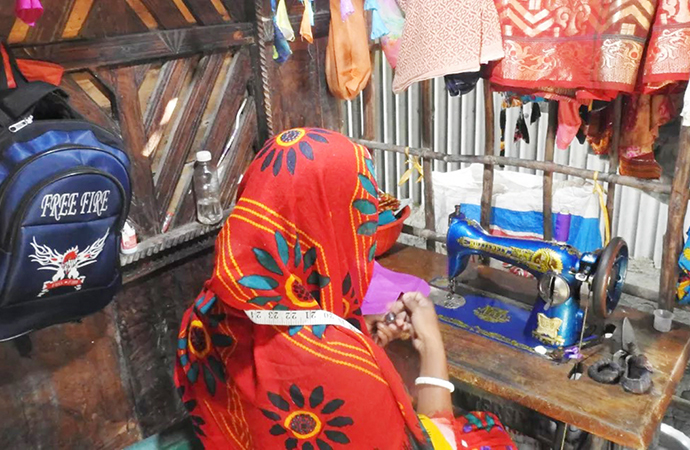
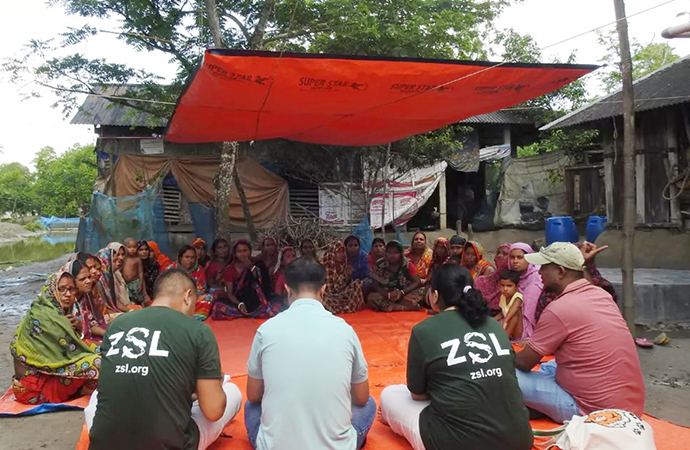
But sometimes, hope finds its way through unexpected hands. Through the Integrated Tiger Habitat Conservation Programme (ITHCP) implemented by WildTeam in 2019 A.D. Mrs. Mondol received an opportunity to participate in a week-long tailoring training. The program aimed to empower women affected by human wildlife conflict, helping them rebuild their lives with dignity and self-reliance.
At first, she hesitated she had never held a needle as a profession, and the thought of starting something new at her age seemed daunting. Yet, with encouragement from the trainers and other women in her village, she found the courage to try.
"I still remember how excited I felt when I first used the sewing machine with knowledge on designing," she smiles. "It was something I could call my own - a tool that could help me stand on my feet."
Along with the training, she received few fabric suit pieces, enabling her to start stitching clothes for the local market. Slowly but surely, her skills improved. Her work - neat, careful, and full of heart - began to attract customers. The once-quiet corner of her house turned into a small, bustling workspace filled with the sound of the sewing machine's rhythmic hum.
As her small business took root, her daughter-in-law, Poornima Mondal, joined her.
Together, they began stitching and selling clothes in their local market, creating not just garments but also a new identity for their family - one built on resilience, cooperation, and creativity.
In the early days, the family barely earned 2,000 to 3,000 Bangladeshi Taka a month, just enough to meet the most basic needs. Today, their tailoring business brings in between 7,000 to 8,000 Taka monthly. It may not seem like a vast fortune, but for them, it represents stability, independence, and hope.
With the steady income, they have been able to ensure better food, education for the children, and a sense of dignity that goes beyond financial numbers. More importantly, their success story has inspired other women in the community who once believed that life after tragedy could only mean struggle.
"When I see other women watching me work, I tell them - don't give up," Mrs. Mondol says with quiet pride. "If I can do it, so can you."
The Mondal family's journey stands as an example to how empowerment, when paired with opportunity, can change lives. A simple sewing machine and a week of training opened doors that once seemed forever closed. Through determination and project's support, the Mondals turned their sorrow into strength, proving that even in the face of loss, new beginnings can be stitched together - one thread of hope at a time.
This article is compiled by Asmita Pandey, Safeguarding and Communication Officer at Zoological Society of London, Nepal Office. She collected the information, data and photographs for the article during her ITHCP Exchange Visit to Bangladesh
A Independent Newsweekly
© Copyright 2026 | Designed by ARK Reepon & Developed by Cosmos Group Software Team






Leave a Comment
Recent Posts
Cancer coverage must go beyond ...
A newspaper story can be accurate, well-sourced and informative, yet s ...
The World Economy Is Swerving, ...
For decades, companies, investors, and policymakers operated on the co ...
A Future With Chinese Characteristics
From Gaza to Trump, the age of ‘Big Security’ is her ..
PM’s popularity cutting across party lines
Bridging Horizons: Singapore and Bangladesh find a s ..