


Reportage
The Trial of Sheikh Hasina: Doughty Street’s ‘urgent appeal’ fails to hold water

An Independent Newsweekly


Reportage
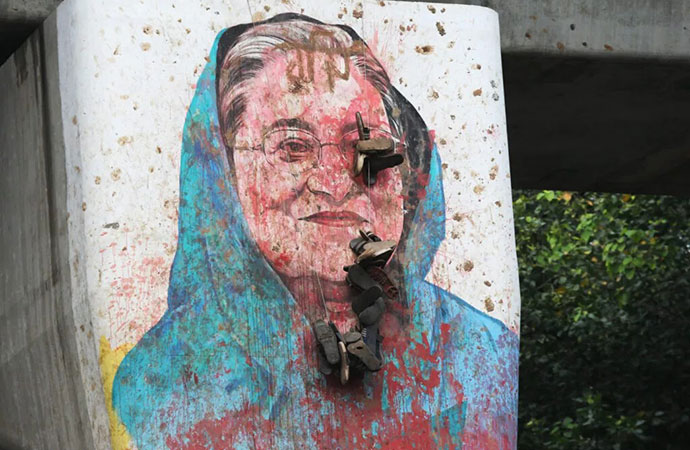
Recently Awami League circles have been abuzz about having hired the services of British law firm Doughty Street Chambers, whose lawyers submitted a 'Request for Urgent Action' in August to the UN Independent Expert on the Promotion of a Democratic International Order, as well as other UN Special Rapporteurs regarding what they described as the 'unjustifiable ban of the Awami League in Bangladesh' - although we know the ban is not on AL as an organisation, but rather on its activities.
This week, ahead of the International Crimes Tribunal's announcement of a date for the verdict in a case against Sheikh Hasina and two of her top aides for crimes against humanity during last year's July Uprising, lawyers from the same chambers filed an 'urgent appeal' with the UN Special Rapporteur on the independence of judges and lawyers and the UN Special Rapporteur on extrajudicial, summary or arbitrary executions, setting out what they described as "serious concerns about the lack of fair trial rights and due process issues arising from her in absentia prosecution".
The filing notes that in July 2025, Sheikh Hasina and two other senior officials were indicted by Bangladesh's ICT for alleged crimes against humanity said to have arisen from the then government's response to protests in Bangladesh in July and August 2024. It said a verdict is due soon with Hasina facing an almost certain sentence of death.
Lawyers Steven Powles KC and Tatyana Eatwell highlight how, "notwithstanding alleged abuses by both members of Sheikh Hasina's government, and serious reprisals committed against her supporters thereafter, the ICT has chosen only to prosecute members of Sheikh Hasina's former government." They made note of the fact that the interim government has decided that those who made the "uprising successful will not face prosecution ... for their acts between July 15 and August 8 [2024]".
The Urgent Appeal sets out how the trials before the ICT are being carried in "an environment charged with political vengeance, under an unelected interim government which itself has no democratic mandate, and raises multiple serious concerns regarding violations of Sheikh Hasina's right to a fair trial."
They note three main concerns
Firstly, that Hasina has not been tried by an 'independent and impartial tribunal', as required by Article 14(1) of the International Covenant on Civil and Political Rights ("ICCPR"). They also raise questions over the apparent political association of the ICT's judges which tried Hasina's case with political parties opposed to her Awami League, saying they "raise serious questions of both actual and perceived bias."
Moreover, they add that the Chief Prosecutor also "suffers from the appearance of bias, himself having appeared at political rallies calling for the ban of Sheikh Hasina's Awami League." Here they're referring to Tajul Islam of course.
Secondly, they refer to the fact that Hasina has been tried in absentia for very serious crimes. A statement on the filing from Doughty Street said: "The trial has proceeded in her absence notwithstanding an extant request for her extradition from India. She has received no formal notification of the charges against her. Moreover, lawyers who have previously acted on behalf of or who are associated with the Awami League have been attacked and are unable to carry out their professional duties without intimidation. As a result, Sheikh Hasina is being represented by a state appointed lawyer with whom she has had no communication and given no instructions."
What they fail to address is this: Can an absconding person use their deliberate evasion of the law to indefinitely halt the judicial process?
The answer is they cannot. It is firmly established in jurisprudence that "Such a breach of duty on the accused's part does call for an alternative procedure so that the ends of justice are not defeated by the conduct of the accused." ("Trial in Absentia: A Necessary Evil?" by Anupama Arigala)
And let's not forget, the very first guilty verdict at the same tribunal in 2013, against Abul Kalam Azad, the former Jamaat leader, was delivered in absentia. Several other Jamaat and BNP leaders were tried in absentia for war crimes and/or crimes against humanity in 1971.
Their contention that she wasn't formally notified, is not credible. They even acknowledge there is an extant extradition request, and don't address what the court is expected to do beyond serving public summons in newspapers for a public figure like her, as the ICT has done.
While the concerns over security for lawyers defending the Awami League may have held true in the first few months after the Uprising, today they evidently don't. Today, a number of her political allies facing similar charges are being represented by lawyers of their choice.
Doughty Street's third area of concern relates to "the imposition of any death sentence following such a manifestly unfair trial" - somewhat pre-empting the tribunal's verdict, that was subsequently set for November 17. Their statement asserts it would effectively amount to 'summary execution' and 'a clear violation' to the right to life guaranteed by Article 6 of the ICCPR.
The filing obviously avoids dealing with the seriousness of the charges against her, and the weight of evidence presented in the proceedings. Chief Prosecutor Tajul Islam submitted the complaint to the tribunal on June 1, detailing five specific counts, according to a report in the Daily Star.
Count 1 accused the defendants of murder, attempted murder, torture, and other inhumane acts. They were accused of abetting, inciting, facilitating, being complicit in, and failing to prevent these crimes committed against civilians by law enforcement and armed cadres of the Awami League and its affiliates.
This count specified that following Hasina's July 14 press briefing, former home minister Asaduzzaman Khan, and former IGP Chowdhury Al Mamun, who are her co-defendants, and other high officials of the then government abetted, assisted, and were complicit in the severe and systematic attack on innocent, unarmed student masses.
In count 2, Hasina is accused of ordering the extermination of student protesters through the use of helicopters, drones, and lethal weapons. The prosecution alleged that the then-home minister and the then-IGP facilitated and executed this directive by instructing law enforcement personnel under their authority. It charged the defendants with ordering, facilitating, being complicit in, and conspiring to commit crimes against humanity knowingly.
Count 3 accused the defendants of the murder of Abu Sayed, a protesting student, near Begum Rokeya University in Rangpur on July 16, 2024. He was the first victim of the crackdown against the students.
Hasina is accused of making inflammatory remarks and ordering the use of deadly weapons against protesting students.
In response to this directive, Asaduzzaman and Mamun, along with other senior government officials at the time, allegedly instigated, aided, and were complicit in the actions of their subordinate law enforcement personnel and armed Awami League cadres.
The prosecution alleged that the defendants ordered, incited, abetted, facilitated, were complicit in, conspired, and committed other inhuman acts, constituting crimes against humanity.
Count 4 accused the defendants of the shooting and murder of six unarmed protesters in Dhaka's Chankharpul on August 5 last year.
Hasina is accused of making inflammatory remarks and ordering the use of deadly weapons against student protesters. In response to this directive, the former home minister and former IGP, along with other senior government officials at the time, allegedly instigated, aided, and were complicit in the actions carried out by their subordinate law enforcement personnel and armed Awami League cadres.
In count 5, the defendants are accused of the shooting of six student protesters -- five of whom were later burned after death, while the sixth was reportedly set on fire while still alive -- in Ashulia on August 5 last year.
Al Mamun, who turned state approver in the course of the trial, has testified that Hasina directly ordered the use of "lethal weapons" to crush the anti-discrimination student movement. In his testimony, Al Mamun said he received the order on July 18, 2024 from then-home minister Asaduzzaman, who conveyed Hasina's directive. From that day, security forces began using deadly weapons against protesters. The carnage, he said, was carried out under the orders of Sheikh Hasina and Asaduzzaman Khan.
Leaked audio of one of her phone calls verified separately by BBC Eye and the Tech Global Institute earlier this year suggested that she had authorised the use of "lethal weapons" in July 2024. The audio, that the prosecution obtained from the National Telecommunications Monitoring Centre, was played in court during the trial.
Over the past 15 months, at no point has she expressed any remorse for student killings during the Uprising, although she would appear to be softening somewhat, in a series of recent "e-mail interviews" with various foreign outlets, where the responses are clearly drafted by someone else on behalf of her.
She continues to describe the ICT, which was constituted by her government to try war crimes and crimes against humanity from the 1971 War of Liberation, as a "kangaroo court" controlled by her political opponents. Various international human rights organisations and even governments raised concerns over the trial proceedings against Hasina's own political opponents when they were being tried at the same tribunal, mainly between 2012-2016. This time, with the ICT's jurisdiction amended to cover crimes committed during the 2024 Uprising, no such protestations have been forthcoming. Despite the filings by Doughty Street, there has been no response from the UN's rapporteurs in her favour. Her guilt almost played itself out in front of the entire world, and so a guilty verdict next Monday, would seem to be nigh a formality.
And not even the swankiest law firm in London can stand in the way of that.
A Independent Newsweekly
© Copyright 2026 | Designed by ARK Reepon & Developed by Cosmos Group Software Team





Leave a Comment
Recent Posts
An onus on skilled economic ma ...
We have now commenced the first full fiscal under the BNP government e ...
How a push to disarm Hezbollah ...
A deal between Lebanon and Israel was billed as paving the way for pea ...
10th Anniversary of the 15 July Coup Attempt: Victor ..
The US military attacked Iran early Wednesday (Jul. ..
The government appointed internationally renowned hu ..
Govt plans sweeping health sector reforms to take sp ..