


Reportage
The Interim Government’s Mixed Record on Human Rights


An Independent Newsweekly

Reportage
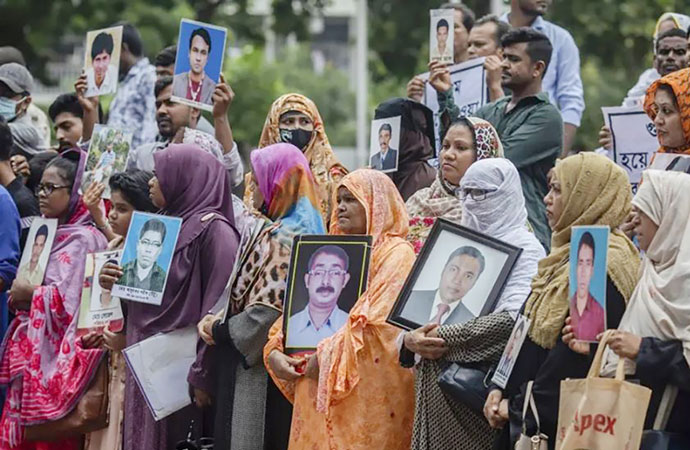
Family members of victims of enforced disappearance allegedly committed by government agencies during the rule of the Awami League hold portraits of their relatives while asking for their return in front of the Shaheed Minar, August 11, 2024. Photo: AP/UNB
In the wake of last year's July Uprising, the human rights landscape has undergone a complex transformation in Bangladesh. While abuses perpetrated by the former Awami League government ceased, the interim government under Chief Adviser Muhammad Yunus has been forced to contend with new challenges, including political retribution, mob violence, and a rise in communal attacks. Particularly since the turn of the year, there was also an alarming spike in violence against women.
The IG itself has come under attack for "turning a blind eye" to some of these offences, in effect allowing them to happen. Which perhaps explains a rather pugnacious appearance by the CA's press secretary, Shafiqul Alam, at a roundtable discussion titled "Human Rights in Transition: Accountability, Institutions, and Fragility in Post-Uprising Bangladesh," organised by Sapran (Safeguarding All Lives), a new human rights organisation, this week.
Sapran, which describes itself as a "rights-based think tank", recently brought out a publication titled "After the Monsoon Uprising: Reviewing Bangladesh's Human Rights Landscape in the Transitional Period (August 2024-July 2025)."
Based on that publication, researcher at Sapran Apsara Islam presented a keynote paper at this week's event. The paper stated that following the July Uprising, mob violence, attacks on journalists, border clashes, and religious conflicts increased, while enforced disappearances, extrajudicial killings, and custodial deaths under state patronage declined.
According to the findings, between August 2024 and July 2025, a total of 496 journalists were attacked across the country. During the same period, there were 2,878 murders, 195 incidents of mob violence, 35 attacks on ethnic minorities, 640 cases of child abuse, and 35 extrajudicial killings. Additionally, 34 people were killed along the border, and over 2,000 push-in cases from India were recorded.
The organisers said the report was prepared based on information published in mainstream media.
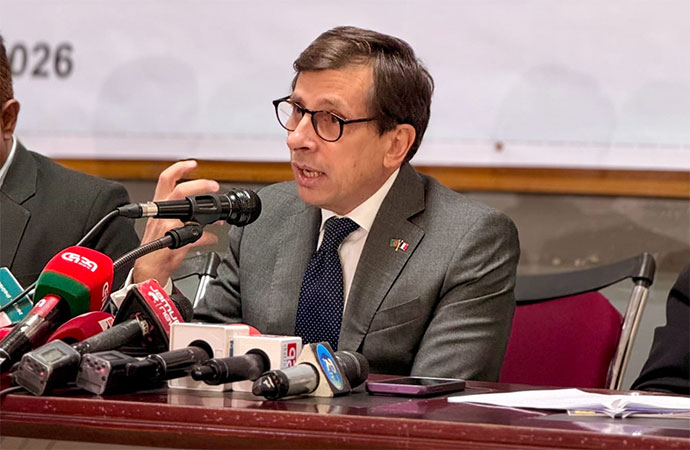
When his turn came to speak, Shafiqul Alam claimed that Bangladesh's law and order situation remains stable and that the reality of human rights conditions is "much better" than what is portrayed in the media. He went on to question the methodology used in putting together such reports.
He said one of the key problems with human rights reports in Bangladesh is their heavy reliance on newspaper coverage. Questioning the reliability of such reports, he argued that the accuracy and credibility of newspaper stories used as primary sources should also be scrutinised.
"Since newspapers have got a lot of freedom, they say many things," he said, adding that Bangladesh's media is now enjoying greater freedom.
Alam further suggested that incidents in Bangladesh should be verified independently through international human rights organisations such as Human Rights Watch and Amnesty International. He left the event shortly after making his remarks, citing urgent official duties, which probably worked to upset his audience as much as his defensive remarks.
His departure was the cue for a procession of speakers to skewer him.
Renowned human rights defender Nur Khan (Liton), who was also a member of the commission that investigated enforced disappearances, put it most bluntly: "I felt sick hearing the government's narrative."
He added, "He (Alam) accused human rights groups of compiling statistics from newspapers Assuming that only government reports are truthful, he questioned the veracity of the reports of rights activists and journalists. It is deeply unfortunate to hear such a narrative from a representative of the interim government."
Saimum Parvez, foreign affairs adviser to the Bangladesh Nationalist Party acting chairman Tarique Rahman, said the press secretary had questioned the credibility of newspapers and human rights reports.
"But it was through newspaper reports that the human rights violations under Sheikh Hasina's government became known," he said. "If anyone wants to criticise the interim government, must we now establish new institutions or rebuild the state structure altogether?"
"The press secretary said 'reality is better,' but probably that's not true. Reality is not better," Parvez, who also runs the new media outlet Bangla Outlook, added.
Human rights defender Rezaur Rahman Lenin called the press secretary's remarks "deceptive." According to him, it has become a habit for government representatives to invoke the UN, Human Rights Watch, and Amnesty International as shields, suggesting that unless they verify a report, it's false. "This kind of rhetoric must stop."
Supreme Court lawyer Manzur-al-Matin, who rose to prominence during the Uprising, commented: "The lens through which Shafiqul bhai views Bangladesh is the same one the police once used to see Abu Sayed. And, according to that lens, the protesters killed Abu Sayed. If everyone in the government now adopts the police's version as the sole truth, then we have every reason to be deeply concerned."
The Sapran roundtable was followed by another right-based organisation, the Human Rights Support Society (HRSS), bringing out its own report that stated the overall human rights situation in Bangladesh remained "alarming" during the first nine months this year, with at least 107 persons were killed in political violence and 130 others in mob beatings.
"After the fall of the autocrat Sheikh Hasina through a student mass uprising in August 2024, the interim government led by Nobel laureate Dr Muhammad Yunus assumed power, but human rights and law-and-order in the country has not improved as expected," the HRSS report said.
In its January-September Human Rights Observation Report, HRSS reported the country continues to witness incidents of political violence, mob attacks, violence against women and children. Enforced disappearances and crossfire killings, however, did not occur.
The report highlighted the brutal killing of trader Sohag, 39, near the gate of Sir Salimullah Medical College Mitford Hospital, and rape of an 8-year-old girl in Magura by her sister's father-in-law.
According to the report, at least 107 people were killed and 5,579 injured in 692 incidents of political violence across the country in nine months. Most of these clashes were linked to internal feuds within the BNP and its affiliated organisations.
Most incidents of violence occurred over establishing dominance, political vengeance, clashes centring rallies, disputes over committee formation, extortion, and the occupation of various establishments, it added.
Among the 107 people killed, 71 were from the BNP, 23 from the Awami League, three from Jamaat-e-Islami, one from Students Against Discrimination, and six from the Chittagong Hill Tracts-based UPDF. The political identities of three others, including one woman, could not be confirmed.
Of the 692 incidents of political violence, 395 occurred due to internal clashes within the BNP and its affiliated bodies, leaving 61 dead. In 124 clashes between the BNP and the Awami League, 19 were killed, while 39 clashes between the BNP and Jamaat left two dead, according to the report, which was prepared based on media reports and the organisation's own investigation.
The HRSS report said at least 340 journalists were victims of murder, torture, or harassment in 236 incidents during the nine months. Two journalists were killed, while 209 others were injured, 36 humiliated, and 54 threatened. Eleven journalists were arrested and 103 others were accused in 29 cases, it added.
The report highlighted the gruesome killing of journalist Asaduzzaman Tuhin in Gazipur and the death of journalist Wahed-uz-Zaman Bulu in Khulna.
The HRSS report said 239 incidents of mob violence and lynching occurred in this period leaving at least 130 people dead and 212 injured.
Between January and September, 1,511 women and girls faced violence, including 663 rape victims. Of the rape victims, 393 were children, the report said. At least 152 women and girls were gang-raped, and 19 rape victims were killed, while nine took their own lives, it added.
Besides, 61 inmates including seven leaders and activists of Awami League died in prisons during this period.
The report said 28 people died in incidents involving law enforcement agencies, including 10 in custody, eight in clash or shooting, and four due to torture. It also mentioned that seven people died while fleeing from police operations.
The HRSS documented 22 incidents of attacks on religious minorities that left five injured and resulted in vandalism of five temples, 37 idols, and 38 homes. It also reported over 50 attacks on religious shrines and mazars across the country, including one at a "darbar sharif" in Rajbari, where the body of a local self-proclaimed Pir, known as Nura Pagla, was exhumed and set on fire.
The report said 23 Bangladeshi nationals were killed, 34 injured, and 56 detained by India's Border Security Force (BSF) during 61 border incidents. It also said 176 incidents of violence against workers resulted in 74 deaths and 828 injuries.
The HRSS said to establish the rule of law and improve the state of democracy and human rights in the country, it is essential to enhance the overall situation through dialogue with political parties, civil society, journalists, and citizens.
Rubbing it in
As if to rub salt in the government's wounds, Human Rights Watch, one of the international human rights organisations cited by Alam, released its latest update on Bangladesh at the end of the week, in which it directly accused the government interim government led by Muhammad Yunus of "increasingly using the recently amended counterterrorism law to arrest alleged supporters of the deposed Awami League government".
It also urged the United Nations human rights team in Bangladesh to immediately seek the release of those arbitrarily detained and encourage the authorities to uphold rights and prosecute all those "who use unlawful political violence".
It said the "temporary" ban on the Awami League was imposed using "new authority under draconian amendments" to the Anti-Terrorism Act, noting that the ban includes prohibitions on meetings, publications, and online speech supporting the party and is being used to arrest Awami League members and 'peaceful activists'.
The Anti-Terrorism Act was enacted in 2009 under the Awami League government. Officials said the 2025 amendments were needed to hold Awami League party members accountable for their abuses while in power, and that they were acting on demands from political parties and student organisations.
"The interim government should not be engaging in the same partisan behaviour that Bangladeshis had to endure under Sheikh Hasina, whether it is stuffing the prisons with political opponents or shutting down peaceful dissent," said Meenakshi Ganguly, deputy Asia director at Human Rights Watch. "The UN's human rights office has been invited by the government to support the protection of human rights in Bangladesh, and it should monitor developments and urgently intervene to discourage politically motivated arrests."
HRW said that thousands have been arrested under the interim government, many on "dubious murder allegations", while scores are being held under the Anti-Terrorism Act. It noted that several have alleged mistreatment in custody, including lack of access to medical care, that HRW described as "a chilling reminder of similar allegations under the Sheikh Hasina government".
It highlighted the incident of August 28, when police detained 16 people, including journalists and academics, from a discussion organised by Mancha 71 at the Dhaka Reporters Unity, where a mob showed up and disrupted the event. After initially telling family members and lawyers that they were holding the detainees for their safety, the police arrested them under the anti-terrorism law.
"It was a discussion, not even a political event, so how can it be considered terrorism?" a family member of one of those arrested said to Human Rights Watch. "These people are in jail, but those that attacked them are roaming free. This government seems to be just like the Awami League government after all."
HRW also said the government has been unable to contain conservative Muslim interest groups that have engaged in violence to press their demands, ranging from targeting alleged Awami League supporters to opposing women's rights. It referred to an Ain o Salish Kendra report that at least 152 people have been killed in mob attacks since January. "Right now, our choices are to be either jailed as terrorists or to face a mob," a political activist told Human Rights Watch. "I am not saying the guilty should not be punished, but it has to be a fair justice system, which the Yunus government has failed to deliver."
Before concluding, HRW referred to the three-year Memorandum of Understanding signed between the UN Office of the High Commissioner for Human Rights and the interim government, to open a mission in the country "to support the promotion and protection of human rights." Although the agreement was signed in July, the office is yet to open. That didn't stop HRW from serving a reminder that the mission's stated aim would be to send "an important message of the country's commitment to human rights as a cornerstone of the transition".
Mixed signals
As if to drive home the interim government's mixed record in this area, Ganguly herself authored an article on the HRW website, "In Bangladesh, a Step toward Justice", within 24 hours of the report discussed above being released, praising the authorities for filing charges against 28 people for enforced disappearances, secret detention, and torture. The article noted the interim government's establishment of a Commission of Inquiry on Enforced Disappearances, which received at least 1,850 complaints, and found that over 300 victims were presumed killed in custody. It also mentioned a documentary "Unfolding the Truth", released by the commission, describing its findings.
Among the 28 accused are former prime minister Sheikh Hasina, her home minister Asaduzzaman Khan, and several army officers, both former and serving, including five former chiefs of the DGFI. The charges against the army officers are without precedent in Bangladesh's history.
Ganguly betrays a personal interest in the development, having been involved in authoring a 2017 Human Rights Watch report on secret detentions and enforced disappearances in Bangladesh. In her concluding paragraph, she writes: "As human rights workers, we too wait for such miracles. Yet, too often, human rights abuses persist. The accused will be prosecuted by the Bangladesh International Crimes Tribunal, but concerns remain about ensuring fair trial standards and the use of the death penalty."
Fair enough. But we shouldn't probably expect the interim government to deliver too many miracles.
A Independent Newsweekly
© Copyright 2026 | Designed by ARK Reepon & Developed by Cosmos Group Software Team






Leave a Comment
Recent Posts
A commendable intervention by ...
A struggle for local dominance in the Chittagong Hill Tracts, specific ...
How close is the Amazon to a ‘ ...
While Brazil’s presidential candidates have not made policy of t ...
Another shipment of highly radioactive uranium fuel
Harmony: Diplomatic community joins Durga Puja celeb ..
What to know about the Ebola outbreak that has sprea ..
Brazil election: Trump’s ‘Donroe Doctrine’ faces its ..