


Reportage
France, Bangladesh share common vision for peace, multilateralism: French Ambassador


An Independent Newsweekly


Reportage
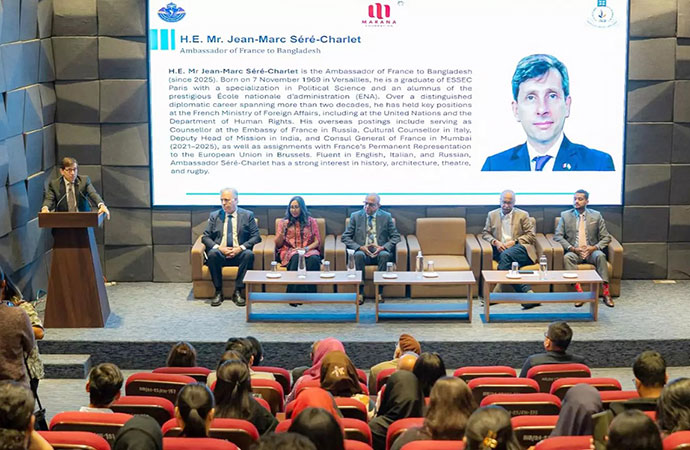
French Ambassador to Bangladesh Jean-Marc Séré-Charlet addresses lecture series “France and the World: Bangladesh in It” at IUB on Sunday. Photo: Tahiyat Nazifa Noor/UNB
France and Bangladesh share a common commitment to peace, multilateralism and the rules-based international order, French Ambassador to Bangladesh Jean-Marc Séré-Charlet said on Monday, stressing the need for closer cooperation amid growing global instability and unilateralism.
He made the remarks while delivering the keynote speech at at a lectures series titled "France and the World: Bangladesh in it" jointly organised by the Center for the Bay of Bengal Studies and Marana Foundation in partnership with the Department of Global Studies and Governance of Independent University, Bangladesh.
Highlighting the long-standing historical ties between the two countries, the Ambassador said France has consistently supported Bangladesh on global platforms and considers the country a key partner in advancing peace and international cooperation.
"The world is changing very fast and not necessarily for the better. What was true a year ago may not be true today," he said, describing what he termed the 'brutalisation' of the global order marked by unilateralism, disregard for international law and growing conflict.
The Ambassador praised Bangladesh's significant contribution to UN peacekeeping operations, calling the country a vital actor in global peace and security.
He said both nations remain firm supporters of the United Nations, multilateralism and international law, which he described as 'the only viable framework for global stability.'
Referring to France's foreign policy priorities, Séré-Charlet said Paris declared a feminist diplomacy a decade ago and places strong emphasis on gender equality.
He commended the host University for maintaining near gender parity, calling it reflective of shared values.
The Ambassador also expressed concern over violations of international law, citing Russia's actions in Ukraine as a serious challenge to the rules-based order.
He also warned about the growing use of hybrid warfare including cyberattacks and disinformation campaigns.
"Disinformation has become a weapon. Democracies must work together to counter fake news and manipulation especially during elections," he said.
He said France is keen to deepen collaboration with Bangladesh in climate action, biodiversity conservation, maritime security and Indo-Pacific cooperation.
He also reaffirmed France's support for the rights of Palestinians and a peaceful solution in the Middle East based on international law.
Marana Foundation Chairman Masud Jamil Khan said France is one of the few European countries with which Bangladesh has maintained a distinct diplomatic relationship even after the formation of the European Union.
He recalled historical ties dating back to the 18th century and noted France's strong intellectual and cultural support for Bangladesh, particularly during the Liberation War of 1971.
Masud Khan said economic relations between the two countries have expanded steadily, with France emerging as one of the major buyers of Bangladesh's ready-made garments.
He also said both countries strongly support international cooperation in addressing the climate emergency, calling for swift implementation of the 2015 Paris Agreement and mobilisation of increased climate and biodiversity financing.
President and Executive Chair of Marana Foundation Nahar Khan said Bangladesh-France relations are evolving beyond traditional development cooperation, increasingly shaped by economic complementarities, shared innovation agendas and long-term strategic alignment.
Khan said the day-long discussion examined bilateral ties from diplomatic, strategic, environmental, economic and regional perspectives, reflecting the growing depth and maturity of the partnership.
"What emerges clearly is that this partnership is no longer defined solely by traditional development cooperation," she said. "It is increasingly shaped by economic complementarities, shared innovation agendas and a long-term strategic alignment."
Nahar noted that both countries contribute uniquely to shared global goals, citing France's expertise in technology and sustainable development and Bangladesh's strong economic growth, creative industries and demographic dynamism.
IUB Vice-Chancellor Professor M. Tamim said Bangladesh and France share a relationship rooted in history, mutual respect and strategic purpose.
He recalled France's early support for Bangladesh during the Liberation War of 1971, including advocacy by former French Minister of Culture André Malraux, and noted that the relationship has since evolved into a multi-layered partnership.
Chairman of the Board of Trustees of IUB Didar A. Hossain explained that the Center operates under IUB's Global Governance Studies, aiming to integrate historical, cultural, and policy perspectives in its research and engagement.
He praised France's commitment to human rights and encouraged stronger academic and institutional cooperation between IUB and French partners.
Pro-Vice-Chancellor of IUB, Professor Daniel W. Lund, expressed gratitude to the Ambassador for sharing his insights and knowledge highlighting France's global influence and the opportunity for mutual learning between France and Bangladesh.
Director of the Centre for Bay of Bengal Studies Rear Admiral Khurshed Alam, and Advisor to the Centre Ambassador Tariq A. Karim also participated in the lecture.
A Independent Newsweekly
© Copyright 2026 | Designed by ARK Reepon & Developed by Cosmos Group Software Team





Leave a Comment
Recent Posts
The right time for an apology
The publication of the posthumous memoirs of lawyer Abdur Razzaq, who ...
Human rights experts commissio ...
Human rights experts commissioned by the UN’s top human rights b ...
Teesta erosion leaves several hundred families homel ..
Housing Without Houses: The Hidden Cost of Banglades ..
The Election Commission will review the timeframe
The story behind the Arafat brothers' ‘Kolpona’