


Politics
Only Liberal Nationalism Can Defeat the Far Right


An Independent Newsweekly




Politics
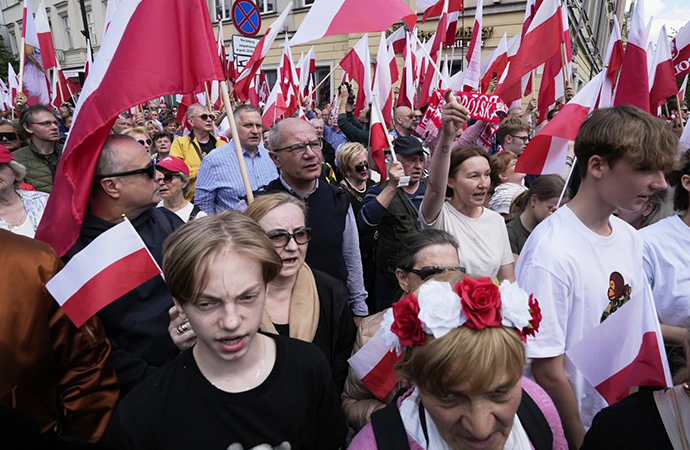
Photo: AP/UNB
Convinced that nationalism belongs to the past, liberals have largely abandoned appeals to cultural identity, allowing far-right political entrepreneurs to fill the void. To counter exclusionary nationalism, liberals must craft a unifying creed that restores a sense of shared destiny.
The far right has emerged as the most dynamic political force in many countries around the world, partly because right-wing populists are adept at presenting themselves as protectors of beleaguered national identity and sovereignty.
US President Donald Trump is the most obvious example. Soon after taking office, he insisted that protecting Americans from "the flood of illegal aliens and drugs pouring across our Borders" was his "duty as President," casting his immigration and trade policies as a form of national salvation.
Other right-wing leaders - including Hungarian Prime Minister Viktor Orbán, India's Narendra Modi, and Turkish President Recep Tayyip Erdoğan, as well as prominent political figures like Nigel Farage in the United Kingdom and Marine Le Pen in France - rely on similar nationalist and xenophobic tropes.
Liberal elites, having long rejected nationalism, tend to regard such rhetoric as retrograde. In the West, especially, nationalism was discredited in the aftermath of World War II, and appeals to national identity were largely abandoned in favor of an emphasis on individual autonomy.
Yet surveys consistently show that nationality still shapes most people's sense of self. While this may seem paradoxical, the modern world's primary political units are nation-states, so national identity is, in a sense, built in. Studies also find that belonging to a large collective helps us categorize the world and situate ourselves within it, enhancing our self-esteem and reducing the risk of social alienation.
The reflexive liberal dismissal of national identity did not make it any less meaningful. Instead, it created a vacuum that political entrepreneurs rushed to fill. In the absence of a compelling liberal conception of the self, many fell back on traditional - and often exclusionary - markers such as ethnicity, race, and religion. Far-right leaders then used this form of identity politics to stoke fear of immigrants, supposedly unassimilable minorities, and supranational bodies imposing unwanted laws.
Too often, progressives have ignored these anxieties or treated their causes as problems that technocratic policymaking could fix, failing to recognize how closely tied they are to voters' cultural identity. Little wonder, then, that so many countries' politics are now defined by a resurgent far right and a liberal establishment struggling to regain its footing.
To counter the far right's exclusionary nationalism and relentless fearmongering, liberals must craft a unifying political and cultural narrative. But what ideals should anchor such a creed? While an emphasis on shared values is vital, constitutional patriotism on its own is too abstract to provide real social cohesion. A narrow focus on good governance is also risky, since even well-run systems can falter.
Three criteria are essential to developing an enduring political faith. First, it must have an emotional core. Its specific form will likely vary by country, but emotion is indispensable.
Western progressives can draw inspiration from the protest movement that swept Israel in 2023. In mass rallies across the country, patriotic protesters cast themselves as the true defenders of Israel's national identity, accusing Prime Minister Benjamin Netanyahu of trying to impose an authoritarian vision incompatible with its democratic and Jewish character outlined in the Declaration of Independence.
A similar dynamic played out in Poland. Ahead of the 2023 parliamentary election, opposition parties framed EU membership as integral to the country's Western identity, warning that the then-ruling Law and Justice (PiS) party's authoritarian turn put it at risk.
Brazil's experience shows that counternarratives can also be driven by external pressures. In response to Trump's attacks on Brazilian sovereignty, President Luiz Inácio Lula da Silva has championed an independent, pluralistic Brazil while portraying his far-right opponents - especially former President Jair Bolsonaro - as deferential to US interests.
A successful liberal-nationalist narrative must also be genuinely inclusive, capable of mobilizing a broad electoral coalition by reaching across demographic, social, and class divides. As Lula put it, a country "belongs to the military, the teacher, the doctor, the dentist, the lawyer, the hot dog vendor, the small and medium individual entrepreneur."
Lastly, because humans have an inherent need for belonging, any effective political narrative must foster a sense of community and shared destiny. That requires reclaiming national symbols that the far right has hijacked and imbuing them with democratic values. Rob Jetten's recent victory over far-right leader Geert Wilders in the Dutch parliamentary election - driven in part by his strategic use of national symbols - offers a useful model. Civil-society groups and opposition parties in Israel, Poland, and Brazil have likewise made national flags central to their campaigns.
But liberal nationalism shouldn't rest on a single story; it should grow out of multiple narratives that reinforce one another and reflect a shared civic vision. Crucially, the aim is not to win over hardened xenophobes - it is to reach moderate and conservative voters who care deeply about their countries and may back illiberal leaders out of fear. In today's polarized political landscape, even small shifts in public opinion can determine whether the future belongs to authoritarians or to those committed to open, democratic societies.
From Project Syndicate
A Independent Newsweekly
© Copyright 2026 | Designed by ARK Reepon & Developed by Cosmos Group Software Team





Leave a Comment
Recent Posts
An onus on skilled economic ma ...
We have now commenced the first full fiscal under the BNP government e ...
How a push to disarm Hezbollah ...
A deal between Lebanon and Israel was billed as paving the way for pea ...
10th Anniversary of the 15 July Coup Attempt: Victor ..
The US military attacked Iran early Wednesday (Jul. ..
The government appointed internationally renowned hu ..
Govt plans sweeping health sector reforms to take sp ..