


Column
COP30: It will take disaster in Global North to bring real climate action


An Independent Newsweekly







Column
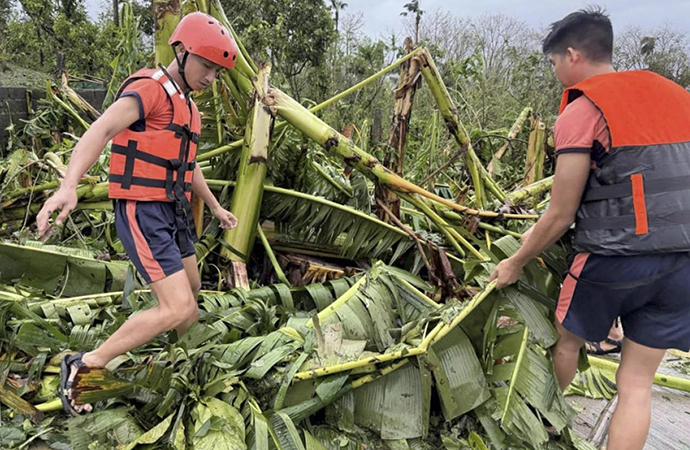
Photo: AP/UNB
Extreme weather is already killing people across Global South, but fossil fuel lobby’s influence is preventing change
With COP30 well underway in Brazil, the global fossil fuel lobby is working hard to preserve its industries. Coal, oil and gas giants are once again joining producer states in actions that are typically most evident at the annual climate summit.
More than 5,000 fossil fuel lobbyists have had access to UN climate talks over the past four years. Their roles are less about the open denial of climate change than advocating for market-oriented solutions, such as carbon capture and storage, whose impact would be minimal over the timescale needed to prevent climate breakdown.
This lobbying follows decades of more direct actions by some of the world's major oil companies, with Texas-based Exxon being a leading actor. Exxon has especially focused its efforts on influencing governmental and public attitudes to climate change across the Global South.
Much of this has come to light following a leak of hundreds of documents earlier this month, which reveal Exxon funded the Atlas Network of right-wing climate-denialist think tanks, in an effort to make the Global South "less inclined" to support UN-led global climate treaties.
The Atlas Network, which was founded 44 years ago as the Atlas Economic Research Foundation, is a US-based non-governmental organisation that coordinates and supports more than 580 think tanks in over a hundred countries. Rooted in a neoliberal economic ideology, the network has a formidable record of promoting free-market solutions and opposing what it sees as the huge threat that seeking to reverse climate change, which it considers a non-problem, poses to the world economy.
Yet from an environmentalist perspective, the case for action on climate breakdown grows stronger by the month, aided by the impact of extreme weather events. Last month's Hurricane Melissa in Jamaica is one example, although the recent experience in the Philippines may tell us more about what is to come, even if it did get far less traction in the Western legacy media.
Typhoon Uwan, which came towards the end of the 2025 Pacific typhoon season, was distinctive in having a very broad trail across the northern Philippines, which left at least ten people dead and 1.4 million displaced. But what was of most concern was that it came just days after another storm, Typhoon Kalmaegi. That typhoon had hit the central provinces of the Philippines on 4 November and killed at least 232 people before going on to Vietnam, where more people died and more damage was done.
Such frequent deadly storms, whether in the Caribbean or South-East Asia, may add a sense of urgency to COP30 in Belèm, yet intense political opposition to climate action persists. That is most obvious when it comes to the likes of Donald Trump and those behind him in the US, but he is far from alone. Other right-wing political leaders around the world are also visibly climate sceptic, and their influence is leading many on the left to water down climate policies in efforts to woo votes and private investors.
What is more positive is that the radical decarbonisation of the world economy that is necessary to prevent climate breakdown is becoming far easier. A swathe of technical developments is leading to much cheaper solar-PV panels, wind turbines and energy storage. While neoliberalism may persist in its approach, it will soon have to accept failure, as its high costs make it unaffordable.
Meanwhile, we are seeing rapid change in the world's biggest economy and biggest greenhouse gas emitter, China. Around two decades ago, Chinese climate scientists and policy makers appear to have recognised that their country could not handle the impending climate breakdown and the subsequent economic collapse. As a result, the autocratic quasi-capitalist state has moved towards a greener economy, to such an extent that its carbon emissions may already have levelled off and even started to decline, years ahead of expectations.
That is reflected in global change. The annual report of the International Energy Agency suggests that more renewable energy projects will become available in the next five years than over the past 40. The agency believes the transition away from fossil fuels is "inevitable".
But will it happen fast enough to diminish local and regional climate catastrophes?
Probably not - not until extreme weather events start hitting the Global North with a regularity and severity that make them impossible to ignore. We're a long way off that; 237 people died in Valencia last year as floodwaters tossed cars around like toys, but their deaths had little impact outside of Spain.
Such severe catastrophes are already happening in the Global South, of course. Take the Derna disaster, which killed between 11,000 and 24,000 people in September 2023. A huge rainstorm in the mountains to the south-west of the Libyan coastal city of Derna caused a massive surge of floodwater to rush towards the city in the middle of the night, destroying two dams on its way. Up to 20% of the city's population was killed as water engulfed entire neighbourhoods.
That these tens of thousands of deaths did not prompt meaningful change - or even discussions about meaningful change - exposes an awful reality: the strength and persistence of the climate-denying lobby means leaders in the Global North, which is responsible for the majority of emissions, are unlikely to get serious about climate breakdown until major northern cities start seeing catastrophes on the same scale. But how many more people in the Global South will have to die before then?
From openDemocracy
A Independent Newsweekly
© Copyright 2026 | Designed by ARK Reepon & Developed by Cosmos Group Software Team






Leave a Comment
Recent Posts
Cancer coverage must go beyond ...
A newspaper story can be accurate, well-sourced and informative, yet s ...
The World Economy Is Swerving, ...
For decades, companies, investors, and policymakers operated on the co ...
A Future With Chinese Characteristics
From Gaza to Trump, the age of ‘Big Security’ is her ..
PM’s popularity cutting across party lines
Bridging Horizons: Singapore and Bangladesh find a s ..