


Column
Maulana of the Masses

An Independent Newsweekly

Column
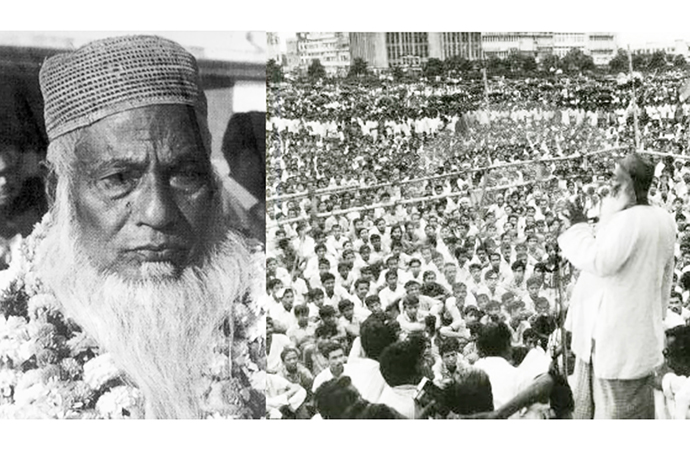
Maulana Bhasani. Photo: Collected
The 49th death anniversary of Maulana Bhasani, that incomparable Bangladeshi, invokes in me a name that was legion as well in the West Bengal of my youth, particularly among Bengali Muslims who searched for a plausible union of homely religiosity and progressive politics.
Abdul Hamid Khan - that being his real name, his nickname being a wryly rustic Chaga - combined the simultaneous quest for Islam, socialism and democracy that situates Muslims within the religious and secular coordinates of universal existence. His outspoken advocacy of the interests of the masses - not only Muslims but all others of any faith or none - revealed him as a true pir, an enlightened soul to whom every other soul is a fellow-pilgrim on the way to collective liberation. That liberation has to be political in this world if it has to have any meaning at all in the next.
The Maulana was educated at the elite and rather conservative Sunni Islamic school, the Darul Uloom Deoband. Yet, he advocated what others have called a form of Islamic socialism that upholds the rights of peasants and the oppressed through the theory of Hukumat-e Rabbaniya (just rule). Interestingly, he also supported the separation of state and religion in politics, or the principle of secularism that many would consider quite rightly to be a defining characteristic of democracy. Secularism would not have to be atheistic (certainly not for a person like the Maulana) but it would give both the majority and the minorities in a Muslim-majority state an equal stake in the welfare of their country. Deen would flourish in a duniya where children would not have to go to bed hungry. These ideas proved Maulana Bhasani's credentials as a true Muslim revolutionary who spoke to all irrespective of caste and creed.
It was this salvationist belief in the material foundations of metaphysical belief that set Abdul Hamid Khan apart from others. Unlike many religious leaders who owed their discursive liberty to the cooptive space that the Pakistani polite elite afforded them, the Maulana was instrumental in the ideational creation a Bangladesh that would in no way give up on its Islamic character to be Bengali - or the other way around - so long as the objective would be to liberate the masses politically. That would be done by extending the protective benevolence of Bengal's soil to religious and other minorities in a seamless search for liberty, equality and fraternity.
What mattered to the Maulana was whether a person was prepared to be Bangladeshi. Exactly what kind of Bangladesh would emerge later would be clear in time, but a Bangladeshi's identity would be contoured at the minimum by her or his readiness to embrace and celebrate the earthy clutch of soil on soul - and the other way around. Faith, socialism and democracy were a trinity. Remove one leg of that existential table, and the whole wooden edifice would collapse on the uncaring concrete floor.
The story continues to this day. The eminent public intellectual Anu Muhammad writes in Prothom Alo English of how religious and political leaders legitimise each other in a common desire for power. "Most religious leaders take money, offer advice, and urge people to be patient, to endure, to accept their fate with satisfaction. Yet these leaders themselves remain bound to the very oppressors who are few in number but hold power." Maulana Bhasani was different. "Unlike many religious figures, Bhasani did not derive his income from their suffering. He offered prayers, charms, and spiritual guidance, but if someone was seriously ill, he advised them to see a doctor and even provided money for medicine if needed... He understood that poverty, helplessness, and a life of deprivation were not mere fate - they were created and sustained by specific causes, systems, and power structures. This understanding set him apart from other maulanas and pirs."
May I say how much I respect Anu Muhammad for writing as a true intellectual and spiritual disciple of the irreplaceable Maulana Bhasani. Real pirs produce real followers, those who preserve the legacy of the best in time through the glad salience of their own beings - in words or deeds or music or song or art or love.
I am reminded of the West Bengal of my youth, when I wanted to meet Maulana Bhasani one day. I never did. But what I have received from him is a conception of a political leader as a person of exemplary honesty, indeed frugality; of intellectual and administrative ability; and, above all, of untiring devotion for the Creator. The best way to prove that devotion is to leave the created world a little better at least than at one's birth.
Maulana Abdul Hamid Khan Bhasani (December 12, 1880 - November 17 1976) did that - and more. He left behind a Bangladesh in perpetual search of itself.
The writer is Principal Research Fellow of the Cosmos Foundation. He may be reached at epaaropaar@gmail.com
A Independent Newsweekly
© Copyright 2026 | Designed by ARK Reepon & Developed by Cosmos Group Software Team






Leave a Comment
Recent Posts
An onus on skilled economic ma ...
We have now commenced the first full fiscal under the BNP government e ...
How a push to disarm Hezbollah ...
A deal between Lebanon and Israel was billed as paving the way for pea ...
10th Anniversary of the 15 July Coup Attempt: Victor ..
The US military attacked Iran early Wednesday (Jul. ..
The government appointed internationally renowned hu ..
Govt plans sweeping health sector reforms to take sp ..