


Column
The Missing Link in Bangladesh’s Rooftop Solar Ambition


An Independent Newsweekly






Column
There are good reasons for Bangladesh to move towards rooftop solar. There is a shortage of land, the demand for electricity is increasing and reliance on imported fuels is imposing economic and foreign exchange pressures. The national GIS study of building footprints has identified 19.6 million building footprints, including an estimated 4.15 million potentially suitable for rooftop solar (30.4 GWp technical potential). The Renewable Energy Policy 2025 has set the target for renewables of 20 per cent by 2030 and 30 per cent by 2040. By March 2026, however, only some 214 MW out of 4,490 net-metered rooftop systems had been activated. So the possibilities are huge but in terms of who gets the reward for a rooftop solar investment, the question is one that needs to be asked.
One Roof, Many Meters
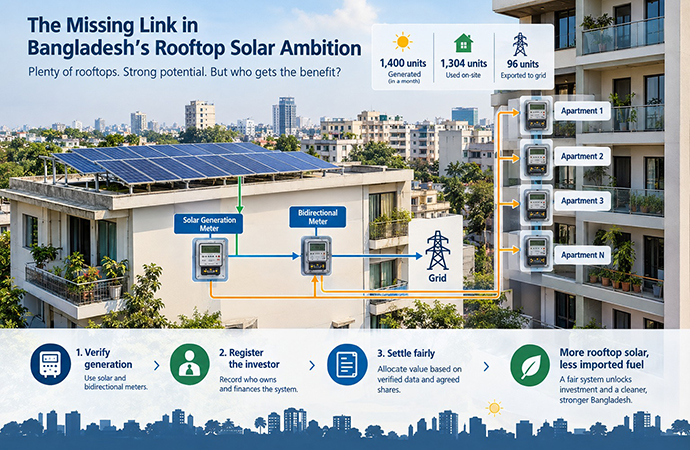
Suppose your apartment building is built but the owner pays for rooftop solar, but each apartment has its own meter. For a month, 1400 units of electricity may be produced by such a system but 1304 units may be used by the residents for their needs and 96 units exported to the grid. Net Metering Guideline 2025 allows for measuring both grid exchange and solar generation. The actual challenge is, however, not to produce enough power, but who benefits from the financial value of the produced power that is used in their apartments with separate meters.
Where the Missing Link Appears
In a single-meter home or factory, solar generation directly reduces the investor's electricity bill. In a multi-meter apartment building, however, the owner may finance the system while residents with separate meters consume much of the electricity. The investor bears the cost, but the benefit largely goes elsewhere. The distribution utility confirmed that solar generation could be monitored, but the present billing arrangement does not necessarily translate that generation into a credit for the investor. This exposes a regulatory gap: if generation can be measured, its financial value should also be fairly allocated.
REB and the Utilities Have a Role
REB and other utilities are best placed to identify such problems through their work with consumers, meters and billing. Rather than merely applying existing rules, they should bring recurring gaps to BERC, SREDA and the Power Division for resolution. Encouraging private investment in rooftop solar requires a clear mechanism showing investors how the electricity they finance will be valued.
Three Steps to Close the Gap
A workable solution need not be complicated.
1. Verify generation.
The Solar Accounting Meter can record total rooftop generation, while the bidirectional meter records imports and exports. In the example, the system generated 1,400 units and exported 96. These measurements provide an auditable basis for determining electricity retained within the premises.
2. Register the investor.
The solar account should identify who financed and owns the installation. If one owner paid for it, that person should be registered. If apartment owners invested jointly, their agreed shares should be recorded. The rules should also cover changes of ownership.
3. Establish a settlement mechanism.
BERC, together with SREDA, the Power Division and distribution utilities, should determine how verified solar electricity consumed within a multi-meter building is valued and allocated. A monthly statement could show total generation, exports, on-site consumption and the accounts receiving the benefit.
One possibility is virtual allocation, where solar benefits are distributed among registered meters according to agreed shares. Another is an approved arrangement under which residents compensate the registered solar investor for electricity they consume.
One Unit, One Benefit
Any solution must avoid double counting. If residents already benefit from solar electricity, the owner should not receive a second full credit for the same units without adjustment. The principle is simple: each unit should be measured once, valued fairly and credited once.
Why It Matters Nationally
This is more than a billing issue. Bangladesh has an estimated 30.4 GWp of technical rooftop solar potential, while only about 214 MW of net-metered rooftop capacity was reported by March 2026. An owner has little incentive to maximise solar generation if much of its value goes elsewhere. Across thousands of buildings, this could discourage private investment. A fair settlement system could unlock more rooftop solar, reduce pressure on conventional power and lower dependence on imported fuel.
Start With a Pilot
BERC could test the system in selected multi-meter apartment buildings under REB and other utilities. The pilot could compare solar generation, grid imports and exports, apartment consumption and financial credits. The results could then guide a permanent billing rule.
Turning Rooftops into Energy Assets
Bangladesh has the sunlight, rooftops, technology and willing investors. What is missing is a clear link between investment, generation, consumption and financial benefit. Closing that gap could turn thousands of underused rooftops into productive energy assets. The success of rooftop solar will depend not only on installing panels, but also on making investment in them economically worthwhile.
Major General (Retd.) Md. Nazrul Islam is the former Executive Chairman of BEPZA and former Executive Member (Planning) of BEZA. He is a PhD researcher focusing on technology, workforce transformation, and industrial competitiveness, and the author of the Zi-DoNa Trilogy.
A Independent Newsweekly
© Copyright 2026 | Designed by ARK Reepon & Developed by Cosmos Group Software Team





Leave a Comment
Recent Posts
Is the international community ...
A spate of downgraded economic projections, from Bretton Woods to Mani ...
A Childhood Lesson in Arithmet ...
As children, we learned a simple mathematical rule: if we know the pri ...
Indian authorities launched a major security crackdo ..
Police dispersed garment workers from the Azampur ro ..
Why Saudi Arabia has struggled to defend itself agai ..
Iran-backed Houthis strike Saudi oil company Aramco’ ..