


Featured 2
Exploring Neurodiversity and Disability: A Critical Look


An Independent Newsweekly

Featured 2
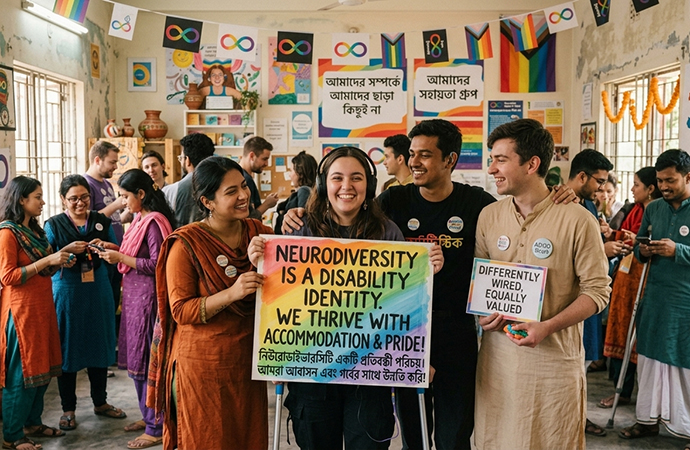
AI Generated Image
Introduction
What do we think of whenever we see the word "disability"? For many of us, to think of disability is to see a person sitting in a wheelchair or on crutches. In a country like Bangladesh, adequate support systems do not exist for disabled peoples and therefore, disabled peoples are condemned to rely on family and social support networks which regrettably do not provide for them the way industrialised nations do.
However, industrialised nations also report the same issues and problems with providing for disabled peoples the way it should be rather than the way it is. In my own personal space, I have found that disabilities exist on the peripheries of imagination rather than documented and certified definitions of what disability is or should be. Human beings can be disabled in so many ways, that it is impossible for us as a species to comprehend how diverse disability looks like in reality.
Today, I will be talking about neurodiversity and disability, investigating how this radical model of understanding disability defines disability and the support measures that are or should be in place to serve those disabled neuro-disability.
Neurodiversity Model Explained
So, what is the neurodiversity model of disability?
The neurodiversity model of disability-as explained by scholar and activist Dr. Nick Walker in the United States of America-refers to neurological "divergences" as "natural" and evolutionary; a part of the human process of evolving and growing. Therefore, to be disabled is to find oneself as normal as can be-there is nothing "different" or "abnormal" in being disabled. Borrowing heavily from the social model of disability-a model which argues that disabled peoples are disabled not just because they are missing a limb or an eye for example, but because society and human settlements are made the way they are to not accommodate for people with different bodily needs and priorities-the neurodiversity model also rejects or refutes the medical model of disability, which seeks an all-end solution to fixing disability, through medication, normalisation or in other words, seeking medical solutions for disabled peoples.
The neurodiversity model of disability might in some cases, reduce the meaning of disability through not giving an ultimate label to it. Scholars however, like Robert Chapman argue that adopting a socio-ecological approach to neurodiversity and disability might uncover new and old spaces of discrimination and limitation faced by those with neurodivergent illnesses and sicknesses. Providing for disabled peoples in accommodating environments might still cause distress and stress in those places where disabled peoples feel welcomed and provided for, and accepting this reality adds more credibility to the neurological model of providing for all who have a disability.
A Rights Based Question and Approach
Having said all of this, how do people with neurological disabilities navigate their way in this world? Well, to look at a few case studies, neurologically-disabled peoples might have problems for example in working with fixed time schedules, accessing education within traditional frameworks of rote learning and might have issues handling "meltdowns" and adjusting to work culture within built environments.
One case study in particular might involve a disabled patron not being able to do administrative work but thrive in creative environments. The solution here is to place her in creative roles and reduce her administrative work-load.
As with the case above or perhaps not to the extent that medicalisation occurs of disability, policy advisors and analysts might recommend putting forth practical recommendations for "fixing" these problems and ending the conversation there.
A true rights-based approach however, will include the disabled patron's own opinion about how he or she should be assisted in his or her own life without a neutral, impassionate third party deciding everything. From a results-based approach, this too will involve a shift in political-social methods of disabled peoples accessing resources and rights for themselves. Indeed, in the context of this article even, I have spoken about disabled peoples as a non-disabled person and my disabilities-when seen as disabilities; for example, not being able to see in the dark-have not warranted any medication or long-term support. I am not part of any political movement for disabled peoples and I have not put myself in any kind of inconvenience advocating for disabled peoples' rights and liberties. In of itself, privileged peoples' writing for non-privileged people do not say much. And that is also part of the broader problem when fighting for disabled peoples.
In Conclusion
I hope that in the future, more and more disabled peoples in global Southern countries and not only in global Northern countries will speak up for their rights and incorporate the neurological paradigm into their work and activism. As a non-disabled person speaking for disabled peoples, I have a lot of power and privilege doing so and do not have the responsibility of "checking" myself when I engage myself in this work. However, I like to believe that people like me have empathetic souls and that we come from a place of good. The good that we have in us have to be better utilised-in a utilitarian approach- by disabled peoples in work that encourage alliance and working in partnerships with one another. This work for disabled peoples also involves unitary work by standalone individuals for disability activism that people will do by themselves without expecting anything in return. I look forward to a time when able-bodied individuals work in tune with disabled peoples-and perhaps that time has already come and passed and the one woefully negligent of such advancements when it comes to disability work is me-and to a space and time where disabled peoples are politically sound and robust on their own, no longer needing privileged peoples' "assistance" for survival.
The world is changing every day. New changes keeping disenfranchised peoples in mind keep it going at a healthy pace. In conclusion, I wish the best for those on any spectrum of the disability paradigm.
The author Nadia Chowdhury is a specialist on Critical Disability issues.
A Independent Newsweekly
© Copyright 2026 | Designed by ARK Reepon & Developed by Cosmos Group Software Team



Leave a Comment
Recent Posts
Is the international community ...
A spate of downgraded economic projections, from Bretton Woods to Mani ...
A Childhood Lesson in Arithmet ...
As children, we learned a simple mathematical rule: if we know the pri ...
Indian authorities launched a major security crackdo ..
Police dispersed garment workers from the Azampur ro ..
Why Saudi Arabia has struggled to defend itself agai ..
Iran-backed Houthis strike Saudi oil company Aramco’ ..