


Technology
How Pulmonary Leagues under the Sea Have Crossed the Rubicon


An Independent Newsweekly







Technology
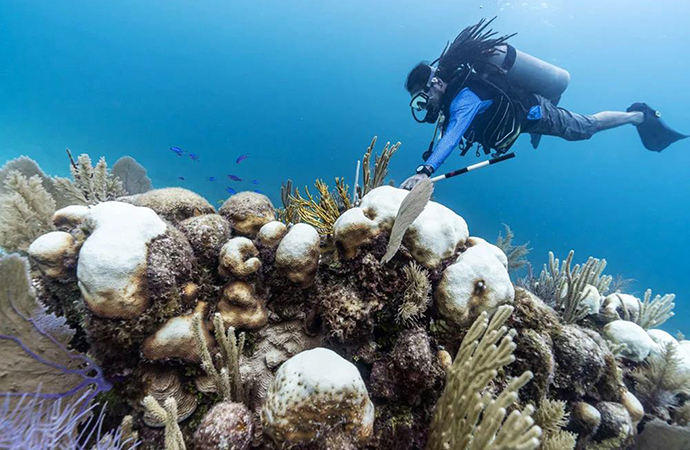
Coral Bleaching in the Great Barrier Reef, Credit: Coral Reef Alliance
Unless global warming is reduced 'as fast as possible', warm water coral reefs will not remain 'at any meaningful scale', a report by 160 scientists from 23 countries warns. But at the tremendous loss of not only optimism, from the depths of the benthos, discoveries prevail and new treaties promise deliverance from the looming eco rupture.
The Rubicon?
In 49 BCE, Roman general Julius Caesar led his army across the Rubicon River into Italy proper from Gaul, a boundary forbidden to armies. This was a direct act of insurrection against the Roman Senate, and thus ignited a civil war against his rival, Pompey, signifying the irreversible - a point of no return.
According to research published by the University of Exeter's Global Systems Institute in October 2025, the coral reefs have reached critical irreversible bleaching. Scientists determined that the tipping point for coral reefs begins when global warming reaches approximately 1.2 degrees Celsius above preindustrial levels, with most coral dying off as temperatures climb to 1.5 degrees. Current global temperatures have already reached 1.4 degrees Celsius above the preindustrial average.
Coral bleaching occurs when heat stress causes coral to expel the colorful symbiotic algae that sustains it, turning pale and weak. If stress persists, the coral breaks down completely. Bleaching events have become more frequent and severe, leading to the loss of 70-90% of reef areas worldwide, with species extinctions now estimated to be 10-100 times greater than natural background rates.
The International Coral Reef Initiative reported in April that an estimated 84% of global coral reefs were under heat stress, marking the most extensive and intense mass bleaching event ever recorded. A fundamental characteristic of tipping points are incremental temperature changes that trigger immutable biome collapse.
Since 1990, global coral cover has declined by over 50%, with the Great Barrier Reef dropping from 28% to 13.8% hard coral cover between 1985 and 2012. Biodiversity loss imposes substantial detriments across major sectors. The World Bank estimates that the collapse could result in global GDP losses of $2.7 trillion annually by 2030, with Sub-Saharan Africa and South Asia facing up to 9.7% and 6.5% annual contractions, respectively. Fisheries face losses of up to $362 billion annually, as global coral reef degradation impacts spawning grounds. Health care costs rise with biodiversity decline due to increased disease transmission, as evident in the past decade, with the largest mark left behind by COVID-19.
WHO estimates ecosystem degradation incurs costs of up to $10 trillion annually across health, agriculture, and fisheries sectors. Tourism, heavily reliant on biodiversity rich environments, suffers billions in lost revenue where coral reefs disappear and marine wildlife migrate preemptively.
The report, released ahead of the UN's COP30 climate conference in Brazil, aims to place tipping points firmly on the policy agenda. Other ecosystems approaching critical thresholds include the Amazon rainforest, ocean currents influencing weather patterns of the temperate latitudes, and the Greenland ice sheet, which assumes responsibility for shedding freshwater equivalent to three Niagara Falls hourly into the North Atlantic.
Coral Extinction
Two of Florida's most iconic reef-building coral species, the branching staghorn and elkhorn corals, have become functionally extinct across the state's coral reef. A study, led by researchers from University of Southern California, the Shedd Aquarium, and the US National Oceanic and Atmospheric Administration (NOAA) found that of more than 50,000 acroporid (small and stony) corals surveyed across nearly 400 individual reefs before and after the 2023-2024 marine heat wave, 97.8% ultimately died.
Functional extinction refers to the fact that too few coral individuals remain to fulfill their ecological role as ecosystem builders. In summer 2023, average sea-surface temperatures across Florida's reef exceeded 31 degrees C, persisting for weeks.
Temperatures were so extreme in the middle and lower Florida Keys that some corals died within days from acute heat shock. Of 200 transplanted corals the research team had been monitoring in the Lower Keys, only three survived by summer's end. NOAA declared 2023-2024 the fourth global bleaching event, with mass bleaching occurring almost simultaneously worldwide. "This type of mass bleaching points to a common environmental driver," the researchers wrote.
The experts emphasized that Florida's acroporids cannot recover without human intervention. Even before the 2023 heat wave, coral populations had been dwindling due to hurricane damage. The event was effectively the final nail in the coffin, with populations now too small to find mates and increased likelihood of inbreeding, the species have entered what conservation biologists call the "extinction vortex."
Hope from the Abyss
Amid the grim outlook, recent discoveries suggest marine ecosystems may possess underappreciated resilience. Led by Dr. Lisa Friesen (University of Copenhagen), an international research team reported nitrogen-fixing non-cyanobacterial diazotrophs (marine bacteria) actively converting atmospheric nitrogen into ammonium under the sea ice, in polar waters - once believed to be inhospitable. This conversion fuels algae growth, an essential component of biogeochemistry. "We believed it was not possible for nitrogen-fixation in the sea ice because we thought the conditions were too harsh," she said.
In the nutrient poor Central Arctic, this process could represent up to 8% of nitrogen needed for plankton growth. The researchers note that the Arctic Ocean will take up more CO₂ because more will be trapped in algal biomass, and not the atmosphere or ocean waters. "For the climate and the environment, this is probably good news", say the researchers.
A separate study published in Science in October 2025 challenged dire predictions about tropical Pacific fisheries. Researchers from UMass Boston analyzed nitrogen isotopes preserved in ancient plankton shells spanning five million years, finding disparities in the scientific notions regarding the Pliocene Epoch. Patrick Rafter (USF) explained: "Our measurements suggest that, on a warmer planet, the availability of marine nutrients to fuel plant growth and fisheries may not necessarily decline."
Research on the impacts of calcifying plankton (organisms that build limestone-kin shells influencing carbon transfer from air to seawater to deep ocean), are grossly oversimplified by scientists when modeling the climate. "By leaving them out of climate models, we risk overlooking fundamental processes that determine how the Earth system responds to climate change," said Patrizia Ziveri from Institute of Environmental Science and Technology (ICTA). This could potentially change ocean carbon calculations across the whole scientific discipline.
But perhaps, the discovery of a vast white coral reef in the Gulf of Naples in October 2025 offered the best surprise. Italian Research Council explorers, using remotely operated submarines in the Dohrn Canyon, found massive deep-water hard coral species distributed along an 80-meter high vertical wall. The reef also contains sponges, fossil traces of oysters and ancient corals. Mission leader Giorgio Castellan called the finding "exceptional for Italian seas," noting that bioconstructions of this magnitude had never been observed in the canyon and are rarely seen elsewhere in the Mediterranean. This patch will now account for a major stake in the rejuvenating European coral stock.
Quick Sea Fix
Addressing the coral crisis demands innovation paired with community-led conservation scaled to global policy. In Madagascar's Bay of Ranobe, where overfishing has devastated both reefs and local livelihoods, marine biologists are pioneering artificial reef construction to expand fishing grounds rather than restrict them.
Reef Doctor, a nonprofit operating in the bay, sinks limestone blocks offshore in long underwater rows, seeding them with autonomous reef structures that accumulate corals, sponges, and other organisms from natural reefs. Marine biologist Mark Little reported that the artificial reefs have begun attracting fish schools, indicating progress. A research team involving Harvard T.H. Chan School of Public Health is examining whether managing resources this way benefits food web dynamics.
With mercury being a critical deep ocean anthropogenic pollutant, the EU-funded MER-CLUB project identified marine bacteria with high potential for mercury detoxification. "Reducing mercury levels in sediments through bioremediation is the basis to restore polluted seas," said Dr. Andrea Bravo, a researcher on the project. While challenges remain in scaling to pilot-plant operations, the research establishes foundations for viable cleanup solutions.
German researchers at the Max Planck Institute developed molecular probes that glow when microbes break down sugars. "Sugars are central to the marine carbon cycle," said lead author Conor Crawford. "With this FRET probe, we can ask: Who's eating what, where, and when?" Understanding which microbes degrade specific sugars helps scientists predict carbon flux responses to changing conditions.
On the policy front, the High Seas Treaty, formally known as the Agreement on the Conservation and Sustainable Use of Marine Biological Diversity of Areas Beyond National Jurisdiction, reached 60 ratifications on September 19, 2025, triggering its entry into force on January 17, 2026. The agreement creates governance regimes for establishing marine protected areas in international waters, covering two-thirds of the world's ocean where overfishing is rampant.
Right now, these measures are like setting up scaffolding around the Titanic, just hoping it's enough to keep it afloat until we figure out how to plug the iceberg holes.
Shoumik Zubyer is an Associate Researcher at the Atmospheric and Environmental Chemistry Lab, Atomic Energy Centre, BAEC and a science correspondent.
A Independent Newsweekly
© Copyright 2026 | Designed by ARK Reepon & Developed by Cosmos Group Software Team






Leave a Comment
Recent Posts
A commendable intervention by ...
A struggle for local dominance in the Chittagong Hill Tracts, specific ...
How close is the Amazon to a ‘ ...
While Brazil’s presidential candidates have not made policy of t ...
Another shipment of highly radioactive uranium fuel
Harmony: Diplomatic community joins Durga Puja celeb ..
What to know about the Ebola outbreak that has sprea ..
Brazil election: Trump’s ‘Donroe Doctrine’ faces its ..