


Reportage
Where Justice Must Prevail


An Independent Newsweekly



Reportage
Reform, justice, elections - the three pillars of the mandate bestowed on the interim government led by Dr Muhammad Yunus, as it was sworn in on August 8, 2024, on the back of the astonishing triumph of the student-led uprising that had toppled the previous, authoritarian regime of the Awami League just three days earlier.
As it nears the end of its tenure now, with elections slated for the first half of February, it is prudent of course to assess its achievements in light of these three criteria. While the election was always going to be kept for last, as a sort of necessary final act, the other two called for well-thought out planning, regular interventions, and wholesale manoeuvring to position the state such that it yielded to these two words that, truth be told, have never enjoyed the greatest currency in Bangladesh.
Last week, we noted that the signing of the July Charter, albeit still missing the endorsement of the Children of the Revolution - i.e. the National Citizen Party, formed by the students who led the nation's great awakening - signaled pretty much the conclusion of its reform agenda. The Charter, in the sum of its proposals, contains the vision arrived at through extensive consultations between the political parties under the auspices of the IG (specifically the National Consensus Commission). Its implementation was always going to be beyond the IG's remit.
If we look back to the beginning, there is the interview with Nahid Islam, published by CIVICUS, on August 8th, 2024 itself, but with Yunus yet to take charge (he would later that evening upon arrival from Paris). In answer to the question "What are your expectations of the interim government?" Nahid said:
"We have demanded that the interim government be led by the internationally renowned Nobel laureate Dr Muhammad Yunus as its chief adviser. The other members of the interim government must be honest, impartial, competent and patriotic. They must ensure justice for all the wrongs committed by the previous regime.
"We want to make it clear that the future of Bangladesh must be determined by the people who participated in the mass uprising, not by some cantonment. Power must be handed over to an interim government proposed by the protest movement. We won't accept anything less, and there is no question of an army-controlled government.
"We have received information that Awami League thugs are still creating chaos and looting to discredit our movement. But we have appealed to people not to take part in any incitement, attack or looting. Those doing this aren't revolutionary students. We urge people to make announcements from mosques in their areas about the need to stop communal attacks and ensure the safety of all, Buddhists, Christians, Hindus and Indigenous people alike. The army is clearly not doing its job properly and we're calling on them to act immediately to keep the peace.
"Killers must be brought to justice and held accountable. Political prisoners and those who've been kidnapped must be released. Our struggle doesn't end with the resignation of the Hasina government; we want the abolition of this fascist system and the building of a new Bangladesh with new political arrangements. No one should leave the streets until we win the final victory."
From Nahid's answer, we shall set aside "They must ensure justice for all the wrongs committed by the previous regime" and "Killers must be brought to justice and held accountable."
The universe of injustices the IG was expected to take on, could be gleaned from setting these two markers. That would then include all the victims of the previous regime, i.e. Awami League's 2009-24 under Hasina, which we all know was BNP-Jamaat mostly.
Additionally when Nahid says "killers" here, we must specify he actually means those who engaged in actions against them, i.e. their direct adversaries on the ground during the July 36 Revolution: those deployed against them at Hasina's orders.
Adding their voice to the need for accountability for what happened during those 36 days, or 20-21 days, Amnesty International, in one of their first statements after the Uprising, said:
"The human rights violations in the last three weeks that have led to the death of more than 300 people, with thousands injured and arbitrarily arrested, should be independently and impartially investigated in a transparent manner. We also call again for the establishment of a prompt, independent and impartial investigation into the deaths and injuries resulting from the protests. Those found responsible must be held accountable and the victims of the violence should receive full reparations from the state, which includes compensation, rehabilitation and guarantees of non-repetition."
This is not something that they can be expected to give away.
Justice as part of the IG's mandate does not concern itself with justice sector or judicial reform. But reforms to the security sector, somehow does come into it. Above it was mentioned we must erase it from our psyche.
On the agenda
In general, the public are well aware, well sensitised, to the fact that atrocities were mostly committed at police level, or under direct political control. We could say it's a new realisation, how DGFI bypasses the Army's bounds, and reports to the PMO. Yet it would be no justice to punish only the head, Hasina, for collective moral bankruptcy. We must put faith in the Tribunal's ability to serve justice - and if not, the Supreme Court is there.
Nahid's answer is also instructive to note the early tensions with the Army that becomes apparent as you read that answer. As it becomes the time to look back now, on its possibilities, its misses and its achievements, we may conclude its a tension the interim government could never really overcome, towards the effective service of its agenda. The early perception that developed, that this was essentially "the Students' government," and that was enough to drive that invisible wedge in between the country's premier security institution and the government it must protect and also serve. The primacy of civilian rule cannot be challenged.
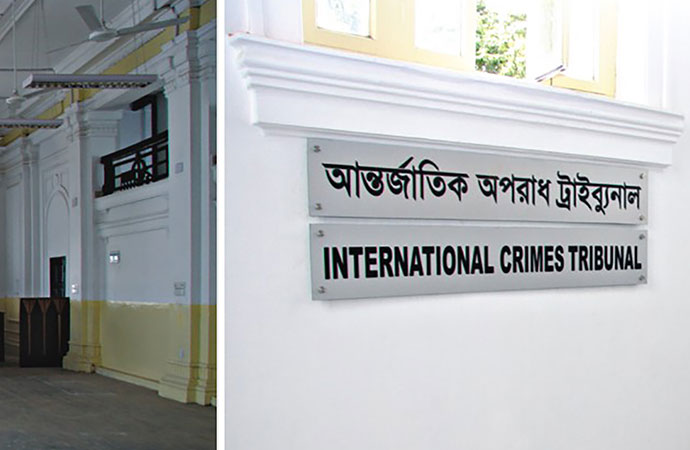
And so the Army in particular leaves itself vulnerable to quite shocking provocations, such as we've seen emanating from Awami League sources over the past week. What the International Crimes Tribunal's main man, Chief Prosecutor Tajul Islam brought up in his closing arguments, has actually been the case in the country's weekly discourse. It wasn't any secret information that Islam was divulging, nothing based on intelligence reports or special investigation - that deposed Prime Minister Sheikh Hasina attempted to create chaos within state institutions and tried to incite the Army. Alongside her, many in the Awami League's ranks could be found to have been engaging in this depressingly childish charade, to draw the Army out of its professional sphere, and into territory where it can never win.
We have to come to a stage, if we are to play this democracy game, that is, it is essential to reach a stage where the thought doesn't arise, of the possibility of a military coup. It must be erased from our universe of possibilities. And I believe it falls upon the military, at least to some extent, to ensure this at the earliest.
Islam made the remarks on Thursday at International Crimes Tribunal-1. The prosecution's final arguments in the case against Sheikh Hasina and two others concluded on the day, and the found their way into his closing.
The press for some strange reason jumped on his statement, delivered as part of his closing, that Sheikh Hasina tried to provoke a civil war in the country. He said she tried to incite the army officers saying, "Your officers are being tried - why aren't you standing up?" This is precisely the sort of talk in almost all Awami forums at the moment, and was throughout the week. Provoke a military coup, 100% in its own interest, absolutely zero in the military's, forget the nation.
The Awami League must devise a strategy to return without having to destroy the country. It has still not come to terms with its overthrow, its narratives are simply wrong, it is barking up the wrong tree stupidly with its.
Alongside Sheikh Hasina, the other two accused in this case are former Home Minister Asaduzzaman Khan and former Inspector General of Police (IGP) Chowdhury Abdullah Al-Mamun, who has admitted his guilt and become an "approver" (state witness). The week ended with closing arguments in the case, and the tribunal set November 13 to announce the date of the verdict, which shall follow soon after.
At the tribunal, Chief Prosecutor Tajul Islam also said the accused (Sheikh Hasina and Asaduzzaman) show no remorse for their crimes till today.
"They have committed such a grave crime - the whole world knows the crime was committed, and they know it too - yet there is never any sign of remorse," Islam said.
"Instead, they have threatened to kill those who have filed cases against them and those who are giving evidence. They have talked about destroying their homes. They have talked about dumping their bodies in the Bay of Bengal," the CP said.
At one point, he sounded conciliatory with the Army, praising them while bashing Hasina:
"She tried to provoke a civil war. But the patriotic Bangladesh Army did not fall into that trap. The people of Bangladesh did not fall into that trap. They remain steadfast in their commitment to bring perpetrators to justice. They brought them to the court. The trial process is being conducted smoothly. Bangladesh is moving forward. No one has taken the bait of any incitement."
The Wheels of Justice
This was of course as 15 serving army officers, including several generals, who surrendered to military custody upon being indicted at the ICT in three separate cases of enforced disappearance, or crimes against humanity. Suffice it to say it would NEVER have happened under a political government - to that extent, this fell within precisely within the mandate of the interim government. those who are saying this should not have happened are plainly taking the side of injustice, or hopelessness in the face of injustice.
On 11 October, the Bangladesh Army, through a press briefing, announced that 15 officers had been taken into military custody, one of whom was on pre-retirement leave (LPR).
Subsequently, on 12 October, the Ministry of Home Affairs issued a gazette notification temporarily declaring a building inside the Dhaka Cantonment as a prison.
According to ministry sources, following the issuance of arrest warrants, the army headquarters requested the ministry to designate 'MES Building No. 54' as a temporary prison.
The International Crimes Tribunal-1 (ICT-1) has ordered that 15 army officers be sent to prison in connection with three separate cases of crimes against humanity.
A three-member bench of ICT-1, headed by justice Md Golam Mortuza Majumdar issued the order around 8:30am Wednesday.
Those ordered to be sent to prison are: Brigadier General Md Jahangir Alam, former additional director general of the Rapid Action Battalion (RAB); Brigadier General Tofayel Mustafa Sarwar; Brigadier General Md Kamrul Hasan; Brigadier General Md Mahbub Alam; Brigadier General KM Azad; Colonel Abdullah Al Momen; Colonel Anwar Latif Khan (currently on pre-retirement leave); Lt Colonel Md Mashiur Rahman, former director of RAB's intelligence branch; Lt Colonel Saiful Islam Sumon; Lt Colonel Md Sarwar Bin Kashem; Lt Colonel Mohammad Redwanul Islam; and Major Md Rafat-bin-Alam, former Border Guard Bangladesh (BGB) officer.
The tribunal also sent to jail three former directors of the DGFI. They are: Major General Sheikh Md Sarwar Hossain, Brigadier General Md Mahbubur Rahman Siddiqui, and Brigadier General Ahmed Tanvir Mazhar Siddiqui.
Amnesty's welcome
London-based human rights organisation Amnesty International has welcomed the Bangladesh authorities' decision to present the 15 army officers before court for alleged involvement in enforced disappearances and torture during the tenure of the previous Awami League government.
In a statement posted on its South Asia Facebook page on Wednesday (22 October), Amnesty described the move as the first instance in Bangladesh where members of the armed forces have been formally charged in connection with enforced disappearance cases. The organisation termed it a "significant step towards accountability and justice for victims."
The officers were among 32 accused, including 25 former and current members of the Bangladesh Army, named in three separate cases of crimes against humanity investigated by the International Crimes Tribunal. Of them, 15 serving officers were produced before the tribunal today, which subsequently ordered their imprisonment.
Amnesty International urged the authorities to ensure that the entire judicial process complies fully with international human rights standards. It also called for the proceedings to be conducted in civilian courts, guaranteeing fair trial rights and avoiding the imposition of the death penalty in line with Bangladesh's international human rights obligations.
The rights watchdog emphasised that accountability for past human rights violations is essential to restoring public trust and ensuring justice for the victims of enforced disappearances and torture.
A Independent Newsweekly
© Copyright 2026 | Designed by ARK Reepon & Developed by Cosmos Group Software Team





Leave a Comment
Recent Posts
Is the international community ...
A spate of downgraded economic projections, from Bretton Woods to Mani ...
A Childhood Lesson in Arithmet ...
As children, we learned a simple mathematical rule: if we know the pri ...
Indian authorities launched a major security crackdo ..
Police dispersed garment workers from the Azampur ro ..
Why Saudi Arabia has struggled to defend itself agai ..
Iran-backed Houthis strike Saudi oil company Aramco’ ..