


Reportage
Transcending politics

An Independent Newsweekly

Reportage
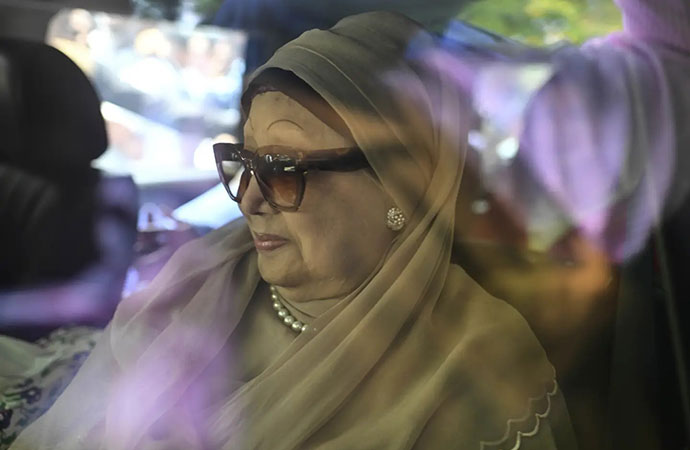
Begum Khaleda Zia. Photo: AP/UNB
"On the one hand, opposition leaders are being sued on false charges of terrorism, while on the other hand, a minister has said that they will be released if they reach an agreement with the government. It is clear from all this that opposition leaders are being sued and arrested on false charges." (Begum Khaleda Zia talking to reporters in December 2013, on rumours circulating about how some of her party's leaders were involved in talks with the AL government)
When Khaleda Zia makes a point like the one above, instead of holding on to the offer as a political card, it signals an essential difference between herself and Sheikh Hasina, whose every pronouncement seems aimed at scraping whatever political advantage she can for herself out of any situation.
Thanks to a media and cultural environment historically more saddled in its disposition towards Awami League politics, for a very long time now, an impression has been cemented in the collective psyche of a certain segment of the population (largely confined to the chattering classes of the capital) that Bangabandhu's daughter, riding the good ship Joy Bangla that her father built, was obviously more preferable to Zia's widow. I know within my social and familial setting it was as if axiomatic. It was hard to realise this "truth" seemed erected on a strange, untouchable pedestal bereft of any objective analysis, or evidence emerging to support it. To be fair, one didn't really come across much overwhelming evidence to the contrary either.
But it lasted only until I learned to think for myself, and became open to the idea that supposed "truths" we'd been fed before developing a way to think could be overturned. And if more of us could affect the same, and carry out a fair assessment of the two women's words and deeds over the course of their careers, the least we would realise is this: at no point did Khaleda Zia take any prerogative to assume this country's fate was subservient to her own will to power, or that the essence of its 140-50-60 million people, its raison d'être, hers to fashion.
Revising the revisionists
The February 15, 1996 election, held under the first Khaleda Zia government (1991-1996), is often used to draw a form of equivalence between her and Sheikh Hasina - they say it is KZ's "January 5, 2014", that both held one-sided elections boycotted by the opposition (Hasina by the end had two of those of course, plus the Midnight one in between), and it is used to paint both parties as essentially undemocratic. A convenient way to "both-sides" the argument, from which the actually undemocratic, even Fascist, force, i.e. Awami League, naturally benefits. Nothing could be further from the truth.
Just two weeks ago, Dr Abdun Noor Tushar, the affable physician-cummedia personality, mentioned on a talk show that the Awami League government in 2001 was the only government in Bangladesh's history that peacefully handed over power - something Hasina started propagating towards the latter half of her autocratic run. You will not hear of something like this anywhere else, except doshore literature. The consensus among political scientists has always been that both 1996 and 2001 were peaceful transfers because the party in power did not try to stay on beyond its mandate - which is the key thing to consider here.
Revisionist history was always part of the AL playbook under Hasina. From turning Zia into a razakar to giving Bangabandhu sole ownership of 1971, she tried everything, and it came back to bite her, badly. So it might be prudent at this point to look back to see what Feb. 15, 1996 election was all about actually, and should Khaleda Zia and her party have foregone it. What would have been the consequences if they did?
The parliament on this occasion was dissolved in December 1995, and elections declared for February 15, 1996.
The problem was that the opposition were on the streets, agitating for a provision that did not exist anywhere else in the world (at the time): a three-month caretaker administration headed by the last-retired chief justice, to oversee the election period. Although modelled on the caretaker that was used to transition out of Ershad's autocracy, in 1990-91 it was understood to be a one-time thing. Now what was being proposed was an overhaul of the electoral system, and it would require a constitutional amendment. These days it is talked about as if such a novel concept should have been accepted by the ruling party (BNP) with their eyes closed. But that is totally out of tune with reality.
Which brings us to the most essential difference between 5/1/2014 and 15/2/96: whereas the former was the culmination of Hasina's well thought-out plan to capture the electoral process by scrapping the caretaker provision, the latter was practically held with the sole purpose of introducing it into the constitution. Without it, there would never have been the 13th amendment, that contained the caretaker provision.
The context they erased
You might wonder why I say that, that without the February 1996 election, there would have been no caretaker. The nearly 2-year agitation by AL, joined by Jamaat and Jatoya Party, had started in March 1994, when a by-election was held in the Magura-1 constituency. BNP was expected to win it anyway, but the process became marred by widespread irregularities. TV cameras captured industrial level ballot box-stuffing by over-enthusiastic party activists. Hasina had infamously vowed to not let BNP govern "even a single day in peace" after losing the 1991 election (she also boycotted the swearing-in ceremony - the country's first free and fair election, the advent of democracy, you played a part in realising it, and then you boycott the inauguration simply because your party lost, or maybe due to your own own poor strike, having won just 1 of the 3 seats you ran for). Her fascist tendencies were apparent from the start, if only people chose to see. She had boycotted the budget as early as 1992. And she seized upon the Magura debacle to raise hell. She called for the government to resign, and hand over power to a caretaker a la Justice Shahabuddin.
Begum Zia wasn't totally opposed to the idea. Nobody had better memories, of course, of the 1991 election than her. It was the 'resign immediately' bit that she opposed, and understandably so.
In order to get an idea of just how unreasonable Hasina was being during this period, from a neutral perspective, I would advise people to read the report by Sir Ninian Stephen, ex-Commonwealth secretary-general, who spent 5 weeks in the country (Oct-Nov 1994). The following bit is from a newspaper interview he gave when he went back to his native Australia:
"The Opposition Leader exhibits bitter antipathy towards the Prime Minister personally and she has made it clear she [Ms Zia] is to step down," he said. Ms Zia's five-year Government is not due to go to the polls until February 1996.
Sir Ninian did draft a peace plan during his stay. This would have established a 45-day caretaker government headed by the Prime Minister with a Cabinet of four appointed by her and five appointed by the Opposition.
"No portfolios would have been allocated and the country would have been run by department heads until the new elections were held," he said. Ms Zia had agreed to the plan, but the Opposition had refused.
Soon after Sir Ninian left, in December 1994, the opposition MPs all resigned. Which was a totally dumb move, since it killed off all chances of passing a constitutional amendment, which required 220 votes in those days. BNP had 168 MPs. And introducing the caretaker provision would require a constitutional amendment. In fact by resigning, Hasina and the other opposition MPs who followed suit made the February 15, 1996 election absolutely necessary. And yet they kept on agitating. Begum Zia had actually come around to the idea, and could well have agreed to introduce it towards the end of her term - the one thing she didn't want to do was also resign early. And why should she? There was absolutely no justification for it, nor any demand among the general population for her to do so.
But they like to believe that it was the intensity of their movement that had forced Begum Zia's hand. They only flatter themselves. First of all they couldn't force her to resign before time - she did see out the term she was elected for in 1991. The second was a given. The entire thing was prolonged because of AL's own thick-headed idiocy, and BNP had no intention of pushing on after passing the 13th amendment bill in the parliament bill. Which lasted a single session, and passed a single bill. They didn't even appoint a cabinet, and clearly there was nothing else on their agenda, except legislating the caretaker. Yet in order to keep applying maximum pressure, on March 25, 1996, six days after that lone session started. AL had the amlas who supported it come out and stage the infamous 'Janatar Mancha' - arguably tainting the bureaucracy forever. Everything was secondary to Sheikh Hasina's will to power.
But Khaleda Zia's stature today, is at a height that we shouldn't allow association with Hasina to taint her. And that is why we chose to revisit this important event from history, where the history is in fact distorted in the popular imagination.
The traditionally AL-dominated media has been only too happy to play along with Hasina's games, that will hopefully subside with her historic exit. But these days, you would be hard-pressed to find even BNP supporters raising any objections to gross misrepresentation of the truth- and that is why we needed to set the record straight.
A Independent Newsweekly
© Copyright 2026 | Designed by ARK Reepon & Developed by Cosmos Group Software Team




Leave a Comment
Recent Posts
Is the international community ...
A spate of downgraded economic projections, from Bretton Woods to Mani ...
A Childhood Lesson in Arithmet ...
As children, we learned a simple mathematical rule: if we know the pri ...
Indian authorities launched a major security crackdo ..
Police dispersed garment workers from the Azampur ro ..
Why Saudi Arabia has struggled to defend itself agai ..
Iran-backed Houthis strike Saudi oil company Aramco’ ..