


Reportage
The Rocky Road to Reform


An Independent Newsweekly





Reportage
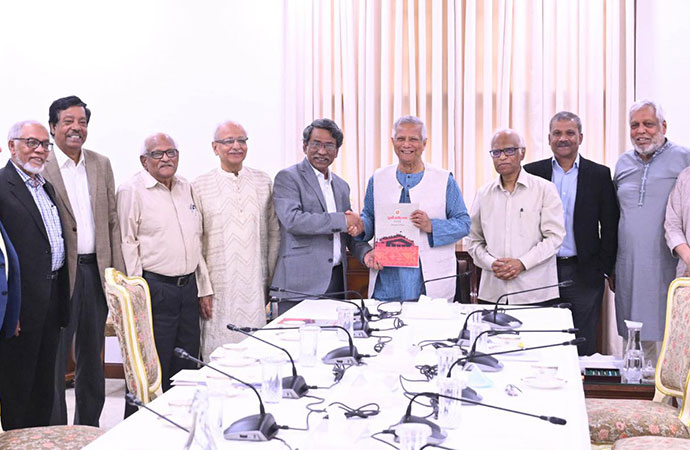
Following a nearly 9 month-process of discussion and deliberation under the banner of the National Consensus Commission, most of which was broadcast live on national television, the commission prepared the final text on a set of reform proposals, 84 in all, that became known as the July Charter. In turn, 48 out of these 84 proposals, that may be called the most important among them, require constitutional amendments.
Even though fully three-fourths (36 out of 48) of these topics or proposals failed to elicit any meaningful consensus among the various political parties that took part in its meetings, the July Charter was presented as a document forged through consensus among the various parties, of their vision for a new Bangladesh rising from the ashes of authoritarianism.
Yet is it ever even realistic, to expect a common vision of the future from any two political parties, let alone three or a dozen, or as the case was here, dozens? The very premise of a political party is that it nurtures a certain vision for the future of a nation, that there is no existing political force that is catering to that vision, and that there is a substantive 'market' for this vision, which translates to a certain threshold of the electorate. In recognition of this reality, the NCC devised the idea of dissenting notes as we got to the business end of the discussions. The various parties all took advantage of this opportunity to register their notes of dissent, which is how we know three-fourths of the proposals failed to achieve consensus among the participating parties.
The parties signed the July Charter incorporating their stated notes of dissent. All except the National Citizen Party of course, who were holding out over implementation guarantees. As the party born out of the 2024 Uprising, NCP's position on the charter held significance. It had registered a dissent on just one aspect of the Charter itself, but it wanted some binding constitutional guarantees that would hold the next parliament, set to be elected through election in February 2026, accountable for the implementation of the charter.
NCP Convener Nahid Islam said the July Charter would be meaningless without a legal foundation, calling it a "deception" and a "farce" for the nation.
"If the July charter has no legal foundation, it will have no value or significance," Nahid said at a press conference held at the NCP's central office in Banglamotor, Dhaka. By not signing the agreement charter, the NCP has not been sidelined from politics, Nahid said, adding that those who signed the charter have been distanced from the mass uprising and the people.
"Yesterday's event (the signing ceremony) reflected or implemented nothing of the people's aspirations. This will happen only when Professor Muhammad Yunus issues an order that creates the legal basis for it as the sovereign will of the student masses who participated in the July mass uprising. On that basis, a referendum is held, and the subsequently elected parliament and people's assembly draft a new constitution," he said.
It is known that all political parties at one point agreed on holding a referendum over the constitutional questions. But there was ambiguity over how the Charter would be implemented and what specific question the public would vote on - the "yes" or "no" question itself, as well as its timing. This week, the Consensus Commission placed its final proposal before Chief Adviser Muhammad Yunus aiming to clarify these issues. But instead of resolving the matter, the Commission's recommendation has given rise to a potentially new crisis.
No room for dissent?
When the notes of dissent were incorporated into the Charter, it was ensured that if any political party mentioned its dissenting views in its election manifesto and later came to power through popular mandate, it would then be able to amend the Constitution in accordance with its own stance.
However, it now appears that in the draft of the July Charter Implementation Order, only the reform proposals themselves have been included. And according to the order, a Constitutional Reform Council, comprising members of parliament, must amend the Constitution "in accordance with the July National Charter described in Schedule 1".
According to Professor Ali Riaz, vice-chairman of the Consensus Commission, even though some parties have submitted notes of dissent, once the Charter is approved through a referendum, it will be implemented as it stands. This implies that if the referendum produces a "Yes" verdict, the constitutional amendments must be enacted precisely as drafted by the Consensus Commission.
In line with the Commission's recommendations, the referendum will not be limited to those issues on which all political parties are in agreement. Nor will there be any scope to take into account the "notes of dissent". The question that arises from such a recommendation is this: why were the dissenting opinions incorporated into the July Charter if they are to have no bearing on the outcome?
If a political party has strong objections to certain proposed constitutional amendments, and those objections were duly recorded, how could that party-upon winning a national election-be compelled to implement the Charter in its entirety? The party could reasonably argue that it had made its position clear before the election. Now if the electorate chooses them, why should it not possess the democratic right to pursue constitutional reforms in line with its declared stance?
It is known that the BNP registered the highest number of dissents against the Commission's proposals - nine in all. If the Charter is passed in a referendum (meaning in full) but the BNP wins the national election in February, the Commission's framework would require the party to disavow its dissents. But can such an obligation truly be enforced?
The next parliament will also serve as the Constitutional Reform Council and have 270 days to complete constitutional reforms in line with the July National Charter proposals passed by a referendum, the National Consensus Commission has recommended.
Failure to do so within the stipulated timeframe would trigger automatic enactment of the referendum-approved bill on the constitutional reforms - another extraordinary suggestion. The referendum will be held before or on the day of the national election. Riaz said the commission has proposed two options for the task of constitutional reforms: it must be completed within 270 days, or if a referendum approves the relevant bill on constitutional reforms but the council fails to implement it within that timeframe, the bill would be automatically passed after 270 days.
He added that the commission has made specific recommendations on 48 constitutional issues to establish legal grounds and a clear implementation roadmap.
According to the commission's recommendation, the next Jatiya Sangsad (JS) would function as the Constitution Reform Council and enforce its constituent power, and also carry out the routine parliamentary tasks. Elected lawmakers will serve as members of both the council and parliament.
Once the necessary constitutional amendments, additions and deletions are made, parliament must approve them, after which the council's tenure would end, he added.
On the formation of an upper house, Ali Riaz said that, based on the recommendations of the Constitution Reform Commission, the Electoral Reform Commission and the National Consensus Commission, it has been proposed that the upper house be formed through proportional representation based on the popular vote.
If the proposal receives public approval, the upper house formation must be implemented within 45 days of the general election, he added.
Riaz went on to say that, for the first time, political parties have been "waived" from the requirement to publish candidate lists for the upper house in advance.
"Our proposal is that the government issue a July Charter Implementation Order, under which a referendum will be held. However, in that order, all 48 constitution-related issues will be presented together in the form of a single bill for the referendum.
"If the bill is approved in the referendum, and the constitution reform council fails to complete its assigned tasks within 270 days, the corresponding constitutional amendments will automatically be incorporated into the constitution."
Ali Riaz expressed hope that the next parliament would fulfil its assigned responsibilities within the 270-day timeframe, so that automatic approval is not necessary.
Wheel of fortune
While it was NCP that was critical of the process when the July Charter was signed on October 17, today it is the BNP that is firing the salvos at the interim government.
BNP Secretary General Mirza Fakhrul Islam Alamgir has accused the National Consensus Commission of deceiving the nation and political parties by omitting the BNP's notes of dissent from the final report submitted to the interim government.
"We were astonished to see that when the Consensus Commission's report was published, our notes of dissent were missing. They were completely ignored. This cannot be called a consensus. Then why was the commission formed at all?
"This is a deception - both with the people and with political parties," Fakhrul said while speaking at a book launching event at the National Press Club on Wednesday (29 October).
Ali Riaz said the commission has recommended that the interim government immediately issue the July National Charter (Constitutional Reform) Implementation Order, 2025.
However, Fakhrul said, "They [Consensus Commission] promised that our dissenting notes would be documented. But when the report was made public, those points were simply not there."
He demanded that the omissions be corrected immediately, warning that failure to do so would undermine the spirit of national unity.
Addressing the CA, the senior BNP leader said, "You must carry out the necessary reforms sincerely and hold an election that will be acceptable to the people. The parliament formed through that election will be the one to resolve the nation's crises.
"Therefore, if there is any failure or if you deviate from this course, the full responsibility will rest entirely on you - and I want to make that very clear."
Within the BNP, there is a belief that by making such muddled suggestions, the NCC on behalf of the IG is looking to delay the election.
Fakhrul said, "At the root of all our problems lies the absence of a truly credible election. Only through a legitimate parliament formed by the people's votes can constitutional reforms be achieved and the nation move forward."
He reiterated that BNP had called for an election immediately after the Uprising, stating, "The longer this election is delayed, the stronger those forces become - those who want to see Bangladesh unstable and prevent true democracy from taking hold."
Meanwhile, BNP Standing Committee Member Salahuddin Ahmed, who represented the party at the NCC discussions, alleged that the recommendations made by the Commission do not fully reflect the discussions held with political parties, nor do they align with the provisions of the July Charter signed on October 17.
"The charter in the schedule includes only the commission's proposals. It does not mention what the political parties recommended, where consensus was reached, or where notes of dissent were recorded," he said while speaking at a seminar held at a city hotel on the day the NCC submitted its recommendations.
Salahuddin said the document signed by political parties at the South Plaza of the National Parliament was supposed to manifest the issues discussed with the commission, but that consistency is missing.
The BNP leader said the charter attached a schedule proposing amendments to 48 articles of the Constitution, which would be subject to a national referendum. "If this was their plan all along, then what was the point of holding 11 months of discussions under the commission?" he asked.
The BNP leader further said that during the commission's deliberations, when political parties sought assurance of the charter's implementation, the BNP had proposed issuing a gazette notification to guarantee it. Although most parties supported the idea, the commission later backtracked on the decision, he claimed.
Reflecting on his own experience with the commission, Salahuddin said, "I often felt isolated, as if I alone was on the opposing side. It seemed the commission and several parties tried to impose their decisions."
He alleged that both the commission and some political parties attempted to impose "unconsidered decisions" on the nation, while the BNP represented the voice of the people.
Salahuddin also claimed that several of the issues now being put forward for a referendum were never discussed at the commission level.
"I was the first to suggest holding a referendum alongside the national election, and most political parties agreed with me then. But the 48 constitutional points now set for a referendum were never discussed with the commission," he said.
Expressing concern, the BNP leader warned that the commission's and government's current approach would deepen political divisions instead of fostering consensus.
He also criticized the Election Commission, terming its decision to compel alliance members to contest under their own electoral symbols "undemocratic."
Salahuddin concluded by expressing hope that the interim government would act as a true caretaker administration, maintaining neutrality in its functions.
A time to say 'Yes'
NCP Chief Coordinator Nasiruddin Patwary on the other hand, asserted that the commission's submission of recommendations to the government for the July Charter's implementation was a result of the party's uncompromising stance on the matter.
"We believe that this was possible thanks to the NCP's unwavering stance to ensure the legal foundation of the July Charter," Nasiruddin added.
"At the same time, we appreciate the commission's sincere efforts," Nasiruddin added, urging the interim government to act without delay to implement the recommendations.
He continued, "The NCP believes that the government should proceed with Proposal 1, or the first draft, recommended by the commission, as Clause 8(e) of that proposal states that if the Constitutional Reform Council fails to complete its work within the stipulated time, the reform bill will be deemed to have been adopted and come into force as law."
He called this a 'vital recommendation' (automatic ascension to the constitution at the end of 270 days) to ensure binding implementation of the referendum mandate on the July Charter, that he noted was "a principle seen in various countries".
Given that NCP has only a single dissent registered against the NCC's 48 proposals, it is understandable that he sees it that way. But for BNP, with its 9 dissents, it isn't the most friendly recommendation.
The other party that has been most prominent over the last 14 months is of course the Jamaat e Islami. It has once again expressed its satisfaction with the NCC proposal, marking itself out as the only party that signed the July Charter and also welcomed the recommendations for implementation. What is noticeable now is its renewed insistence on holding the referendum before the election, which itself is just 3 months away. This has once again been perceived as a delaying tactic by BNP supporters.
If Jamaat get their way, the country may be headed to polling stations as early as November to vote in the referendum. The party's Nayeb-e-Ameer, Syed Abdullah Mohammad Taher, while expressing his hope that the upcoming 13th National Parliamentary Election will be held on schedule, urged the government to hold the referendum on the July Charter beforehand, even if the national polls are delayed.
Taher said, "If, for any reason, the national election cannot be held on time - though we hope it will, Insha'Allah - the July Charter must still be passed. Linking the election and the referendum together may push the reform agenda toward uncertainty."
He stressed that the referendum should be held before the national election, not simultaneously, and urged the government to announce the date without delay. Citing the Consensus Commission, he noted, "The commission advised holding the referendum on or before election day. Constitutional reforms and national elections are distinct matters; the referendum must come first."
Taher also called for a prompt directive on the National Constitutional Council (NCC). He suggested that if the referendum is announced in early November, it could be held by month-end, requiring less time and cost than a national election.
Law Adviser Asif Nazrul has said the chief adviser will make a final decision soon, on the July Charter's referendum.
"We must decide on how to implement the July Charter and when to hold the referendum. The chief adviser will make that decision soon, and we will assist him," Asif Nazrul said while speaking at a briefing after Thursday's advisory council meeting at the Foreign Service Academy.
A Independent Newsweekly
© Copyright 2026 | Designed by ARK Reepon & Developed by Cosmos Group Software Team






Leave a Comment
Recent Posts
A commendable intervention by ...
A struggle for local dominance in the Chittagong Hill Tracts, specific ...
How close is the Amazon to a ‘ ...
While Brazil’s presidential candidates have not made policy of t ...
Another shipment of highly radioactive uranium fuel
Harmony: Diplomatic community joins Durga Puja celeb ..
What to know about the Ebola outbreak that has sprea ..
Brazil election: Trump’s ‘Donroe Doctrine’ faces its ..