


Reportage
Getting it right, on police reform


An Independent Newsweekly



Reportage
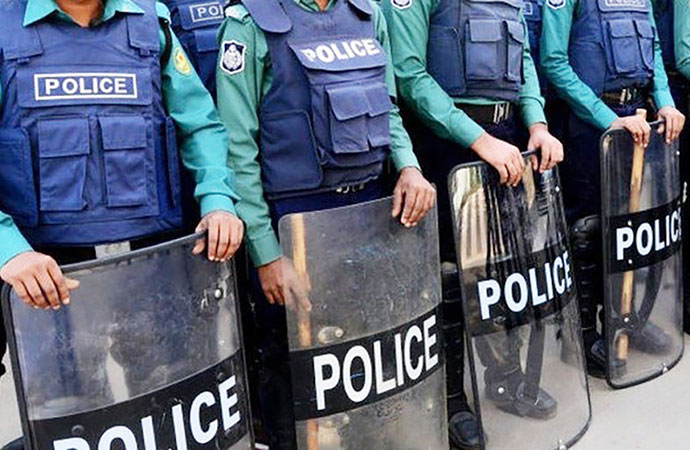
Photo: Collected
In writing about state institutions, political scientist Robert Reiner noted that in a democracy, the police is the state's primary legitimate expression of power. He thus argued for careful scrutiny and accountability of any state's policing institution.
The agenda for prioritizing a truly democratic reform of the police became imperative following the role of the police in the July Uprising of 2024. Among the estimated 1,000+ killings of citizens, the police were the primary perpetrators, with other armed forces and the Chhatra League following closely behind. After the regime was uprooted and the interim government was formed to reform state institutions damaged by 16 years of authoritarian rule, police reform became a matter of utmost importance to citizens.
According to the South Asian Institute of Policy and Governance (SIPG) at North South University, in 2015, public trust in the police was recorded at 45%. While this figure does not indicate an overwhelming level of confidence, it suggests a moderate level of public support for the police force, with nearly half of the population trusting its operations. By 2020, this number had slightly improved to 48%. However, despite this minor gain, the subsequent data from 2024 paints a starkly different picture. Trust in the police has plummeted to a mere 11.1%, a drastic reduction that indicates a severe crisis in public perception and confidence.
A Police Reform Commission headed by Safar Raj Hossain, a retired civil servant who was Home Affairs Secretary from 2003-7, was duly appointed. The Police Reform Commission's report presented 108 recommendations to transform Bangladesh's police into a transparent, accountable, and impartial institution. Key proposals included revising outdated laws, creating an independent commission, and enhancing police training and human rights practices.
However, police reforms were not discussed in the televised National Consensus Commission's sessions. This led to the impression that police reforms had been ditched, thanks to the opposition within the Home Ministry over the formation of an independent commission of police, even though it was made clear that police reforms would not be on the NCC's agenda since it won't require constitutional changes.
Badiul Alam Majumder, secretary of Shushashoner Jonno Nagorik (SHUJAN) and a member of the consensus commission, noted that political parties unanimously agreed to an independent police commission.
"However, this won't be a constitutional commission. Being a constitutional body does not guarantee independence. This has to be created through law," he said, pointing out that the home ministry dissented on the proposal.
Mohammed Iqbal, a member of the reform commission and former director general of the Department of Narcotics Control, said no conclusive recommendation on the formation of an independent police commission was made because of debate over the issue of its oversight.
"Some interpreted it [independence] as a commission that is out of the government executive branch. Fundamentally we agree that there should be an independent mechanism that will oversee police activities and how the state manages this institution. However, we cannot have a fully independent police commission outside of ministerial oversight," he said.
Hope at last
Against this backdrop, the news that the government has finalised a draft ordinance for forming an independent police commission, aiming to ensure accountability within the force and make policing fair, transparent, and free from undue influence, and would be looking to present it soon at the advisors' council, came almost as a surprise.
The draft Police Commission Ordinance 2025 gives the proposed commission authority to oversee promotions and postings.
Under the proposed law prepared by the Law Ministry, the president will appoint the inspector general of police (IGP) based on the commission's recommendation from a pool of three senior officers, each holding at least the rank of additional inspector general, for a two-year term.
The ordinance is expected to be placed before the advisory council soon, sources in the Law and Home Ministries said. If passed, it will take precedence over other related laws and give the commission broad powers to oversee discipline, integrity, and performance within the force, and recommend reforms in policing policies and practices.
The commission will also be able to recommend action against any person or entity found attempting to exert unlawful or undue influence over police activities.
It will also investigate citizen complaints against police members and take appropriate action, ensuring confidentiality of the complainants.
The commission will function as a self-governed statutory authority, entitled to acquire and manage property, and will have the power to sue. The commission can be sued as well.
In reply to a journalist's query, Home Adviser Lt Gen (retd) Jahangir Alam Chowdhury said he could not yet explain what benefits the commission would bring or how it would function. "Those details will be announced once the process is complete," he said.
Who will be on the Commission?
According to the draft, the commission will have seven members. The chairperson will be a retired Supreme Court judge, and the member secretary a retired police officer not below the rank of additional IGP.
Other members will include a retired district judge, a retired senior government officer, a retired head of the Police Academy or Police Staff College, a professor of law or criminology, and a human rights activist with at least 15 years of experience. At least two members must be women.
The chairperson and members will serve a four-year term and will not be eligible for reappointment.
Anyone declared bankrupt, a loan defaulter, a foreign citizen, dismissed for misconduct, convicted of a crime, declared of unsound mind will be ineligible to be part of the commission.
The president will appoint them on the recommendation of a seven-member selection committee led by a justice of the Appellate Division, nominated by the chief justice. Other members will include the chairperson of the National Human Rights Commission; two MPs, one from the ruling party and one from the opposition, from the parliamentary standing committee on home affairs; the chairpersons of the University Grants Commission and Public Service Commission; and a citizen representative nominated by the president with proven experience in human rights or governance.
The draft says the commission will help build a people-friendly, efficient and rights-compliant police force with integrity, free from political or bureaucratic interference.
It will frame policies and issue recommendations on recruitment, promotion, and posting. The commission will also advise on reforms, training, welfare, gender-friendly workplaces. It will also ensure mental and physical health support for police members.
The commission will monitor police activities to ensure those respect human rights. It will review investigations and prosecution practices, guide the use of technology and force, and hold regular public interactions to strengthen trust between the police and the public.
The commission will review existing laws and recommend amendments, if needed, and promote research on modern policing and good governance.
Police Accountability
The ordinance outlines procedures for receiving and resolving public complaints and internal police grievances.
According to the draft, the commission will investigate citizen complaints against police officers, determine responsibility, and recommend appropriate action to the relevant authorities. It will ensure the safety and confidentiality of complainants, review such cases quarterly, and issue directives to prevent misuse of power by the police. To ensure fair and timely handling of complaints nationwide, the commission will also establish divisional units to conduct inquiries and resolve cases.
Within three months of the commission's formation, the police must set up an internal system to handle complaints within 90 days. If a citizen still remains dissatisfied, they may appeal within 30 days to a divisional Police Accountability Unit, which will be led by a district judge and include a senior government officer and a human rights expert with at least 10 years of experience. The unit must resolve complaints within 60 days.
A Citizen Complaint Management Board, consisting of three commission members, will hear appeals against decisions made by the accountability units within 30 days. It will have the authority to initiate investigations, summon witnesses, and publish outcomes.
Similarly, a Police Grievance Redress Board will address complaints from police personnel regarding unfair treatment, transfers, promotions, or disciplinary actions.
The commission and its subordinate bodies will have the power to issue protection orders for complainants, witnesses, and whistleblowers. All authorities must implement the commission's directives within two months or face misconduct charges under service rules. Whistleblowers will be protected under the Public Interest Information Disclosure (Protection) Act, 2011.
The commission will coordinate with the Ombudsman and the National Human Rights Commission to prevent overlapping jurisdictions, according to the draft.
It will hold regular meetings, form expert committees, engage consultants, and arrange internships for law and criminology students with support from the finance division.
Each year, the commission will prepare an annual report detailing its activities, the state of law and order, and recommendations for reforms. The report will be submitted to the president within three months of the fiscal year's end. It will also be placed before parliament, and published online.
The commission's financial matters will be audited by the Office of the Comptroller and Auditor General.
This is not the first attempt to establish an independent police commission.
In 2007, the caretaker government proposed an 11-member body aiming to free the police from political control and ensure transparency in recruitment and promotions. The proposal, however, was never implemented due to bureaucratic resistance.
Earlier this year, the Police Reform Commission, in its report submitted to the chief adviser, recommended forming an 11-member police commission, led by a retired justice of the Appellate Division or a retired IGP, with the serving IGP as member secretary. Ut wasn't immediately clear why the Law Ministry deviated from the recommendation.
Most observers have cautiously welcomed the draft, calling it a positive step towards reforming the police, but others have argued we are still falling short.
Transparency's Intervention
Transparency International Bangladesh (TIB) has called on the government to comprehensively revise the draft Police Commission Ordinance, 2025, finalized by the interim government, to ensure the genuine independence and effectiveness of the long-awaited Independent Police Commission.
Based on a clause-by-clause review of the draft obtained from reliable sources, TIB has identified several issues that pose serious risks to the commission's independence and functionality, along with relevant recommendations for reform, according to a press release on Wednesday.
The organization warned that if left unaddressed, the ordinance could pave the way for government control over the commission and turn it into a workplace for former bureaucrats and police officials.
Although the draft has not been officially published by the government, TIB Executive Director Dr Iftekharuzzaman, referring to the version obtained from credible sources, pointed out risks regarding the composition of the selection committee and the commission, recruitment, and financial independence.
He said: "The proposed inclusion of one retired bureaucrat and two police officials among the seven members of the commission risks transforming the body into a center that rewards past loyalty and brings it under the control of the government's executive branch."
He added: "In line with international best practices, the provision allowing former or current bureaucrats and police officers to serve as members must be abolished. Instead, the commission should be composed of impartial experts in law, justice, law enforcement, human rights, and good governance, including university teachers and researchers."
Iftekharuzzaman also said: "To safeguard the commission's independence and effectiveness, the provision requiring government approval for staff recruitment must be abolished, and full authority over recruitment should be vested in the commission."
"Furthermore, appointments on deputation should be made only based on the commission's recommendation and approval, which must not exceed ten percent of total positions. If the government proposes the deputation of any public official and the commission disagrees, the commission's decision should prevail," he added.
Emphasizing the need to appoint individuals who have set a precedent of neutrality, human rights protection, honesty, and integrity in their professional lives, the TIB executive director said: "The provision allowing a retired police officer to serve as the member-secretary of the commission must be repealed, and the authority to recruit all staff, including the secretary, should rest entirely with the commission through an open and competitive process."
He added: "The ordinance should also stipulate that the secretary's rank and salary will be equivalent to that of a government secretary. In addition to serving as the commission's chief executive officer, the secretary should, by virtue of office, act as a non-voting member of the commission - a clause that would be logical to include."
He also said: "Furthermore, the ordinance must clearly specify how a citizen with proven experience in human rights protection and the promotion of good governance will be included as a member of the selection committee. TIB also calls for incorporating a provision requiring the public disclosure of the final list of all candidates recommended by the selection committee."
It is essential to include a clause granting the commission the authority to make necessary recommendations and provide guidance to the government for the formulation or amendment of laws, rules, and policies related to police operations, as well as security, intelligence, and surveillance agencies, in order to clarify professional standards and the scope of work and ensure human rights and sensitivity.
The statement further recommended including a clause requiring the government, within six months of the commission's establishment, to prepare and enact a modern Police Act-drawing on the positive elements of the long-shelved draft Police Ordinance 2007-to replace the colonial-era law.
To ensure financial independence and transparency, TIB demanded the inclusion of a clause stipulating that "the government shall ensure allocation of the budget requested by the commission, and the commission shall publish its annual audited expenditure report on its website within seven working days of submission."
A Independent Newsweekly
© Copyright 2026 | Designed by ARK Reepon & Developed by Cosmos Group Software Team





Leave a Comment
Recent Posts
Is the international community ...
A spate of downgraded economic projections, from Bretton Woods to Mani ...
A Childhood Lesson in Arithmet ...
As children, we learned a simple mathematical rule: if we know the pri ...
Indian authorities launched a major security crackdo ..
Police dispersed garment workers from the Azampur ro ..
Why Saudi Arabia has struggled to defend itself agai ..
Iran-backed Houthis strike Saudi oil company Aramco’ ..