


Reportage
Bank Looters Must Face Trial: Experts Warn Against Using Public Money to Bail Out Banks


An Independent Newsweekly




Reportage
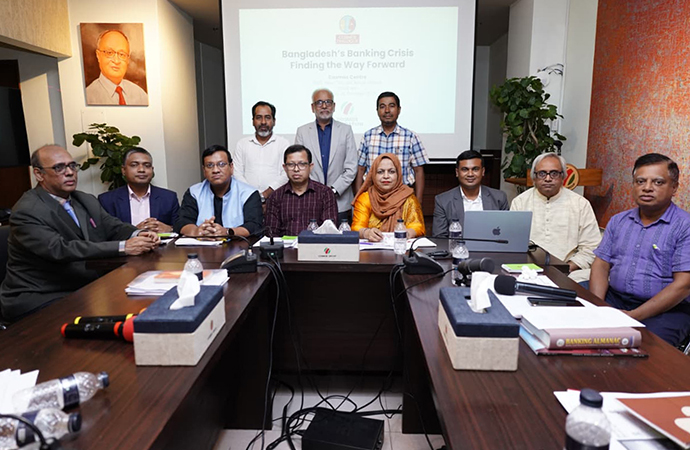
Photo: UNB
Bangladesh's banking sector is at a crossroads. Years of political interference, corruption, and mismanagement have left a trail of non-performing loans worth nearly Tk 5 lakh crore. Yet, as policymakers scramble to merge failing banks and inject billions of taxpayers' money, experts warn that the true culprits-the bank looters-remain largely unpunished.
At a seminar titled "Bangladesh's Banking Crisis: The Way Forward" on18 October, speakers stressed that genuine banking reform cannot succeed without accountability. The event, organised by the Cosmos Foundation with the United News of Bangladesh (UNB) as media partner, drew economists, bankers and policy analysts.
"The effort to recapitalise failing banks repeats a shameful history in which ordinary people paid for the failure of banks that were looted under political protection," said the seminar panel.
A Crisis Rooted in Politics and Corruption
Deputy Governor of Bangladesh Bank Nurun Nahar who spoke as chief guest, traced the sector's decline to 2017, when certain Islamic banks were taken over. She recalled that the situation before 2017 was relatively stable, and criticised the suppression of non-performing loan (NPL) data by banks to project false financial strength.
"Holding the bank looters accountable is undoubtedly central to the banking sector reform," Nahar said. She acknowledged the immense pressure on the central bank: "Yes, one could have resigned under political pressure-but could anyone guarantee that their successor would take the right decision? I don't know."
She warned that the central bank alone cannot shoulder the blame. Directors and management of commercial banks also played a role in the system's failures. Yet, she added, reforms are underway: the sector is regaining independence, ethical practices are being reinforced, and accountability mechanisms are strengthening.
Profits Should Rescue Banks, Not Public Funds
For Towfiqul Islam Khan, additional director at the Centre for Policy Dialogue (CPD), the crisis is "less technical and more political." He argued that unless the central bank is allowed to operate independently and bank looters are punished, crises will recur.
Towfiqul suggested an alternative to taxpayer-funded bailouts: use a portion of the central bank's profits. Last year, Bangladesh Bank earned Tk 22,000 crore-far exceeding the most profitable commercial bank, which reported Tk 700 crore. Similar profits were recorded in the two preceding years.
Merger Plans Under Fire
As the government has planned to merge five troubled banks, injecting Tk 20,000 crore from the national budget, the speaking sharply criticized the move arguing that it would ultimately rewards looters as they were going to be rewarded with taxpayers money.
Nehal Ahmed, professor at the Bangladesh Institute of Bank Management, and MGK Jewel, consultant at the Asian Development Bank, jointly presented the keynote paper, advocating for central bank independence from the finance ministry to adopt global best practices.
Citing examples from other countries, Professor Nehal Ahmed emphasised freeing the central bank from finance ministry influence to establish best practice in the financial sector.
Abdul Mannan, former executive director of Bangladesh Bank, traced the rise of defaulted loans from Tk 22,000 crore in 2008 to nearly Tk 5 lakh crore in 2024, blaming weak governance and intervention by state agencies.
Shahidul Islam Zahid, chairman of the Department of Banking and Insurance at Dhaka University, criticised banks for prioritising oligarchic interests over ordinary depositors.
Muhammad Mahboob Ali, professor of economics at Bangladesh University of Business and Technology, labelled Bangladesh's Islamic banking system "one of the worst in the world," and urged stronger depositor protection through insurance policies.
Salahuddin Bablu, director of Karmasangsthan Bank, questioned monetary policy decisions tied to the national budget, highlighting the failure of past bank mergers and the central bank's inability to curb inflation, which increased the burden on ordinary citizens.
A Path Forward
There are signs of recovery despite the bleak picture, said Bangladesh Bank's Deputy Governor Nurun Nahar, assuring that the depositors of the five banks due for merger, particularly those with deposits below Tk 2 lakh, would soon receive refunds.
Dr M Kamal Uddin Jasim, additional managing director of Islami Bank Bangladesh; Sheikh Md. Riyaz Uddin, first assistant vice president of Islami Bank Bangladesh; and business journalist Farhad Hossain Talukder were among the other prominent attendees.
The consensus was clear: reform is impossible without justice. "Unless bank looters are held accountable and the public is protected from paying for others' crimes, the cycle of crises will continue."
A Independent Newsweekly
© Copyright 2026 | Designed by ARK Reepon & Developed by Cosmos Group Software Team






Leave a Comment
Recent Posts
Is the international community ...
A spate of downgraded economic projections, from Bretton Woods to Mani ...
A Childhood Lesson in Arithmet ...
As children, we learned a simple mathematical rule: if we know the pri ...
Indian authorities launched a major security crackdo ..
Police dispersed garment workers from the Azampur ro ..
Why Saudi Arabia has struggled to defend itself agai ..
Iran-backed Houthis strike Saudi oil company Aramco’ ..