


Global
The Dollar's Twilight: Why Europe Must Act Before the Currency Wars Begin


An Independent Newsweekly




Global
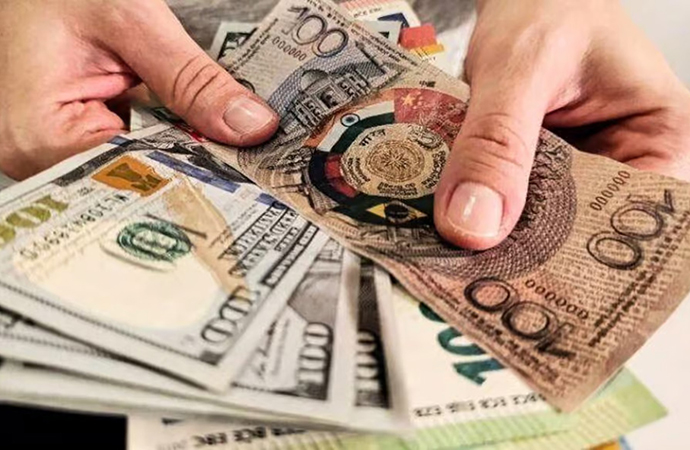
"The BRICS challenge to dollar dominance presents a once-in-a-generation opportunity for the pound and euro, if they're bold enough to seize it."
The Ground Shifts Beneath Our Feet
The old global monetary order is crumbling. For eight decades, the international monetary structure has supported international trade, but now it is undergoing a significant transformation. At the core of this shift stands an implausible coalition: the BRICS nations, which are now expanded and exercising their combined economic might akin to a pack of wolves encircling a helpless elk.
Currently, BRICS comprises ten full members, including the recent additions of Indonesia and Ethiopia. Representing roughly 45.8% of the global population, this expanded group commands approximately 35.6% of the world's GDP based on purchasing power parity, as reported by the IMF's 2024 Global Economic Outlook. Yet it is challenging for mere statistics to convey the substance of what historians will discern as a pivotal juncture, poised to redefine prevailing archetypes.
This constitutes the first substantive opposition to American monetary hegemony since the Bretton Woods system established the dollar on its throne.
Building the Alternative Arsenal
The BRICS nations are building the infrastructure to circumvent dollar-based systems. They have developed payment systems such as BRICS Pay, whilst probing the concept of a commodity-backed shared currency. The weaponisation of financial systems, as seen in the removal of Russia from SWIFT, has paradoxically further propelled the monetary rebellion.
Most recently, during the 2025 Moscow Financial Forum, BRICS introduced an exchange for precious metals using payments in gold, platinum, diamonds, and rare earth minerals. That would be a resource-backed setup outside of SWIFT and Western financial systems, considering their control of 72% of reserves with 12,500 tons of gold in existence.
The 2022 Triennial Central Bank Survey indicates a swift rise in the use of the Chinese yuan for trade settlements. In 2024, yuan-denominated trade settlements attained $7.4 trillion, up from $4.6 trillion in 2020. Meanwhile, other BRICS currencies have asserted themselves in cross-border transactions.
Yet even amidst these efforts to reduce the dollar hegemony, the UK and EU have remained curiously passive. Despite possessing the necessary pedigree, infrastructure, and credibility to challenge the dollar's dominance, the pound sterling and the euro seem content to assume a mere observing role during this pivotal shift.
Europe's Strategic Blindness
Europe's inaction is perplexing and perilous. Monetary transitions often manifest as detrimental separations for the global economy, inflicting adverse consequences upon all parties involved.
The USD became the reigning currency during and after World War II, superseding sterling as the world's principal reserve currency. However, this transformation did not happen overnight. It was realised only after a world war and Britain's financial depletion. Eichengreen's "Golden Fetters" (2019) shows that such transitions typically take decades, and the shift from sterling to dollar required almost thirty years.
The past is not merely prologue; after the Cold War, it presents another unique opportunity for British and European currencies to exert influence on the global order rather than adapting to its remnants.
The ECB's 2025 Economic Bulletin posits that rivals face significant hurdles in challenging dollar dominance, but this action tends to miss the forest for the trees. The BRICS assault is creating fractures in the system through which other currencies could flood.
Sterling's Renaissance and the Euro's Hidden Strength
The pound sterling is poised for a significant resurgence. While the euro is the world's second-largest reserve currency, the British pound offers a historical legacy of global financial leadership and unparalleled infrastructure. London's foreign exchange markets accounted for 43.1% of global daily turnover, processing $7.5 trillion daily (BIS, 2022).
Freed from European constraints, post-Brexit autonomy has fostered adaptability. The yuan is shackled by capital controls, while the ruble is crippled by geopolitical exile. Conversely, the Sterling epitomises market-driven capitalism with a firm foundation in the world's most sophisticated legal bedrock.
The euro, meanwhile, brings institutional gravitas and continental magnitude. Together, Sterling and Euro represent the might of democratic capitalism that BRICS currencies, for all their GDP, cannot replicate. Collectively, they could create a "third pole" in the multipolar monetary system.
Europe's Proven Track Record
In contrast to BRICS, Britain and Europe have already resolved many hurdles. The pound's centuries-old stability and the euro project's successful integration demonstrate that democratic nations can oversee sophisticated monetary systems.
The Bank of England's success in navigating the 2008 crisis and Brexit turbulence, alongside the ECB's crisis management, affords precisely the credibility that any contender currency requires.
London's financial markets provide the depth and liquidity that any reserve currency requires. City UK reported London managing $4.9 trillion in international banking assets, while processing 49% of global over-the-counter derivatives trading.
Although BRICS has proposed blockchain-based systems and commodity-backed currencies, they persist largely as theoretical constructs, untested by actual stress.
What Europe Must Do
What is absent in British and European leaders is vision, cohesion and political courage. They must acknowledge that this epoch is a rare historical juncture when established systems become susceptible to transformation.
A planned British-European synchronised response, collaboration between the Bank of England and ECB, establishment of digital currency infrastructure, and advocacy for sterling and euro in trade finance, could establish a strong position. Reuters' 2025 Currency Analytics indicates that both the pound and euro have strengthened substantially against the dollar in early 2025, with sterling gaining 8.3% and the euro appreciating 6.7%.
Failing to act would risk Britain and Europe remaining monetarily subservient for another generation, beholden to Washington's dictates. Properly leveraged, British and European currencies could emerge as the stable, democratic alternative that much of the world seeks.
A Moment of Truth
The BRICS nations have fired the starting gun in the endeavour to reconfigure the global monetary system. The question is whether the currencies of Britain and Europe possess the requisite political will and strategic vision to compete.
In monetary affairs, fortune favours the courageous. The old order is fading while a new one struggles to emerge. Britain and Europe must choose to be midwives to this emerging future or pallbearers for a past slipping away.
About the Author
Asif Amer is an international development strategist and diplomat dedicated to driving systemic change and social development, currently employed at the UK Government's Foreign, Commonwealth and Development Office (FCDO). With over ten years of experience, he has worked across Bangladesh, East Africa, and the wider Global South on sustainable and equitable development, strategic diplomacy, and cross-sector partnerships. His expertise includes development strategy and planning, policy innovation, social research, inclusive systems change, and implementing initiatives that empower marginalized communities.
A Independent Newsweekly
© Copyright 2026 | Designed by ARK Reepon & Developed by Cosmos Group Software Team






Leave a Comment
Recent Posts
Cancer coverage must go beyond ...
A newspaper story can be accurate, well-sourced and informative, yet s ...
The World Economy Is Swerving, ...
For decades, companies, investors, and policymakers operated on the co ...
A Future With Chinese Characteristics
From Gaza to Trump, the age of ‘Big Security’ is her ..
PM’s popularity cutting across party lines
Bridging Horizons: Singapore and Bangladesh find a s ..