


Featured 1
The most critical of reforms, and why it must wait

An Independent Newsweekly



Featured 1
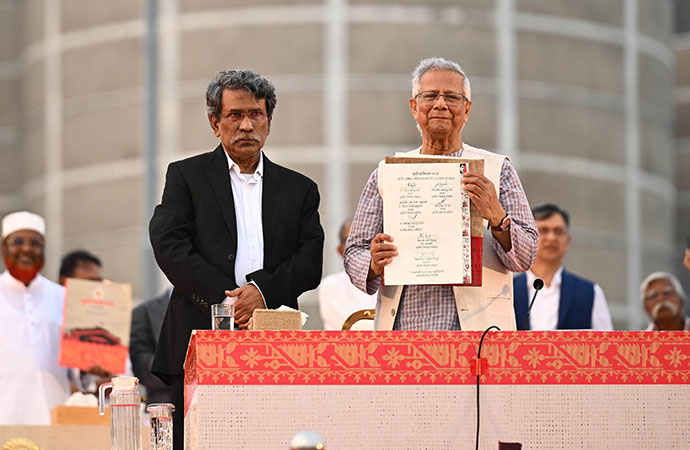
The July Charter, signed last week, is an important milestone in Bangladesh's journey post the Uprising of 2024, but some equally if not more important work has been taking place in the country's courts since August of last year. One that we have followed keenly in these pages throughout has been the movement of two petitions filed shortly after the Uprising that challenged the abolition of the caretaker government by the last regime.
That is because we maintain that fixing the utterly broken electoral mechanism in the country, so that the people can have their say, and elect who governs them, fairly and squarely at fixed intervals, was the change most necessary. That all that was wrong about the previous government flowed from the fatal intervention of the 15th Amendment (through which the caretaker system was scrapped). That nothing could be fixed, without a return to free and fair elections in the country, and for that it was absolutely crucial to reinstate the caretaker government system. All else, for better or for worse, will flow from this. Whatever the future holds, we shall own it.
Last December, delivering its judgement on the two petitions that were filed, the High Court scrapped a part of the 15th amendment to the constitution that abolished the non-partisan caretaker government system, and also restored the provision for holding referendums for bringing any amendment to the constitution.
On that day, the HC bench also said the Appellate Division of the Supreme Court will make the final decision about the restoration of the caretaker government system as review petitions on a verdict on the amendment are pending with the apex court. Those hearings commenced this week. Questions raised by Chief Justice Dr Syed Refaat Ahmed included whether restoring the caretaker government system would undermine the authority of the National Parliament.
During the hearing, the Chief Justice said the Appellate Division did not aim to provide a temporary solution by reinstating the caretaker government. Instead, it sought a long-term resolution regarding the election-time government to prevent repeated disruptions and ensure a lasting impact on democracy. He also asked when, if restored, the caretaker government system would take effect.
It is good that the Chief Justice is raising these important questions, because only through such a process can we restore the system in a manner that is both durable and bereft of questions.
Significantly, Dr Sharif Bhuiyan, representing Badilul Alam Majumdar, secretary of Shushashoner Jonno Nagorik (Shujan) who is one of the petitioners, urged the court to restore the caretaker government system and implement it from the 14th National Parliamentary Election - which is to say the one after the next one scheduled for February, that we all expect to be held under the interim government. Anything other than that would be too disruptive at this stage, and we must be mindful of that. The abolition of the caretaker government will stand as the biggest blight on democracy the country witnessed in the post-1991 period. But returning to it must wait, for the sake of the stability of the country.
A Independent Newsweekly
© Copyright 2026 | Designed by ARK Reepon & Developed by Cosmos Group Software Team




Leave a Comment
Recent Posts
Is the international community ...
A spate of downgraded economic projections, from Bretton Woods to Mani ...
A Childhood Lesson in Arithmet ...
As children, we learned a simple mathematical rule: if we know the pri ...
Indian authorities launched a major security crackdo ..
Police dispersed garment workers from the Azampur ro ..
Why Saudi Arabia has struggled to defend itself agai ..
Iran-backed Houthis strike Saudi oil company Aramco’ ..