


Column
When politics decides history: The case of 1971


An Independent Newsweekly




Column
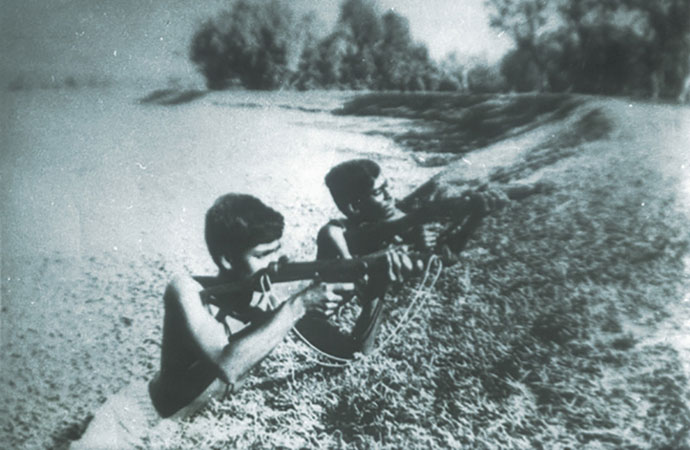
Photo: Collected
This year's 1971 as observed on Facebook, social media's most representative platform was fascinating, to say the least. I know it sounds cliché but it's the sheer variety of interpretations in 1971 that was puzzling. Just about everyone, almost all belonging to one political colour or banner, spelt out what they felt had happened ranging from denial to disdain to hate and glorification. And they had very little to do with facts.
Although the days went by darkened by the attempted murder of a political activist Hadi and the subsequent events that follow in all cases, the debates around 14th December, the day of the murder of Intellectuals as observed nationally was also a time to let out hate and claim and accuse various groups and clusters both internal and external but of course facts were not that much necessary. And such intense hate can't be produced by an already distant past but the present where many are trying to carve out a space for themselves.
It's only by reading Bangladesh's FB posts can one realize that 1971 history is well and truly alive and thriving and duplicating and multiplying every day to serve the many needs it serves. The most important one of course is that history may do many things including repeat itself but historical narratives can be born with each political need producing many histories where facts are little or not relevant at all.
In other words, as the once famed US political theoretician Francis Fukyama had said after the fall of the Soviet Union, "The end of history" had arrived. Sort of paraphrasing him we just need to add, that while histories may end but their children and grandchildren are born every next day. Bangladesh is literally the land of endless histories that breed like weeds on garbage dumps. And they need to be based on facts, which is the most critical point of them all.
When facts and political realities clash
2025 saw the full blown multiplicities and conflicts that exist among Bangladeshis about the nature, character and historical tradition of the State. The idea that all Bangladeshis are one when it comes to these issues is not true. Why they oppose is important but the monolithic concept doesn't exist about the nature and purpose of the State and they are rooted in multiple spaces.
The media has been very loud about December and 1971 this year but the essential tone is the same which is a conflict between the AL and the anti-AL groups as well as internally conflicting positions of the group members such as the Left.
AL doesn't have a branded formal media identity now in suspension so its missing but social media has many voices including those who would counter-attack the anti-AL position. In the end though it has been reduced to a discussion on the Jamaat's role and position and as claimed now by it and those contesting the same. Jamaat has of course benefitted by an environment that is less hostile to it as officially they are not being stigmatized as they would be under any AL regime.
BNP is of course silent as they have nothing to gain or lose by participating in this debate. In the end, it's about political power not historical facts displaying its enormous power.
When demonization and deification competes
Whether one dislikes social media or not, there can be no argument that it suits Bangladeshis best. It's a social place, an addakhana, which is of course universal but in Bangladesh it's the only space where one can safely utter any anecdote without having to be true. And that is so because it's driven by assumptions, prejudices, hate, passion, obsession and all together into production of tribal/cult instincts that has created a world driven by the desire to overcome the 'enemy' rather than produce claims based on historical facts.
The position held by various groups on 1971 history is not facts based but it doesn't need any facts to serve its purpose. And that is the kind of content that social media of Bangladesh thrives on. It is post factual and is part of the social discourse that wants to enter or be noticed by the Statist sources.
And this is an interesting equation because the social space is much stronger in comparison than the Statist space but a section has the aspiration to enter that. The problem is, the structural limitations of the State to accommodate more than a limited number and institutions given its capacity is limited. Hence the conflict within the status quo and the aspirant space is high. Historical narratives are part of it of course but facts necessarily don't have to play a role.
Bangladesh is close to producing complete historical narratives which don't need facts. And that's what makes it so significant. Its history which has liberated itself from facts. That's rare.
A Independent Newsweekly
© Copyright 2026 | Designed by ARK Reepon & Developed by Cosmos Group Software Team




Leave a Comment
Recent Posts
Is the international community ...
A spate of downgraded economic projections, from Bretton Woods to Mani ...
A Childhood Lesson in Arithmet ...
As children, we learned a simple mathematical rule: if we know the pri ...
Indian authorities launched a major security crackdo ..
Police dispersed garment workers from the Azampur ro ..
Why Saudi Arabia has struggled to defend itself agai ..
Iran-backed Houthis strike Saudi oil company Aramco’ ..