


Column
The Iran Endgame


An Independent Newsweekly


Column
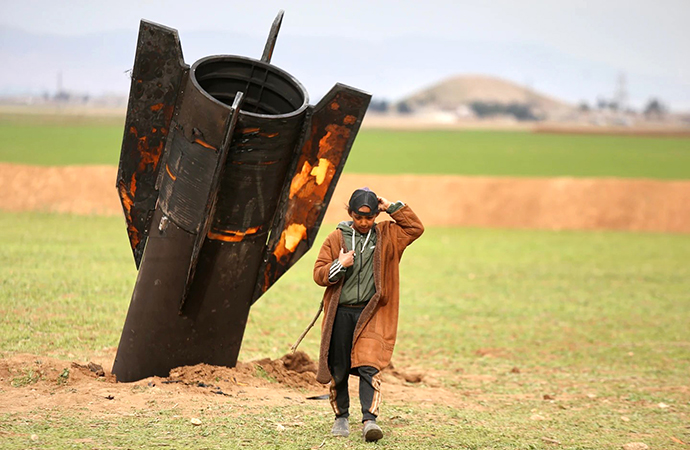
A shepherd boy walks away from an unexploded Iranian projectile that landed in an open field in the outskirts of Qamishli, eastern Syria, Wednesday, March 4, 2026. Photo: AP/UNB
No matter when and how the Iran war ends, its provenance is clear. This is a war between theocratic Iran, a confessional Islamic state; and secular Israel and America, two Western nations produced by the European Enlightenment that secularised Christian thought in Europe and beyond. This war may not have occurred without Shia Iran's biological hatred for Jewish Israel. Israel has not called for the destruction of the Iranian people; Iran has called for the eradication of the "Jewish entity" from the geography of the Middle East. Scriptural readings of contemporary international relations can go only so far, whichever the interpretations and the faiths involved. Nuclear weapons and ballistic missiles have no religion.
At the global level, Iran is not so important to either Russia or China that they will wage nuclear war with America over its assassination of Supreme Leader Ali Khamenei and its pursuit of regime change in Teheran. Israel, too, is not so important to America that Washington will invite self-destruction in a nuclear conflict with Moscow or Beijing over American support for Jerusalem's maximalist objectives in the Middle East. In the absence of regime change in Teheran, or the unlikely capitulation of Israel and America to Iranian interests and demands, the war will continue. Look at Ukraine. Wars are easy enough to start, but they are difficult to end.
What is occurring is that America's forward presence in the Middle East is being tested sorely. America is an offshore balancing power there. Its military bases in the region host its deterrent capacity as it seeks to keep the peace between Israel and Arab states. Certainly, the American alliance with Israel - anchored in a shared Judeo-Christian heritage - is intrinsic to America in a way that its relations with Arab Muslim states can never be. Those states understand this. However, the Sunni Arab states of the region, feeling threatened by Shia Persian Iran far more than by Jewish Israel, have looked to America for protection. Their oil wealth and consequent profile on the global stage have given the United States good reason to invest in their security.
Over the years, during which America-hating regimes such as those of Iraq and Libya have fallen by the strategic wayside, the US has come to be understood by regimes - and contested by dissidents - as the indispensable power, the default underwriter and guarantor, of the status quo in the Middle East.
It is that reputation that is under attack. Less-powerful nations trust in a security guarantor only so long as it can really underwrite their welfare. Wartime actions matter and not peacetime words and gestures. What is happening in this war is that Iran has no way of hitting the United States on its soil because Iranian missiles do not possess that reach. America, by contrast, is hitting Iran from forward American positions. Iran is hitting Israel, its regional attacker, but also the Sunni oil states that are not formally a part of the war but are implicated in it because of their hosting of American facilities.
These Arab states, which thought that they could depend on America, are now facing the unsettling consequences of their choice. From a global perspective, what is at stake is not the future of Iran - whether it wins or loses - but the future of America in the Middle East. Israel is involved in an existential fight for survival as a state, Iran in an existential fight for regime survival, but the Arab states are not involved in either of those ways. How much of Iranian punishment are they therefore willing to absorb to stay true to America's course in world affairs, which allows Israel to be so powerful? Will they decide to broaden their strategic horizons beyond the American-Israeli nexus and look to Russia or China or both in order to shore up their security beyond this conflict?
This war may well redraw the political map of the Middle East that has stayed in place essentially since the end of World War II. Also, how it ends will influence offshore America's staying power in other parts of the world. Nothing succeeds like success; nothing fails like failure. It is not the case that America will cease to be a global power any more than Israel will cease to be. It might be the case, however, that Russia and China will rise in Europe and Asia as default powers, with America consigned to its preferred sphere of dominance in the Western Hemisphere.
Who knows? The fog of war hides uncomfortable truths. But the fog disappears ultimately. Peace can be very uncomfortable as well.
The writer is Principal Research Fellow of the Cosmos Foundation. He may be reached at epaaropaar@gmail.com
A Independent Newsweekly
© Copyright 2026 | Designed by ARK Reepon & Developed by Cosmos Group Software Team






Leave a Comment
Recent Posts
Is the international community ...
A spate of downgraded economic projections, from Bretton Woods to Mani ...
A Childhood Lesson in Arithmet ...
As children, we learned a simple mathematical rule: if we know the pri ...
Indian authorities launched a major security crackdo ..
Police dispersed garment workers from the Azampur ro ..
Why Saudi Arabia has struggled to defend itself agai ..
Iran-backed Houthis strike Saudi oil company Aramco’ ..