


Column
The Goodness of Jane


An Independent Newsweekly





Column
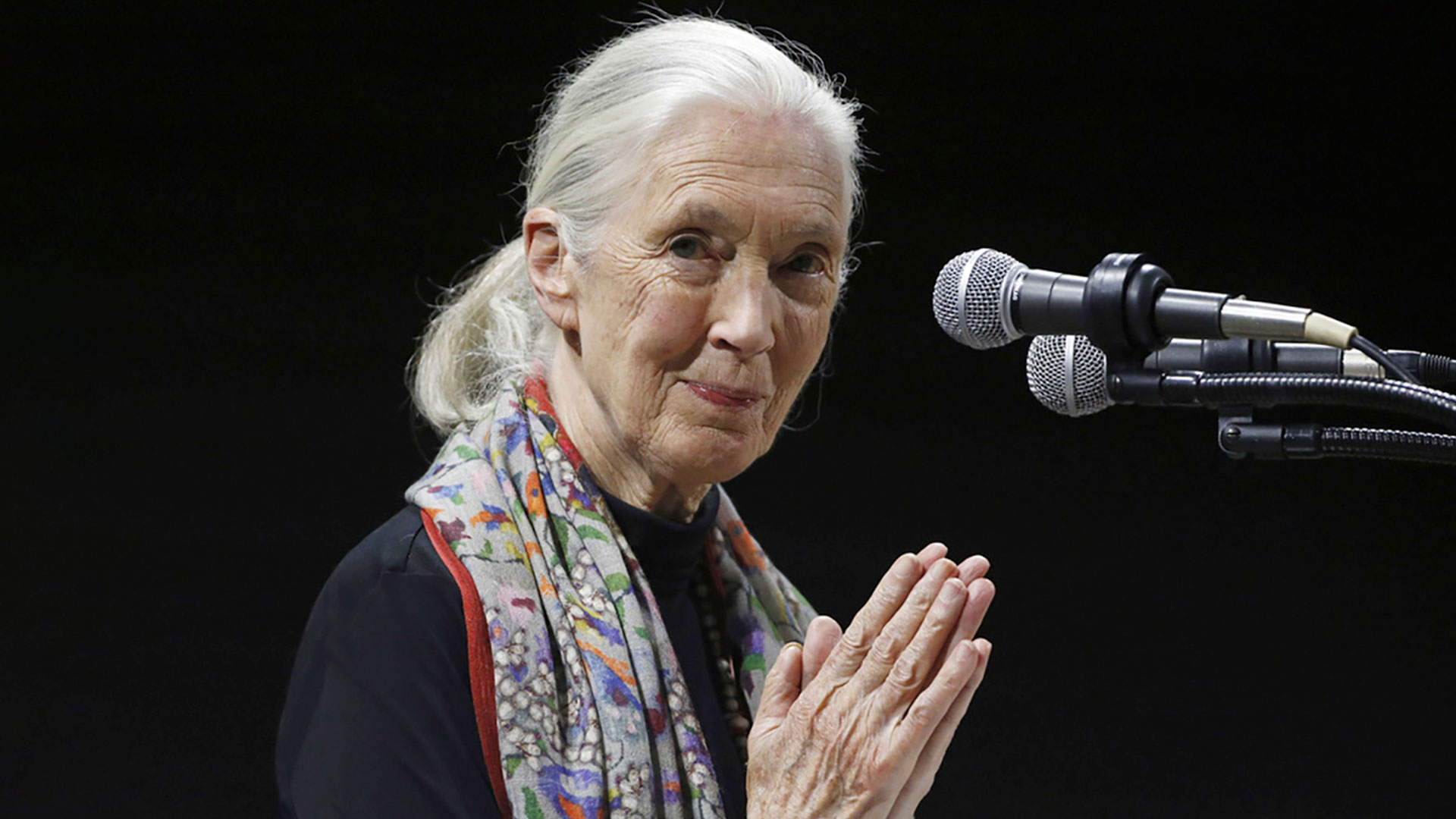
Primatologist and conservationist Jane Goodall delivers the 50th George Gamow Memorial Lecture at the University of Colorado. Photo: AP/UNB
The passing of the primate expert and wildlife advocate Jane Goodall last week reminded me of the words of the theoretical physicist and cosmologist Stephen Hawking: "We are just an advanced breed of monkeys on a minor planet of a very average star. But we can understand the Universe. That makes us something very special." In the spirit of Hawking's words, Goodall's work with chimpanzees and other great apes in Africa brought the world closer to a sense of its biological evolution and hence to its origins. Of course, it helped that she was a great ape herself, like the rest of us, but, unlike many of us, she recognised her affinity with chimpanzees, gorillas and other citizens of the animal kingdom and put her wisdom into practice in the human region of that sprawling kingdom.
Religious provenance and secular process do not have to contradict each other. The environmentalist Richard Attenborough was once asked about his belief in a divine Creator. He replied that when he had taken off the top of a termite hill, he had seen its inhabitants go about their jobs with the utmost sincerity, oblivious to the presence of a human watching them, because they were blind. Commensurately, as a human, Attenborough declared that he could well be deficient in possessing the sense organs that would alert him to the presence of a superior being. Clearly, his own deficiency could not logically mean that such a being did not exist. Attenborough's acknowledgement made him an iconic agnostic: a person willing to accept the possibility of what he does not know even as he holds on to the certainty of what he knows.
As an advanced breed of monkeys which can understand the Universe, humans can affirm the Creator's existence even as they affirm the biological chain of being that ties them most closely to their primate cousins. Goodall did just that. May her soul rest in a universal peace that embraces chimpanzees as much as it does humans.
The world paid tribute to her in words that echoed her sentiments for life. Among the best tributes, I think, were those from the actor and conservationist Leonardo DiCaprio and the environmental lawyer Farhana Yamin. DiCaprio wrote: "Her groundbreaking research on chimpanzees in Tanzania transformed our understanding of how our closest relatives live, socialise, and think - reminding us that we are deeply connected not only to chimpanzees and other great apes, but to all life." Yamin said that Goodall had "helped us understand apes but also ourselves. Thanks to her outstanding observations we know that language, love and caring are core parts of the more than human world and we don't own nature but are part of it". Former American President Barack Obama added a feminist dimension when he observed that "Jane Goodall had a remarkable ability to inspire us to connect with the natural wonders of our world, and her groundbreaking work on primates and the importance of conservation opened doors for generations of women in science".
Several themes are woven into these statements: nature (which requires conservation), animals (of which humans are a part, of course), femininity (which enables birth), and science (which testifies to the agency of reason in human imagination). Combine them, and we understand that life on earth is possible because of community.
This is an interesting word. One definition of it goes thus: "A community is a group of people linked by a shared characteristic, interest, or identity, residing in the same place or connected through shared virtual spaces, forming a social unit that provides a sense of belonging and shared action. These groups, which can be large or small, are crucial for socialisation, collective identity, and achieving common goals, influencing social norms and collective action within society." Keeping in mind that animals are people like us, it is possible to expand this definition to include the animal kingdom.
Indeed, "community" is etymologically linked to "communication" - the exchange of information and ideas within a community that fosters understanding and connection - and "communion", which is a deeper experience that emerges from communication, where (in one definition) "members achieve a profound sense of closeness, unity, and mutual belonging. In essence, communities communicate to build relationships, which in turn leads to communion, or a unified state of common understanding and shared existence".
Think of the nobility of those words. They testify to the value of Goodall's work. She communicated with chimpanzees to foster communion with people like us in an ecological community built on a shared sense of the possibilities of life on earth. She was a celebration of life itself.
How could we continue her work? Let us keep communicating with chimpanzees and other great apes, including humans; with dogs, cats and other kinds of non-great apes; and with saplings, plants and trees - all of which proclaim, in their diverse ways, the sublime beauty of a common life on earth.
That is what she did.
Goodness, Jane!
The writer is Principal Research Fellow of the Cosmos Foundation. He may be reached at epaaropaar@gmail.com
A Independent Newsweekly
© Copyright 2026 | Designed by ARK Reepon & Developed by Cosmos Group Software Team







Leave a Comment
Recent Posts
Is the international community ...
A spate of downgraded economic projections, from Bretton Woods to Mani ...
A Childhood Lesson in Arithmet ...
As children, we learned a simple mathematical rule: if we know the pri ...
Indian authorities launched a major security crackdo ..
Police dispersed garment workers from the Azampur ro ..
Why Saudi Arabia has struggled to defend itself agai ..
Iran-backed Houthis strike Saudi oil company Aramco’ ..