


Column
Media in the post-ideological era


An Independent Newsweekly
Column
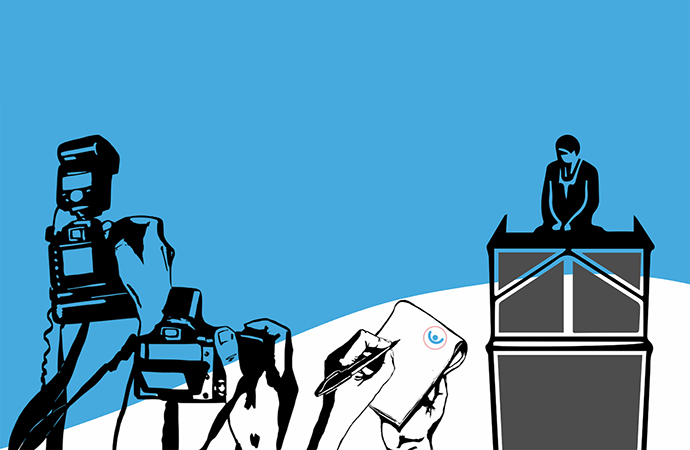
Image: Collected
Rarely has the media been as vilified in Bangladesh as they are now. At the same time, the media has also been upheld as a force of political change. Today, in many names, "partisan" journalism has moved from being frowned upon to being valorized and idealized as having independent agency to influence political processes. People who prefer to use the media space to support their noble causes are seen as 'media warriors" and idols of the consumer. And it is social media that determines the space and time of such judgmental ties.
Many such media persons are also very active on Facebook and other media platforms making distinctions among them irrelevant in most cases. No one knows where social media ends and professional media begins if there is such a construct as the last mentioned.
Both have become part of the same reality and the media itself has preferred to wither this distinction as the digital reality has put all under the same umbrella. More importantly, none can survive without a social media presence. And it's not a Bangladesh phenomenon, it's a global one. Honestly spoken, social mode dominates all the rest.
The concept of post ideological States
There are many factors that influenced the rise of new media apart from technology but it received a big spurt when global ideology as a force of deciding the means of production declined. It began with the death of the Soviet Union's socialist model.
It failed not because the state had run out of socialists or the arch enemy USA invaded and dismantled the system. It happened because the Soviet economic production model couldn't cope with the demands of efficiency that was required to sustain a centralized bureaucracy-run non-market model of governance.
China survived this threat by resorting to demand driven production models of the state and a variety of multiple ownership forms that evolved running from state ownership to private ownership to a series of hybrid entities in between. The state ownership model, no longer was seen as the only solution to economic needs management and China leapfrogged into the global players' main table.
All over the world State institutions were called into question and most failed to pass. This was not just in the economic space but elsewhere too. Even in the ideological space, the statist model cheered for a while claiming that the Western model had triumphed and such a historical search for the ideal governance model had come to an end.
It was known as "the End of History" model claiming that the Western model had won. However, history has shown that this didn't exactly win since to the ideological mind it was a competition between the "democratic vs socialist' model- but in reality it was a conflict between the efficient and the inefficient and the obvious won the battle. The death of history is no longer discussed.
The rise of the technological state
What the "end" of the ideological era did was increase focus on technology. It could also be a co-incidence but the rise of technology in the last few decades is obvious and the most significant marker of the global system. What this technological advance also did was establish a "global "system particularly in communication which of course includes the media. While ownership till date belongs largely to the traditionally more early players in global economics that is the West, the participants are truly global , that is from everywhere. The digital economy is here and now looks forward to the AI economy next as ideologues are even less needed.
Consumption, market response and social media
The rise of social media was possible because of technology responsive to the needs of the market. The information system since birth had been more focused on the contents rather than form leading to the issue of creating pressure groups outside the media.
However, as global productivity grew, the response mechanisms needed upgrading and the market opportunities for social media grew too. As a new market space increased, it made the need for making higher investment in the sector necessary. This led to many major developments which we see particularly in media technology. Thus social media is not just about expressing opinions but selling goods too in the form of opinions as well. It's basically a market monitor and responds to demands and supplies accordingly.
And in Bangladesh?
The situation in Bangladesh is that of a basically inefficient state unable to deal with the formal structure for the development and regulation of economic activities. Hence the market situation is disorganized and not system based. Over the years it developed a crony capitalism scenario which like all such structures is built without efficiency as a component. Although not expected but always inevitable, this inefficient market system also produced internal competition and ultimately conflict leading to several regime changes over the years as well.
Thus the functional utility of social media in providing quality information also depends on the general quality of informational goods that exist in the media market. If the general media /professional media products are not of quality than the chances of the response mechanism being efficient will also be less.
One of the reasons why social media is so abrasive is because professional media is also so. And professional media is also so because the market doesn't demand efficiency and competition on the basis of goods but only ownership -read crony- clusters. And the state is a party to that, each regime promoting such clusters which needs aggressive protection duty which includes not just abuse but bias and subjectivity as well.
As a low efficiency low-productivity value addition, not creation driven internal market and export and most workforce employed either by foreign governments or the informal sector, the chances of quality media emerging doesn't exist.
A Independent Newsweekly
© Copyright 2026 | Designed by ARK Reepon & Developed by Cosmos Group Software Team




Leave a Comment
Recent Posts
Cancer coverage must go beyond ...
A newspaper story can be accurate, well-sourced and informative, yet s ...
The World Economy Is Swerving, ...
For decades, companies, investors, and policymakers operated on the co ...
A Future With Chinese Characteristics
From Gaza to Trump, the age of ‘Big Security’ is her ..
PM’s popularity cutting across party lines
Bridging Horizons: Singapore and Bangladesh find a s ..