


Column
An Australian Lesson


An Independent Newsweekly



Column
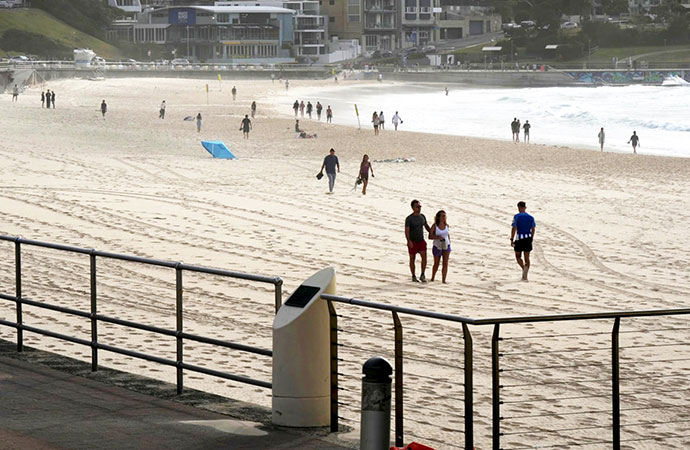
People walk along Sydney’s Bondi Beach a day after a mass shooting Monday, Dec. 15,2025. Photo: AP/UNB
Some time after the terror attack in Sydney's Bondi Beach in December, I called an Australian friend to ask what had gone wrong in his country. This friend, an environmental journalist whose work and concerns span Australia, Indonesia and Singapore, is a universalist to the core of his Australian heart. That is to say, he contextualises his national experience globally in order to define it. Thus, he believes in the essential goodness of the Australian people because he knows the essential goodness of people in Indonesia and Singapore. Equally, he fears the capability of Australia's worst because he understands the intentions of the world's worst.
The Earth rotates around the Sun without and around the ideas, habits and predilections of its best and its worst within, with the majority of earthlings lying uncomfortably in between human extremes. My friend excels in making ecological sense of the laws of the physical world. He is attuned as well to the ways of the sentient beings who make or break the laws of the social world.
Every environmentalist knows this quotation from Catherine McKenzie's book, "Fractured": "They say that if a butterfly flaps its wings in the Amazonian rain forest, it can change the weather half a world away. Chaos theory. What it means is that everything that happens in this moment is an accumulation of everything that's come before it. Every breath. Every thought. There is no innocent action. Some actions end up having the force of a tempest. Their impact cannot be missed. Others are the blink of an eye. Passing by unnoticed."
The Bondi attack did not pass by unnoticed, and it should not have done so. The 15 innocent Jews (including a girl child) who lost their lives at a community celebration, the many more Jews who were injured, and the general shock felt by a multireligious citizenry - all these pointed to the evil designs of an immigrant Muslim father and his son who chose to break the very Australian law whose secular protection they had enjoyed all along.
My friend, of Irish ancestry to whom Australia is a multi-generational home, acknowledged the vicious power of imported ideas over the domestic mentally-impressionable: Radicalised by Islamic State's global propaganda, the father-son duo had perpetrated an act of unforgivable terror on the Australian people who lived metaphorically next door. The media mentioned hate speeches made freely by questionable speakers at some mosques in this disquieting context. However, my friend - who I imagine is a Christian, although I never enquire into such details in my journalistic line of work - drew my attention to the way in which some Jewish and Christian groups in Australia, too, seek to consolidate their hold on the faithful through exclusivist teachings. That said, Judaism, Christianity and Islam are not at fault as religions: Criminal responsibility lies firmly at the doors of those who would turn faith into violence.
My friend put it this way: "All cultures, all faiths must feel that the laws of Australia apply fairly to everyone in the nation and that no faith or culture should feel vulnerable like people of the Jewish faith have been."
We spoke as well of the access to guns that had allowed the father and his son to carry out the attack. I agree with my friend completely: Legal public gun ownership has to be regulated intensely with a clear eye to its consequences. Those living in rural Australia need guns to keep predatory animals at bay: Urban Australians possess no such excuse. Sydney is Australia's most iconic city. Whatever do gun clubs in cities have to do with feral animals in the countryside?
Looking for more material on the international context of the national terror attack in Sydney, I chanced upon an excellent article written by Steve Killelea AM, Founder and Executive Chairman of the Institute for Economics and Peace. He makes the important point that "even societies considered among the world's most peaceful are not immune to sudden, devastating violence". The Bondi attack, he writes, "reflects a broader global trend: the rise of small-cell terrorism, in which two or a handful of individuals radicalise together, often within close social circles. These groups draw their inspiration not from formal extremist organisations, but from online ecosystems that merge personal grievance, ideological narratives and global conflict imagery."
Those ecosystems reflect in turn what the writer calls the Great Fragmentation: "a world where trust - between countries, communities and institutions - is breaking down. Our mechanisms for cooperation are weakening at the very moment when collective challenges such as climate change, economic inequality, mass displacement and rapid technological disruption require unprecedented collaboration. When these pressures converge, violence becomes more likely, whether in conflicts abroad or in violent incidents at home". Tellingly, the world "is entering its most fragile period for international consensus since the end of the Second World War... global peacefulness has declined in 13 of the past 15 years. There are now more active conflicts than at any time since the Cold War".
This is where arms come in. The writer cites evidence to reveal "the ease of access to small arms and light weapons. The proliferation is staggering: more than one billion firearms are in circulation globally, of which around 85 per cent are held by civilians. Access to weapons does not automatically lead to violence, but it heightens the potential for it".
Yes, because weapons "amplify the environment in which they exist. In cohesive societies with strong institutions, risk is contained simply by the social cohesion of society. In fragmented societies, the same weapons can turn local tensions into mass-casualty events". However, even in cohesive, law-abiding societies such as Australia, all it takes a father-and-son duo to try and break the social contract is access to weapons. That is all.
Australia is a country of the global heart: People all over want to live there. But the government must do much, much more to ensure that foreigners' Australian Dream does not turn into natives' Australian Nightmare.
Keep one eye on guns. Keep the other eye on thoughts. Thoughts cannot be policed, but their consequences can.
The writer is Principal Research Fellow of the Cosmos Foundation. He may be reached at epaaropaar@gmail.com
A Independent Newsweekly
© Copyright 2026 | Designed by ARK Reepon & Developed by Cosmos Group Software Team




Leave a Comment
Recent Posts
Is the international community ...
A spate of downgraded economic projections, from Bretton Woods to Mani ...
A Childhood Lesson in Arithmet ...
As children, we learned a simple mathematical rule: if we know the pri ...
Indian authorities launched a major security crackdo ..
Police dispersed garment workers from the Azampur ro ..
Why Saudi Arabia has struggled to defend itself agai ..
Iran-backed Houthis strike Saudi oil company Aramco’ ..