


Business
Is the Iran War America’s Suez or Its Gallipoli?


An Independent Newsweekly




Business
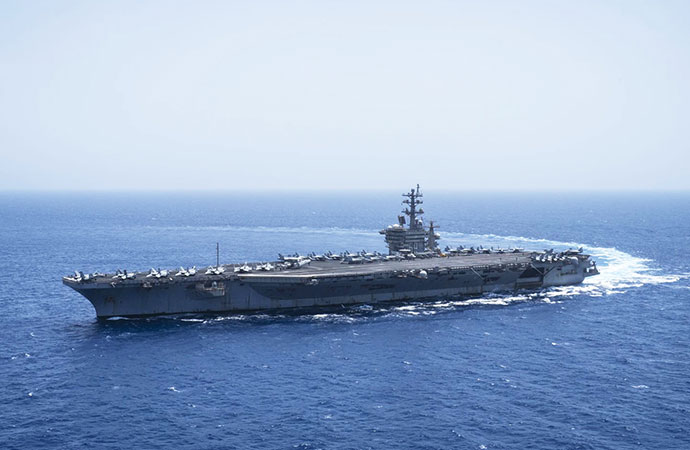
Photo: AP/UNB
The Iran war is not America’s "Suez moment," but it may well turn out to be America’s Gallipoli moment. It was there, in 1915, that the British Empire overreached disastrously—underestimating the tenacity of a decadent regime, overestimating its own military capacity, and demonstrating stupendous strategic confusion.
When Egypt closed the Suez Canal for five months in 1956, it triggered events that shrunk the global standing of Britain's pound sterling, inaugurated the petrodollar age, and demonstrated how a small country can inflict serious damage upon the economic power that had subjugated it decades earlier.
Some argue that the United States is now facing its own Suez moment. While this is a facile take on the financial impact of the closure of the Strait of Hormuz, so is the nonchalance with which some assume the dollar's hegemony to be impervious to President Donald Trump's Iran war blunder.
The similarities between Iran's actions and the Suez Crisis are deceptive. True, Egypt and Iran both choked off oil supplies by closing down a waterway under their control. Energy prices rose sharply in the hegemons' economies. Financial markets suffered, and so did the poorest, who always bear a disproportionate share of cost hikes for fertilizer and transport. But several fundamental differences suggest that Hormuz will not be for the US what Suez was for Britain.
Suez merely confirmed Britain's bankruptcy, the result of precise and intentional acts 11 years earlier by the emerging American hegemon. In December 1945, the US roped Britain into a paid-for loan that rolled over Britain's wartime debts. Britain's insolvency was sealed. All Suez did was to confirm that a bankrupt former empire could no longer project imperial power. The US, in contrast, is nowhere near such a state of disrepair, despite Trump's incompetence and reckless governance.
Though there is much consternation about US bond yields, against the backdrop of spiraling federal deficits and debts, any comparison with Britain's fiscal stress in 1956 is beside the point. The British Empire never succeeded in establishing sterling's exorbitant privilege-the remarkable power of the US to ensure that its deficits are paid for by massive capital inflows that are the flipside of America's massive trade imbalance with the rest of the world.
Today, non-Americans require around $1 trillion annually to buy oil from non-Americans-roughly the size of the 2026 US defense budget. They must sell goods and services to the rest of the world to earn dollars to buy their energy, raw materials, and US weapons. The US, unlike everyone else, prints the dollars that others need to buy all the stuff they want and need-and then passes the borrowing costs on to foreigners. Add to this the $100 trillion of outstanding dollar-denominated global debt, and we get a fuller picture of America's enduring inordinate privileges. Britain never had them.
Likewise, though rising gasoline prices are inflicting pain on the majority of Americans, the US does not need oil from the Gulf to keep its gas stations open. This was not true of Britain in 1956, which needed the oil coming through the Suez Canal for its own energy as well as to keep a respectable share of foreign transactions denominated in sterling.
It's a similar story with the two countries' banking systems. The Suez Crisis dented the City of London's earnings severely. Seventy years later, Wall Street banks are reporting trading revenues of more than $40 billion for the first quarter-profiting massively, along with the rest of corporate America, from the volatility in financial markets caused largely by Trump's adventurism. The fact that most Americans suffer terribly is irrelevant in a world where American hegemony and the wealth of America's ruling class are inversely related to its citizens' well-being-which, ironically, is the contradiction that fueled Trump's rise to the presidency.
While the closure of the Strait of Hormuz does not signal the end of the petrodollar system's dominance, it does point to the structural changes necessary for a transition away from American hegemony.
Consider Pakistan, whose military government is basking in the glow of having emerged as a key intermediary between Trump and the Iranian regime. For a while now, Pakistan has been shifting its industrial base from a petro-economy to an electro-economy reliant on renminbi-denominated Chinese solar panels. Other Asian and African countries are following suit, eroding the US hydrocarbon-dollar complex. This development is a bigger problem for the US than the trickle of oil transactions (such as sales of Iranian or Russian oil) denominated in renminbi rather than dollars.
Then there is the Ukraine effect. By sequestering Russian assets of almost $300 billion and instantaneously severing the country's access to the circuits of global finance, the US inadvertently sent a signal to the rest of the world: "Today it was the Russians, tomorrow it could be any of you!" The message was received loud and clear by oligarchs not only in countries inimical to the US but also in Saudi Arabia, various emirates, Indonesia, Malaysia, and even Ukraine.
Almost immediately, they began to seek hedging strategies. It was then that they focused on the technologically brilliant but barely used payments infrastructure that China had assembled: its central bank digital currency, its constantly upgraded Cross-border Interbank Payment System, the blockchain-based BRICS Pay (an alternative to the clunky SWIFT messaging system), and even WeChat.
None of these developments spell the dollar's decline per se. Indeed, several BRICS+ countries increased their dollar reserves while also dallying in non-dollar payment and debt-raising schemes. But taken together, these developments, boosted by the Hormuz double blockade, foreshadow the rise of an alternative financial architecture that is not controlled by the US and in which Europe is spectacularly irrelevant.
So, while the Iran war is not America's Suez moment, it may well turn out to be America's Gallipoli moment. It was on that peninsula in the Dardanelles where, in 1915, the British Empire overreached disastrously-underestimating the tenacity of a weakened regime, overestimating its own military capacity, and demonstrating stupendous strategic confusion. Sound familiar?
From Project Syndicate
A Independent Newsweekly
© Copyright 2026 | Designed by ARK Reepon & Developed by Cosmos Group Software Team




Leave a Comment
Recent Posts
A commendable intervention by ...
A struggle for local dominance in the Chittagong Hill Tracts, specific ...
How close is the Amazon to a ‘ ...
While Brazil’s presidential candidates have not made policy of t ...
Another shipment of highly radioactive uranium fuel
Harmony: Diplomatic community joins Durga Puja celeb ..
What to know about the Ebola outbreak that has sprea ..
Brazil election: Trump’s ‘Donroe Doctrine’ faces its ..