


Reportage
Beijing seeks joint efforts to boost renewable energy cooperation with Dhaka


An Independent Newsweekly


Reportage
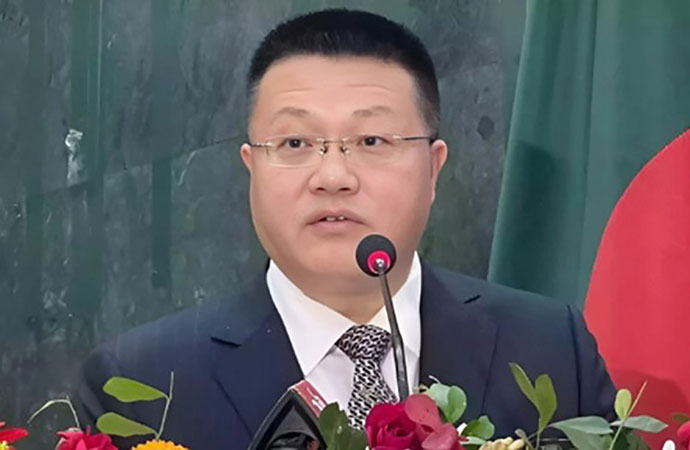
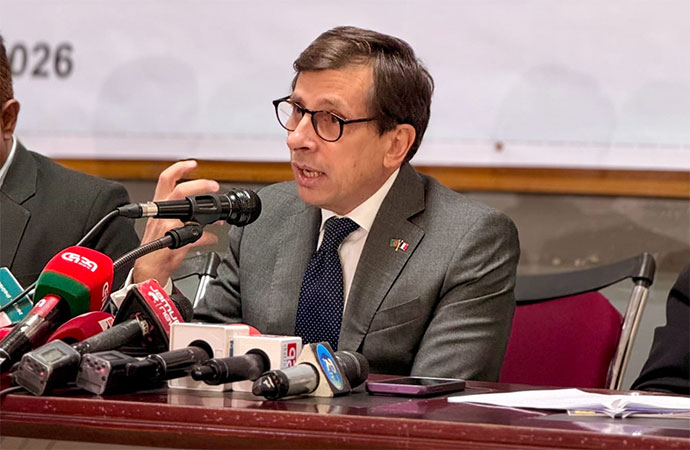
Chinese Ambassador to Bangladesh Yao Wen. Photo: Courtesy
China ready to scale up investment support through diversified channels, says Ambassador Yao
Chinese Ambassador to Bangladesh Yao Wen on Monday laid emphasis on joint efforts to strengthen renewable energy cooperation and set a certain exemplary model for green development under the Belt and Road Initiative (BRI).
"I'm confident that with joint efforts, China-Bangladesh renewable energy cooperation will yield more fruitful results and a certain exemplary model for green development under the BRI," he said while speaking at the 4th Bangladesh-China Renewable Energy Forum in the city.
Power, Energy and Mineral Resources Minister Iqbal Hassan Mahmood spoke as the chief guest at the Forum organised by the Centre for Policy Dialogue (CPD).
Executive Chairman of the Bangladesh Investment Development Authority (BIDA) Chowdhury Ashik Mahmud Bin Harun spoke as a special guest at the event moderated by CPD Research Director Dr Khondaker Golam Moazzem.
The Ambassador highlighted the importance of working together to deliver tangible benefits to the people through practical cooperation, contribute to addressing global climate change, and build a community with a shared future for both countries.
Ambassador Yao said it is high time for Bangladesh to really move to renewable energy. "It is also high time for China and Bangladesh to work together in this sector."
The Chinese envoy said they all know what is happening in the Middle East while they see some diplomatic efforts. "But no one knows when the conflict will be over and when the supply of oil and gas will be resumed."
He said the government of Bangladesh has already taken many initiatives to come to the rescue and to relieve the difficulties faced by the people, factories and businesspeople. "They have done everything possible. They also asked for China's help. We also do whatever we could."
The Ambassador, however, said it is just a short respite effort and if Bangladesh really wants to get rid of this, there needs to be a systematic solution. "And China will be part of it."
Looking forward, the Ambassador said China is ready to deepen cooperation and scale up investment and financial support through diversified financial channels.
He said China will provide long-term, stable and preferential financial support for key renewable energy projects in Bangladesh.
The Bangladesh-China Renewable Energy Forum has, over the past editions, emerged as an important policy dialogue platform bringing together key stakeholders from government, private sector, development partners, and international investors, particularly from China.
The initiative is aimed at fostering mutual understanding, strengthening cooperation, and facilitating informed dialogue on Bangladesh's renewable energy transition.
Developing renewable energy is not only a strategic choice for Bangladesh to ensure energy security and strengthen export competitiveness, but also a priority area for Bangladesh-China cooperation that echoes the times and serves the well-being of both peoples, said Ambassador Yao.
He said China stands ready to work with Bangladesh to deepen the comprehensive strategic cooperative partnership through renewable energy cooperation, and support Bangladesh in realising its vision of national prosperity and sustainable development.
According to International Energy Agency data, global energy investment reached 3.3 trillion US dollars in 2025, among which 2.2 trillion US dollars are invested in clean energy.
Over the past decade, China's share in global clean energy investment has risen from 25% to nearly 33%.
Three Strategic Implications
Boasting of the world's largest installed solar and wind power capacity, prominent full-chain cost advantages and a sound policy framework, Ambassador Yao said China has forged a distinctive path of energy transition and is willing to share experience and development opportunities with Bangladesh.
Recently, the ongoing Middle East conflicts have intensified global energy market volatility and supply chain risks, posing severe challenges to global energy security.
The envoy said Bangladesh is highly reliant on imported fossil fuels, with a high proportion of oil and gas consumption and low renewable energy penetration.
Accelerating energy transition is not only an urgent task, but also embraces broad prospects and huge potential, he said.
Ambassador Yao said renewable energy development carries three 'strategic implications' for Bangladesh.
First, to safeguard national energy security, reduce reliance on fossil fuel imports, hedge against global price fluctuations, and enhance economic resilience.
Second, to sharpen core export competitiveness, help pillar industries such as textiles and garments meet international green supply chain standards, stabilise global market shares, and drive industrial upgrading.
Third, to advance green and low-carbon development, boost employment, attract foreign investment, foster the domestic clean energy industry, and advance carbon neutrality and sustainable development goals.
The Ambassador said China-Bangladesh renewable energy cooperation boasts of solid foundations and fruitful outcomes.
Areas of Future Cooperation
First, the Ambassador highlighted the importance of strengthening policy coordination and experience sharing.
"Having gradually shifted from feed-in tariff subsidies to grid parity, China has established an effective policy system for the photovoltaic industry," he said, noting that China is ready to assist Bangladesh in improving electricity pricing mechanisms and power purchase agreements, and shore up long-term investment confidence through stable policy expectations.
Secondly, he talked about deepening industrial and technological collaboration.
"As the world's leading manufacturer of photovoltaic modules and wind power equipment, China delivers cost-effective and highly adaptable products that can substantially lower construction costs in Bangladesh," Ambassador Yao said.
He said Chinese enterprises are ready to jointly build assembly lines for photovoltaic modules and energy storage batteries, promote technology transfer, talent training and local manufacturing, so as to cut import dependence and create jobs.
Highlighting the importance of boosting investment and financing support, the Ambassador said they will also assist Bangladesh in cooperating with multilateral institutions including the IMF, the World Bank and the ADB, to improve project bankability and attractiveness, and effectively address funding bottlenecks in energy transition.
"As developing nations with similar development priorities, China and Bangladesh enjoy enormous room for cooperation," said Ambassador Yao.
He said China always respects Bangladesh's development path and energy strategy, upholds win-win cooperation with no political strings attached, and remains a reliable development partner for Bangladesh.
A Independent Newsweekly
© Copyright 2026 | Designed by ARK Reepon & Developed by Cosmos Group Software Team





Leave a Comment
Recent Posts
A commendable intervention by ...
A struggle for local dominance in the Chittagong Hill Tracts, specific ...
How close is the Amazon to a ‘ ...
While Brazil’s presidential candidates have not made policy of t ...
Another shipment of highly radioactive uranium fuel
Harmony: Diplomatic community joins Durga Puja celeb ..
What to know about the Ebola outbreak that has sprea ..
Brazil election: Trump’s ‘Donroe Doctrine’ faces its ..