


Column
We know about the “Deep State” but what is the “deep shit “theory?


An Independent Newsweekly






Column
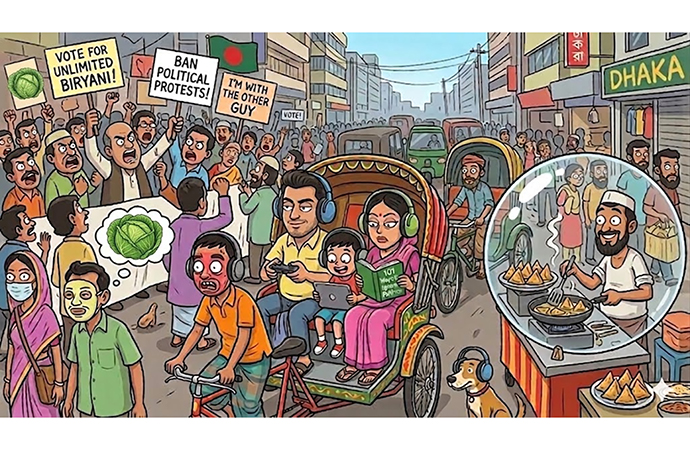
AI generated image
The term "deep state" which is being bandied about a lot recently is of Turkish origin. It comes from the term "derin devlet" which means 'deep state' in that language. It grew after the establishment of republican political rule replacing the Ottoman empire in the early 1920s.
In reality, this rule of President Kemal Ataturk -after whom our local Banani has an avenue named, in case you are wondering who he is, was the "dad" of modern Turkey.
In his time, power in reality belonged to a small group of people largely made up of a "network of military, intelligence, and bureaucratic elements operating independently of elected officials to maintain a particular ideological or political status quo." People in front were there but didn't have the final word on matters. That belonged to the "Derin Devlet", hence the "Deep State" connotation.
This was 1923-24 and today everyone knows that behind every visible power structure lies a series or groups of powerful elements not publicly visible. Since then its not seriously discussed but taken as obvious. But its true , its more discussed in places where the state system is rather weak or withered.
However, beyond conspiracy theories involving the "deep state" which is now rather routine as mentioned, other theories are making the rounds in the western world where some of the deep state is actually anchored according to most.
Recently, -that means a decade or so- one term that may seem odd to all has an interesting angle but does draw attention. It's called the - Deep Shit" theory of the state and politics. Yep, you heard it right... but what is it?
The "Deep Shit" Perspective
Deep shit" as an idea can be interpreted as an acknowledgement of the existential crisis and dysfunctional systems producing chaotic governance noises independent of whichever political party is in power. It is about a state of deep, structural chaos not a temporary political party-based crisis.
"Deep Shit", Bull shit etc
In real life aside from politics "deep shit" or "big shit" means being in serious trouble and getting out of which is not easy. In political theory made popular by Harry Frankfurt of Princeton university, it means the fundamental mechanisms-whether economic, environmental, or social-are deeply dysfunctional. This is a situation where partisan debate (e.g., "right" vs. "left") is irrelevant because the foundational structure is failing.
It also means that the quality of public discourse is so meaningless that philosopher Harry Frankfurt called it "Bullshit" which is - "communication without regard for the truth".
This happens not because of a political party has failed but a systemic failure has taken place that makes it impossible for people to identify facts that matter and act on them.
That is why it's sometimes called the "Deep Shit" is a Crisis: When no one can do anything or wants to do anything. Or even knows what is going on.
The "involvement in politics" argument
Some argue that no one can be "apolitical" and refusing to take a side itself is a political decision. That this actually upholds the status quo.
The pro-political theorists say that refusing to get involved arguing that "everything is in deep shit" can be viewed as a decision of the "lazy or privileged" because the person can afford not to be involved. They are not immediately threatened by the outcomes of "deep shit".
The counter argument is that a group benefits from "deep shit" and everyone's involvement justifies its continuation through large scale stake holding. Thus, involvement in "deep shit" actually normalises and sustains it.
In essence, "deep shit" is a concept that recognises that the world is in a deeply chaotic or broken state, where the traditional, superficial, or partisan political solutions are insufficient to address the core problem.
Fundamentally, it refers to the fundamental, messy, and often inescapable facts about how systems function, regardless of who is in power.
It's the realisation that certain issues-like systemic inefficiencies or the tragedy of the systems-exist as structural problems, not just "the other side's" fault.
Philosophical Perspectives
Many argue that non- politicism isn't about laziness because it can be a deliberate philosophical choice to focus on what lies beneath the politics.
It's an attempt to move away from partisan positions to a focus on substance, feasibility, and sustained human capital at work.
Many scholars particularly those studying large multi-national models supported by mathematical tools, say that much of the argument for politics has less validity based on empirical data analysis as many political statements are meant to persuade not present "truth" or facts. "Being apolitical, in this sense, is an act of opting out of a dishonest game. "
Thus, the arguments go on and people don't know for sure if they make or not make sense anymore.
Not an easy state to be in.
A Independent Newsweekly
© Copyright 2026 | Designed by ARK Reepon & Developed by Cosmos Group Software Team





Leave a Comment
Recent Posts
A commendable intervention by ...
A struggle for local dominance in the Chittagong Hill Tracts, specific ...
How close is the Amazon to a ‘ ...
While Brazil’s presidential candidates have not made policy of t ...
Another shipment of highly radioactive uranium fuel
Harmony: Diplomatic community joins Durga Puja celeb ..
What to know about the Ebola outbreak that has sprea ..
Brazil election: Trump’s ‘Donroe Doctrine’ faces its ..