


Column
The Sundarbans is Like a Mother, Father, and Brother: it Nurtures, Protects, and Supports

An Independent Newsweekly





Column
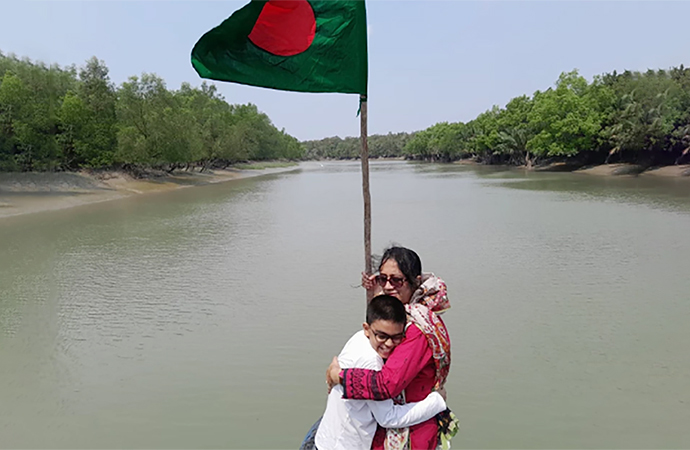
Sundarban Mayer Moton — Tawfeeq hugs his mother in the Sundarbans. Photo: WildTeam
The Sundarbans, the world's largest mangrove forest, nurtures us like a mother, stands as a vital natural barrier along the coast-protecting millions of people from cyclones, storm surges, and rising sea levels like a father-and supports us like a brother.
Beyond these roles, the Sundarbans is a biodiversity hotspot, as well as a World Heritage Site and a Ramsar Site.
Recently, I visited the Sundarbans with my grandsons, Tanzif and Tawfeeq, along with their parents, Shahrin and Asif. We returned on 26 March 2026. It took me quite some time to convince my daughter that visiting the Sundarbans is far more rewarding than visiting Cox's Bazar. I was referring to her perceptions based on what others had said about the Sundarbans.
One particularly memorable reflection came from an eminent scientist, academic, and philanthropist, worked in coastal areas, including the Sundarbans buffer zone, for a long time, who recently, visited the core zone of the forest for the first time with an environmentalist friend and later wrote to me:
"Thank you for a phenomenal trip to the Sundarbans. This was beyond my wildest imaginations-Subhanallah. The Almighty's incredible creations! A humbling and wonderful experience at the same time. Thank you for such a memorable experience, Professor Anwar."
I was deeply touched by these words. They brightened our days and lifted the spirits of the WildTeam team, reinforcing our commitment to working in the Sundarbans.
I also wondered what the Sundarbans means to our younger generation. In doing so, I came across the words of Samia Jahan Shefa (shefasamia8@gmail.com), a student in the Department of Genetic Engineering and Biotechnology at Jashore University of Science and Technology. On June 3, 2024, she wrote to the editor of The Financial Express:
"The Sundarbans, the largest mangrove forest in the world, is like our mother who endures adversity but protects us. It safeguards the coastal areas, offering protection from Nature's fury. In recent memory, two of the deadliest super cyclones-Sidr in 2007 and Aila in 2009-hit the coastal areas of Bangladesh. After these devastating cyclones, other severe storms made landfall, including Fani and Bulbul in 2019, Amphan in 2020, and Yaas in 2021. Each time, the protective Sundarbans played the role of a saviour against Nature's ferocity. It was no different at the time of Remal. The Sundarbans, our first line of defence against natural disasters, once again safeguarded the nation from Cyclone Remal. It saves us but pays a heavy price in terms of the forest's ecosystem, wildlife, and biodiversity. The flora and fauna of the forest sacrifice their lives to save us. .................... If the Sundarbans survive, Bangladesh will survive, as it takes care of us. But who will take care of it? Bangladesh aims to be a developed country by 2041. What will be the condition of the Sundarbans then? Will it become a scapegoat for 'development'? We don't want a developed Bangladesh at the cost of destroying our 'saviour mother,' the Sundarbans."
Her words give me confidence that the future of this country rests in capable hands.
On 17 February 2012, WildTeam (formerly Wildlife Trust of Bangladesh), with support from the Bangladesh Forest Department, launched a local campaign called "Sundarban Mayer Moton" (Mother-like Sundarbans). The event included a rally, an art competition, and a concert. Vice Chancellors from Dhaka and Khulna University, the Chief Conservator of Forests, and the Conservator of Forests of the Khulna Circle attended to raise public awareness about tiger conservation and the value of the Sundarbans. Musicians and celebrities from Dhaka and Khulna also performed.
The Sundarbans is one of Bangladesh's most important natural assets. It is home to extraordinary wildlife, including the Bengal tiger, and supports the livelihoods of millions of people. WildTeam's vision is to help protect the Sundarbans habitat and its wildlife. To achieve this, we work to connect local communities with the benefits of the forest through the "Motherly Sundarbans" (Sundarban Mayer Moton) campaign. This initiative has strengthened the relationship between village communities and the forest, catalysing behavioural change and reducing key threats to both the ecosystem and its wildlife. However, until recently, there was no central hub to celebrate and sustain this work.
The Sundarbans had no place to tell its own story.
WildTeam's EK Sundarbans Museum and Interpretation Centre (EKSMIC), established with support from the Bangladesh Forest Department, German Cooperation through KfW and IUCN's Integrated Tiger Habitat Conservation Programme, as well as EchoTex, Echonits, Cosmos Group, and Crescent Lighting Ltd, now serves as that home. It gives voice to the Sundarbans-its biodiversity and its people. Built on the trust WildTeam has developed within local communities, the Centre ensures that the message of the Motherly Sundarbans is passed on to future generations.
EKSMIC is located at one of the gateways to the Sundarbans: the WildTeam Conservation Biology Centre (WCBC), popularly known as TigerHouse, in Joymonir Ghol village in the Chandpai Range of the Eastern Sundarbans, near Mongla. The Centre provides accommodation for visitors and includes a conference facility that can host around 120 participants. EKSMIC will play a crucial role in advancing WildTeam's behaviour-change approach to conservation, helping to improve public knowledge of, and attitudes towards, the forest.
Dr Md. Anwarul Islam, Chief Executive, WildTeam, Former Professor of Zoology, University of Dhaka.
A Independent Newsweekly
© Copyright 2026 | Designed by ARK Reepon & Developed by Cosmos Group Software Team





Leave a Comment
Recent Posts
Is the international community ...
A spate of downgraded economic projections, from Bretton Woods to Mani ...
A Childhood Lesson in Arithmet ...
As children, we learned a simple mathematical rule: if we know the pri ...
Indian authorities launched a major security crackdo ..
Police dispersed garment workers from the Azampur ro ..
Why Saudi Arabia has struggled to defend itself agai ..
Iran-backed Houthis strike Saudi oil company Aramco’ ..