


Essays
Songs of Hyacinth Boats & Hands: Reading Conversations with Suleman by Afsan Chowdhury


An Independent Newsweekly



Essays
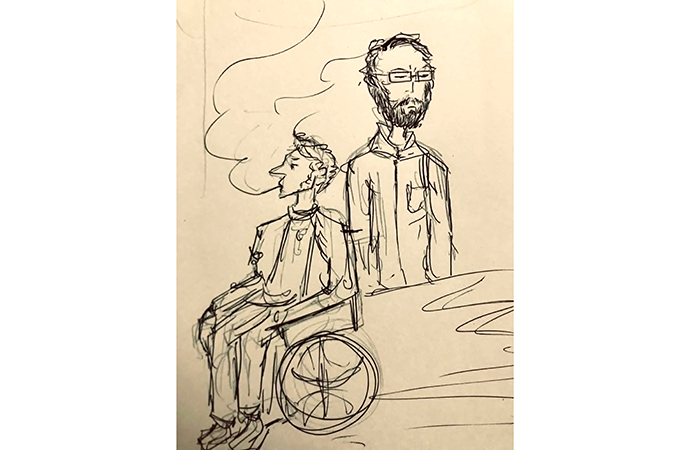
A budding friendship surviving not only the ordeals of war, but the bitter taste of lingering grief is a page after page confession in Afsan Chowdhury's "Conversations with Suleman". Each "split" is a canto that metamorphoses into a book. Before this book, Dr Afsan and I often sat together after lunch, and as conversations often go, he would recount certain moments of his life in between sips of his coffee. Fooled by the objective knowledge of age and its course of time that leads one to repeat one story many times, after this poetic reading, I, however had come to a conclusive realization of not only do we all tend to repeat the past that wallows in the shadows, but that we choose to confide in these stories however many times we can, to keep the ones we love alive with tales.
Conversations with Suleman weaves itself with an unstructured form of rhythms, with each line chaotically walking through the metaphors and allusions of 1971 war and the days after independence.
The days of freedom for the two friends come with a cost of remembering. The poem recalls the gruesome consequences of the war with the image of Pakistani military forces lining up countless innocents, some murdered and assassinated and myriad others who have disappeared into the unknown. He recalls a young girl and her plea to hide from the "fair skinned arms" that would inevitably lead to her demise as her body escapes in the river.
Amidst these memories, he turns to his comrade, his confidant, his friend Suleman, whose days of freedom and joy were paralyzed into a form of rage and sorrow as he looks at his hands and is jostled by the memories that impermissibly recur in his thoughts. What war took from him was his body but never the grit of survival. "Suleman's hands are regularly washed..legs..belly..prick...but he won't let them touch his mouth"-a rebellion against the Kafkaesque life he was not willing to live. His injury during the war alludes to a mother bleeding as it births a child, seemingly the same rebirth that Suleman had experienced amidst the nine months of war.
The blend of the past and present showcases a struggle of an unknown youth at war that chooses to live and as age catches up with the speaker and his friend, their hands are a predicament of being. With each canto, we come to the griming realization that Suleman with age and destitute illness carries a disillusionment that has no treatment and as the two friends meet again and walk in this newer city that glimmers in the flashing lights of the billboards, Suleman's existence is the living embodiment of life. The lines read to the painful conclusions of how there are no treatments for those who survive wars-no aid for their physical or psychological needs. The trauma that remains for years is unaddressed and often forgotten. War remains unholy for those that experience the taints of sins that they never committed. The spirit of Bangladesh is reflected throughout the poem as nature grieves her people with steaming khichuri, unruly bhadra and the shrieks of the river waves.
The poem recollects the day when Suleman was rescued and carried back on his friend's back like a "burned offering to an unknown God", but the ultimate battle ignites not in the battlefield rather with the soul that is tarnished as Suleman whimpers in pain almost every night. The poem remains as a testament to the realistic notion that there simply must not remain any space for romanticizing the war. Suleman's bravery of living in pain with the sudden changes is no short of a revolutionary phenomenon.
His survival reminds me of the living dead, a zombification of the brave Frankenstein he searches for a full stop in this land "punctuated by endless commas".
Conversation of Suleman is not just a 1971 poem, it is a temporal and spatial testament of friendship, sacrifice and pain that often loses itself in translation of glorified history of war.
Sumaiya Tasnim teaches english literature at BRAC University
A Independent Newsweekly
© Copyright 2026 | Designed by ARK Reepon & Developed by Cosmos Group Software Team





Leave a Comment
Recent Posts
Bangladesh’s first drought-res ...
In a groundbreaking development for Bangladesh’s agriculture, Ga ...
US and Iran hold another round ...
Iran and the United States were holding another round of indirect talk ...
An early hiccup for the new government?
Japan invites PM Tarique, eyes cooperation with Bang ..
Bangladesh to achieve sustained growth, prosperity u ..
Dhaka indicates ‘forward looking, balanced partnersh ..