


Column
COP30’s outcome: A diplomatic setback


An Independent Newsweekly





Column
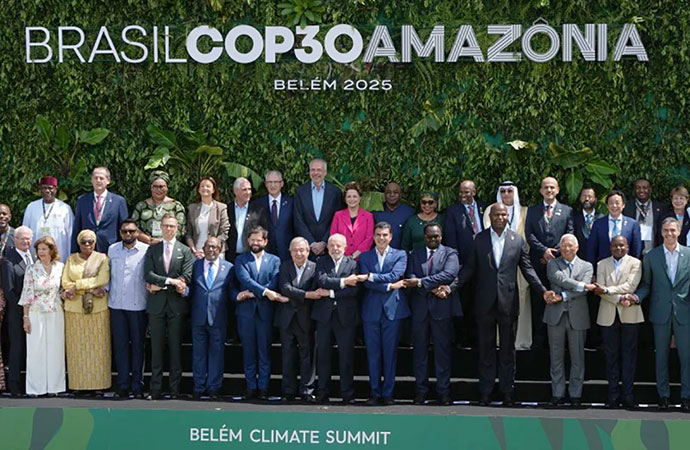
Photo: AP/UNB
The 30th Conference of the Parties (COP30) to the UN Framework Convention on Climate Change (UNFCCC) produced a lacklustre outcome by any measure, as reflected in many post COP analyses. This remains significant because COP outcomes continue to shape the direction, pace, and credibility of global climate diplomacy, even when they fall short.
The COP presidency undertook extensive year-round preparations, circulating a series of letters, appointing around two dozen foreign and national envoys, and establishing four high level leadership circles, including one of finance ministers. These initiatives were meant to mobilise global support to uphold multilateralism and align climate negotiations with people's lives. The presidency even decried the "banality of inaction" and pledged to avoid the "brutality of inaction" seen at previous COPs.
Despite such resolve, the Political Package largely represents non substantive and non-effective decisions. This matters because weak outcomes at one COP often lower ambition in subsequent negotiations. The two cardinal issues of climate diplomacy-ambitious-mitigation and climate finance-failed to pass even a minimum test.
Aspirations for ambitious mitigation are not backed by real commitments, as reflected in more than 60 formally recorded new Nationally Determined Contributions (NDCs), with slightly higher unofficial counts cited during COP30. Even the word "fossil fuel," or a reference to the previously agreed "transition away," was absent from the text. This avoidance points to a troubling alliance of major emitters from both developed and developing countries, to which the presidency itself appeared complicit.
Alongside being the largest producer of petroleum and other liquid fuels in South America, reports suggest that vast stretches of the Amazonian coastline hold a major share 'of newly discovered reserves. Even weeks before the COP, the host government commissioned offshore drilling, ignoring strong opposition from global advocacy groups. A report by the Stockholm Environment Institute further notes that by 2030, fossil fuel production will be double the level compatible with emissions reductions needed to keep the 1.5 degrees Celsius target under the Paris Agreement within reach.
Although climate finance was not a prominent agenda item, adaptation finance was promoted under the banner of a "COP of Adaptation and Implementation." There was a "call for efforts to at least triple adaptation finance by 2035," without specifying any baseline. Based on the Glasgow COP26 decision to double adaptation finance by 2025 compared to the 2019 level of $20 billion a year, the least developed countries (LDCs) have called for $120 billion annually by 2030.
A "call" is a weak operative verb, and a call for "efforts" does not amount to a commitment. Once again, there is a blatant use of constructed ambiguity in the decision text, allowing rich countries a wide scope for subjective interpretation. If UNEP's latest estimate of $26 billion for adaptation finance in 2023-down from $28 billion in 2022-is any indication, the tripling target is unlikely to be met by 2035.
Brazil did, however, succeed in launching its flagship initiative, the Tropical Forest Forever Facility (TFFF), with an initial capitalisation target of $25 billion and pledges amounting to $6.7 billion. A key reason for holding COP30 in Belem, a relatively small city in the Amazon, was to mobilise resources for the TFFF, even though the city was arguably ill-equipped to host an event of this scale.
This raises a recurring question: what is the utility of continuing the COP process when even minimal agreed outcomes fail to justify such hugely expensive annual gatherings? Yet, no viable alternative exists for a universal climate negotiation platform. The frequent extension of COPs beyond the stipulated two weeks itself signals dysfunction. Many negotiators from small countries are forced to leave early, while those who remain are exhausted by late night, non-stop negotiations. Decisions are then hastily gavelled through, often overlooking dissenting voices, on the argument that consensus does not mean unanimity.
Amendments to decision-making are technically allowed under Article 22 of the Paris Agreement, based on a three fourths majority vote, but only as a "last resort." This option is unlikely to be exercised, as developing countries command more than three fourths of the majority.
Consequently, negotiators repeatedly defer unresolved issues to future meetings or settle for innocuous work plans. Despite climate change affecting all countries, vulnerability and interdependence have failed to anchor negotiations in pragmatic realpolitik. The raw pursuit of national interests by major emitters continues to prevail, even within climate diplomacy.
The persistent intractability of fundamental issues reflects a dire lack of leadership. History shows that multilateral negotiations succeed when a powerful country, or a cohesive group, leads the process. Ozone diplomacy under the Montreal Protocol succeeded largely due to U8 leadership, supported by European countries. A genuine global crisis like climate change cannot be resolved without similar strong leadership.
However, current global trends- including a fraught geopolitical and geoeconomic environment, the U8 withdrawal from the Paris process, the rise of right wing politics in rich countries, sharp cuts in foreign aid by major European governments, and renewed emphasis on military security at the expense of climate security-do not bode well.
Western European countries, historically the most progressive bloc, remained largely muted, perhaps due to President Trump's distancing from their economic and security concerns. China, too, maintained a low-key presence, unlike in previous COPs. Yet, as the largest emitter and the global leader in green technology, China retains the capacity to fill this leadership vacuum.
China is no warmonger, historically or in modern times. It possesses unparalleled liquidity, enabling it to establish two development banks operating across continents. After the Paris Agreement, it also created the South-South Solidarity Fund to support climate action in developing countries. With greater transparency, high concessionality, and easier accessibility, this fund could meaningfully address the needs of climate vulnerable nations. The institutional foundations for leadership are already in place.
Perhaps the world must wait and observe China's tradition of reflection before action. Yet, one thing is clear: no other country currently has the potential to assume leadership in addressing this extraordinarily complex global commons challenge. One can only hope that when the Asian turn comes in 2027, China hosts COP32 and demonstrates such leadership in confronting the defining global crisis of our time.
Mizan R Khan is technical lead at LDC Universities Consortium on Climate Change (LUCCC).
First Published in The Daily Star
A Independent Newsweekly
© Copyright 2026 | Designed by ARK Reepon & Developed by Cosmos Group Software Team




Leave a Comment
Recent Posts
Is the international community ...
A spate of downgraded economic projections, from Bretton Woods to Mani ...
A Childhood Lesson in Arithmet ...
As children, we learned a simple mathematical rule: if we know the pri ...
Indian authorities launched a major security crackdo ..
Police dispersed garment workers from the Azampur ro ..
Why Saudi Arabia has struggled to defend itself agai ..
Iran-backed Houthis strike Saudi oil company Aramco’ ..