


Column
Brazil- Argentina fan rivalry: Why is it so intense?


An Independent Newsweekly
Column
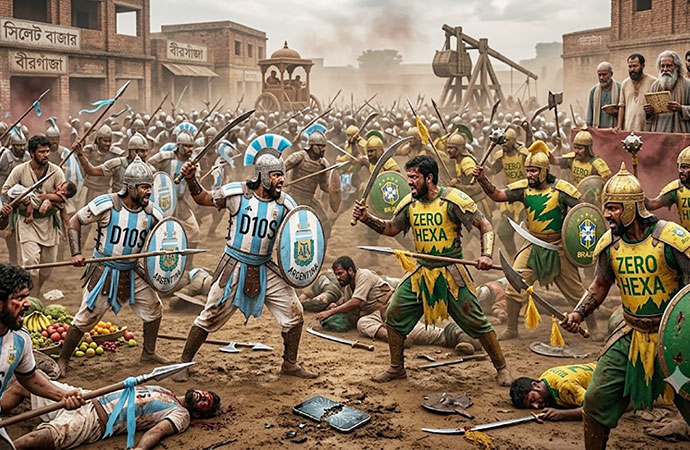
AI Generated Image
Few countries in the world are as obsessed with the Argentina-Brazil rivalry as is Bangladesh. It cuts deep into every layer of society and often erupts into violence. Even in the source countries, we don't find such heat. Why is it that sports do interest but football World Cup simply invites madness of a special kind that is now being recognised all over as unique.
However, in all fairness to other "mad" zones, we see a sprinkling of that in India as well, particularly brotherhood land that is West Bengal and Kerala. Support is split down the middle and the haphazard chaos that we witness here is sometimes seen there too.
Giant cutouts of Lionel Messi and Neymar are erected in rivers and busy intersections. Streets are painted entirely in blue-and-white or yellow-and-green, and local fan clubs organise massive community feasts depending on who wins.
In Kathmandu screening parties draw thousands wearing matching jerseys. Screen time, social media arguments, and local tea-shop debates are all about who is greater.
Lebanon is not far behind Haiti but smaller in scale with an interesting difference. Fans are split between Brazil and Germany though a huge Argentinian fan base also exists.
Beirut and other major cities are draped in flags and if Israel hadn't attacked so heavily, they probably would have celebrated even more.
Another country in another continent also has similar swaying and that is Haiti. So much so, social scientists are asking deeper questions about this belligerent rivalry in certain places. Why is the rivalry so intense and why in these zones? For the moment though most attention is being paid to Bangladesh. Aren't we proud?
Why Does This Happen?
TV booms of the 1980s and 1990s brought global soccer inside their homes and initially supporting a game that was not dominated by Europeans played a role but over time this has changed and its more about the situation internally, experts. And looking at Bangladesh this is obvious.
And this is intense. So intense that people have died in India and Haiti, though the overall death count remains highest in Bangladesh. These deaths are not from stadium hooliganism but arguments exploding into brawls, flag and jersey-wearing related brawls and occasionally large mobs of fans attacking each other.
Why does it get so bloody?
Sociologists and criminologists tag this violence to collective aggression and "territorial loyalty". In closely-knit communities, a minor soccer argument quickly transforms into a defence of neighbourhood honour, escalating a simple game into a high-stakes tribal conflict, they say.
However, another band of sociologists and psychologists point to an even deeper phenomenon called "proxy tribalism".
"It is not just about cheering for a winner or blindly mimicking local political aggression; rather, it is a psychological fusion where a foreign team becomes a vessel for a person's entire identity. "In other words the fans effectively become the citizens in their mind of that country. Wow.
The phenomenon is fuelled by several distinct behavioural drivers:
The Need to Identify with Success ("Basking in Reflected Glory"). Psychologists use the term BIRG (Basking in Reflected Glory) to explain why fans in non-participating football countries identify with South American giants. They lack victories in their own public life. And its probably not just sports glory but other glories as well.
By adopting historically dominant teams like Brazil or Argentina fans get to experience the chemical high of global triumph and supremacy. Winning makes the fan feel like a winner in their own everyday life.
Historical Alignment too exists. In Bangladesh it's not just the big two but for many, supporting Muslim majority countries was common as well. It was a shared global identity.
Mimicking existing "rivalries"
While the love for the teams is real, the physical violence is heavily shaped by pre-existing cultural patterns of territorial, political, and tribal aggression unique to these regions.
The "Us vs. Them" Blueprint: In Bangladesh, daily life is historically shaped by intense, hyper-polarised rivalries-most notably the fierce, multi-decade political feud between the Awami League and the Bangladesh Nationalist Party (BNP). Sociologists note that when the World Cup arrives, the youth naturally copy this exact "either you are with us or you are an existential enemy" tribal structure.
Interestingly, a big political player of today, Jamaat-e-Islami totally condemned the WC and some even said watching the event was haram. They tried mobilising public opinion which among other things showed when it came to sports rivalry religious teaching by huzurs didn't carry much weight for most.
In close-knit, highly dense South Asian communities, sports arguments quickly morph into a defence of neighbourhood honour. Researchers look at this through the lens of collective aggression: a minor disagreement over a referee's call between two people instantly pulls in whole families and village factions, escalating an abstract game into a physical turf war.
Ultimately, these fans are not just watching a sport. They have invested so much of their personal identity, pride, and local social standing into these distant colours that a draw or a loss feels like a direct, personal humiliation-which they feel forced to defend with force.
Doesn't explain it all but its fascinating that so much lies behind such sports rivalries.
A Independent Newsweekly
© Copyright 2026 | Designed by ARK Reepon & Developed by Cosmos Group Software Team




Leave a Comment
Recent Posts
Mosque in my memory
Recently, I saw a pamphlet published by the Islamic Foundation which s ...
Why the fastest-growing Ebola ...
The Ebola outbreak in eastern Congo is now the fastest-growing one in ...
US reimposes its blockade on Iran after Tehran’s att ..
Oil Shocks Are No Longer So Shocking
Bangladesh urged to build AI capacity, strengthen di ..
Metamorphosis: Bishwajit Goswami on Art, Nature and ..