


Society
Saving Lives, Safeguarding Tigers: WildTeam Expands Safety Training in the Sundarbans


An Independent Newsweekly







Society
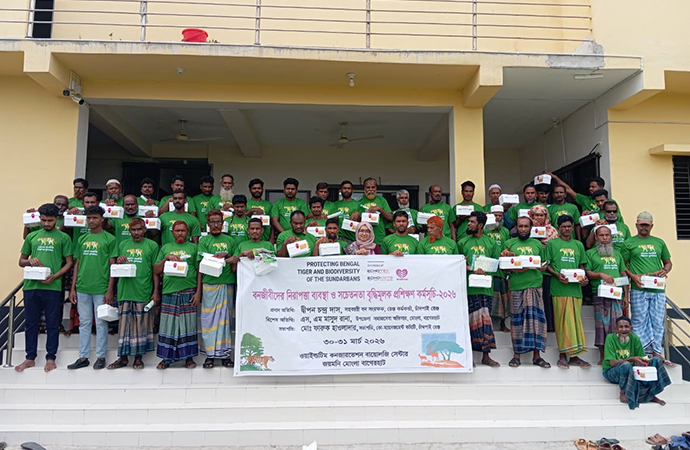
Guardians of coexistence: In Joymoni, forest-edge residents unite through safety training to protect their communities and preserve the Sundarbans, home of the Bengal tiger. |Photo: WildTeam
WildTeam has launched the Training Programme on Safety Measures and Awareness Building for Forest-Dependent People - 2026 in Joymoni under the Chandpai Range of Mongla and Kolbari under the Satkhira Range of the Sundarbans, reinforcing a vital message at the forest edge: protecting human life and conserving wildlife must go hand in hand. The initiative is being implemented under the five-year programme "Protecting Bengal Tiger and Biodiversity of the Sundarbans," supported by Echotex and Echoknits, a Bangladesh-UK joint venture.
Designed for people whose lives and livelihoods depend on the forest, the training equips participants with practical knowledge on forest safety, human-tiger conflict mitigation, wildlife and forest laws, compensation provisions, basic first aid, and the sustainable harvesting and processing of forest resources. Safety kit boxes have also been distributed among participants to improve emergency preparedness and reduce risk while entering or working near the forest.
This year, a total of 200 participants have been trained-100 in the Chandpai Range and 100 in the Satkhira Range-marking an important step toward strengthening community-level safety and preparedness. Over the five-year project period, the programme aims to train more than 1,000 forest-dependent people, building a critical mass of informed and prepared community members across the landscape.
This initiative carries deep conservation value. In forest-edge communities, unsafe encounters with wildlife can lead not only to injury or loss of life, but also to retaliatory harm against tigers and other species. By teaching safe forest-entry practices, group movement, early risk detection, and emergency response during tiger encounters, the programme helps communities avoid danger while also protecting the ecological balance of the Sundarbans. In this way, the training supports a more secure future for both people and wildlife.
The timing of the training is particularly significant, as the annual honey collection season-one of the most high-risk periods for forest-dependent communities-will begin on 1 A and continue until 30 June. During this period, large numbers of mawals enter the forest, increasing exposure to tiger encounters and other hazards, making safety preparedness critically important.
The programme builds on lessons from earlier conservation interventions under the Integrated Tiger Habitat Conservation Programme (ITHCP), implemented with support from German Cooperation through KfW and IUCN. Experience from those earlier phases-including improved community preparedness, reduced pressure on forest resources, and stronger local response systems-has helped shape the current integrated approach in the Chandpai and Satkhira ranges.
Speaking at the training, Chandpai Range Assistant Conservator of Forests (ACF) Dipon Chandra Das called on forest users to show greater care for the Sundarbans, especially ahead of the honey collection season. He emphasised that the forest does not ask for anything in return except awareness, restraint, and responsibility. He urged communities not to kill deer, wild boar, or tigers, and warned against destructive practices such as tree cutting and poison fishing, which silently damage biodiversity and weaken the forest ecosystem.
Assistant Commissioner (Land) of Shyamnagar Upazila, Rashed Hossain, highlighted the serious risks faced by honey collectors during the harvesting season, noting that many mawals have been injured or killed in tiger attacks over the years. He stressed that conflicts can be reduced if collectors follow basic safety techniques and always enter the forest legally with permission from the Forest Department.
S. M. Delowar Hossain, Social Welfare Officer of Shyamnagar Upazila, also spoke about the ethical responsibilities linked to forest livelihoods, urging collectors not to adulterate honey. His remarks reinforced a broader message of integrity, stewardship, and respect for both nature and the resources it provides.
Shyamnagar Upazila Engineer, M. Abdus Samad also underscored the importance of practical preparedness for forest-edge communities. He said that people living at the edge of the Sundarbans face real risks every day, and that such safety training equips forest-dependent communities with practical knowledge to protect themselves, respond more effectively during emergencies, and reduce avoidable conflict with wildlife. He further noted that stronger community safety also strengthens conservation, because protecting people and protecting the forest must go hand in hand.
The training complements other community-based conservation measures already underway in forest-edge villages, including improved cooking stove distribution and solar light installation. Together, these interventions are reducing dependency on forest resources, improving safety in high-risk zones, and helping build a more balanced and resilient relationship between communities and the Sundarbans.
WildTeam is also strengthening awareness through community platforms such as BaghBandhu, TigerScouts, village forums, and Sundarbans Education Centres, ensuring that conservation knowledge reaches adults, youth, and children alike. By combining training, awareness, practical support, and long-term engagement, the organisation aims to nurture a culture in which local people are not only forest users, but also active guardians of one of the world's most important mangrove ecosystems.
WildTeam said it seeks to create sustainable, measurable, and long-term change through integrated actions that unite community safety, awareness, and conservation. With continued support from the Forest Department, local administration, and community stakeholders, this initiative offers hope for a future in which people can live more safely, livelihoods can remain secure, and the Sundarbans-and its iconic Bengal tiger-can continue to thrive.
Zimam Ahmed, Programme Officer, WildTeam
A Independent Newsweekly
© Copyright 2026 | Designed by ARK Reepon & Developed by Cosmos Group Software Team







Leave a Comment
Recent Posts
A commendable intervention by ...
A struggle for local dominance in the Chittagong Hill Tracts, specific ...
How close is the Amazon to a ‘ ...
While Brazil’s presidential candidates have not made policy of t ...
Another shipment of highly radioactive uranium fuel
Harmony: Diplomatic community joins Durga Puja celeb ..
What to know about the Ebola outbreak that has sprea ..
Brazil election: Trump’s ‘Donroe Doctrine’ faces its ..