


Reportage
For whom the bell tolls


An Independent Newsweekly

Reportage
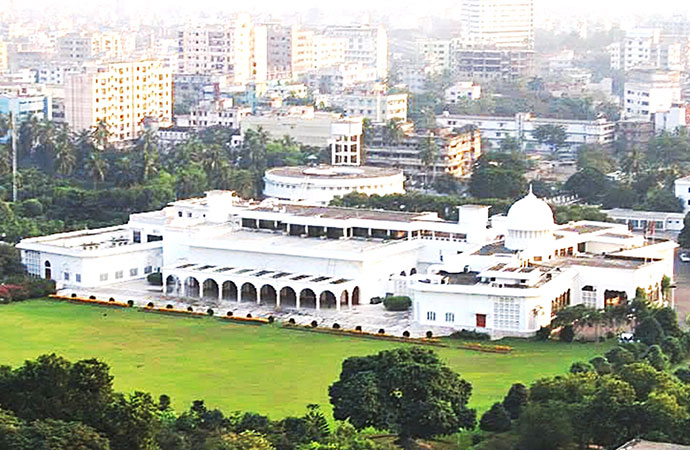
Photo: wikimedia
President Mohammed Shahabuddin has resigned from office. Following the acceptance of his resignation letter, Speaker of the Jatiya Sangsad (national parliament) Hafiz Uddin Ahmad has called a press conference, which will be held at 5:00 pm at the Jatiya Sangsad Bhaban.
With the office of the President now vacant, the Speaker will assume the duties of Acting President, in accordance with the Constitution, until a new President takes office.
Under Article 50(3) of the Constitution of Bangladesh, the President may resign by submitting a signed letter addressed to the Speaker.
Article 54 provides that, if the office of the President becomes vacant, or if the President is unable to discharge the functions of the office due to absence, illness or any other reason, the Speaker shall perform the functions of the President until a new President is elected and assumes office.
Under Article 123(2) of the Constitution, if the office of the President falls vacant due to death, resignation or removal, a new President must be elected within 90 days. Under Article 48(1), the President is elected by a vote of the members of parliament.
The ruling Bangladesh Nationalist Party (BNP) has a two-third majority in parliament, making its nominee the overwhelming favourite to become the next President.
Senior BNP leaders have been holding discussions over the past several days on who should be nominated as Mohammed Shahabuddin's successor.
Earlier today, Speaker Hafiz Uddin Ahmad returned to Dhaka from Bangkok, where he had travelled on July 19 for medical treatment.
Although he had originally been scheduled to return on Sunday (July 26), he cut short his visit and arrived in Bangladesh two days ahead of schedule.
Speaking to journalists at Hazrat Shahjalal International Airport at around 12:15 pm, before the resignation was announced, the Speaker said he had no knowledge of any plan by the President to step down.
Noting that he had been abroad, Hafiz Uddin Ahmad stated that if the President were to resign, the resignation letter would be submitted to the Speaker. In that case, the Speaker would assume the functions of Acting President under the Constitution, while the Jatiya Sangsad would elect a new President within 90 days.
Speculation over President Mohammed Shahabuddin's possible resignation had intensified in political circles over the past several days.
On Thursday, informed sources indicated that he had become mentally prepared to step down. One source familiar with the matter also claimed that, during a meeting with senior officials at Bangabhaban, the President had spoken of making preparations for his departure from office.
Mohammed Shahabuddin assumed office as Bangladesh's 22nd President on 24 April 2023, during the tenure of the Awami League government, for a constitutional term of five years. His term had been due to expire in April 2028, but he resigned nearly two years before completing his tenure.
Following the fall of the Sheikh Hasina government during the July 2024 mass uprising, Mohammed Shahabuddin's continuation in office became the subject of sustained political debate.
The discussion intensified after the BNP returned to power following the 13th Jatiya Sangsad election. His resignation has now brought about a change at the country's highest constitutional office.
Following the ouster of Sheikh Hasina, Shahabuddin became the only remaining figure from the previous constitutional setup even as an interim government led by Nobel laureate Muhammad Yunus took charge of the country's governance.
At the time, Shahabuddin, whose term was supposed to end in 2028, told Reuters that he was keen to leave his position. He said he felt "humiliated" by the Yunus-led government after they suddenly removed his portraits from Bangladesh consulates and embassies. But it seems that this doesn't tell the entire story. For the past two days, Bangladesh media outlets have been reporting that the Tarique Rahman-led government has been pressuring Shahabuddin to resign, as they are no longer comfortable with him being in office.
A Prothom Alo report quoting a government official said that the administration was unhappy over reports that Shahabuddin had recently attempted to re-establish contact with Hasina.
Additionally, the Daily Star also reported that Shahabuddin had made contact with Hasina while he was in London back in May. The newspaper report claimed intelligence agencies later learned about the conversation, after which a message was conveyed to the president suggesting that he step down.
A member of the ruling Bangladesh Nationalist Party (BNP), however, noted that Shahabuddin's decision to contact Hasina isn't the only reason the government is pushing for his resignation.
What he wrote in his resignation letter
In the letter, Shahabuddin said he had served the country with "honesty, integrity, and full allegiance to the constitution" since taking oath as the 22nd president of Bangladesh on April 24, 2023.
"I, Mohammed Shahabuddin, was elected as the 22nd president of the People's Republic of Bangladesh and took the oath of office on April 24, 2023. Since then, I have discharged my responsibilities with honesty, integrity, and full allegiance to the constitution," he wrote.
Referring to the events following the fall of the then government due to the student-public uprising in August 2024, Shahabuddin said the country had faced a governance and constitutional crisis.
"To overcome that constitutional crisis, acting under the authority of Article 106 of the constitution, I sought the opinion of the Appellate Division of the Supreme Court of Bangladesh. Subsequently, based on the advice of the Appellate Division, I formed the interim government. In consultation with political parties, the interim government arranged the general election to the Jatiya Sangsad.
"Based on the election results, the present government was formed and is now administering the country. The ruling party and the opposition are carrying out their responsibilities in parliament through democratic practices.
"Owing to my prudent and historic role, the country did not experience any constitutional vacuum," he wrote.
Explaining his decision to step down, Shahabuddin cited a number of health complications.
"I have long been suffering from heart disease, high blood pressure, diabetes, and kidney complications. Recently, I have also been diagnosed with a condition called autonomic neuropathy," he wrote, adding, "Because of this illness, I occasionally lose consciousness."
"Due to the progression of these illnesses and the resulting physical and mental incapacity, it is no longer possible for me to perform the responsibilities of the important constitutional office of the president. I require long-term medical treatment," he said.
Concluding the letter, Shahabuddin wrote: "Therefore, in accordance with Article 50(3) of the constitution, I hereby resign from the office of the president."
'All confusion cleared'
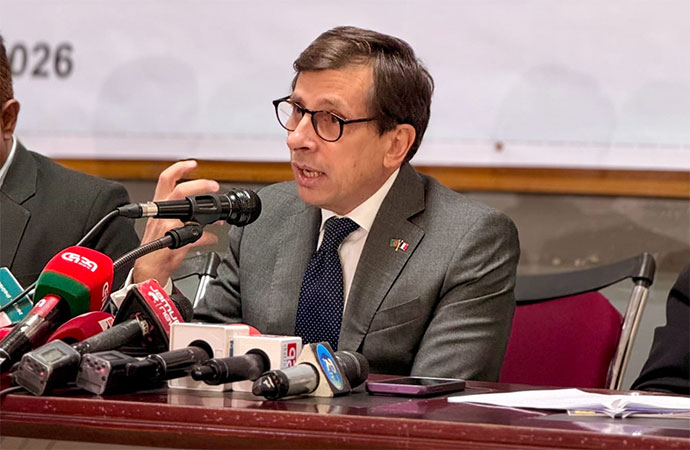
President-in-charge and Speaker of the National Parliament Hafiz Uddin Ahmad said all confusion has been cleared with the resignation of Mohammed Shahabuddin from the post of president.
Speaking at a press conference held at 5:30pm on Friday in the oath-taking room of the parliament, the president-in-charge wished good health and overall well-being to the immediate-past president, who resigned citing illness.
Announcing that he received the president's resignation letter at 5:01pm, Hafiz Uddin said, "I have accepted the resignation letter and directed the National Parliament Secretariat to preserve the records and take necessary administrative actions. I have assumed the responsibility of the president in accordance with Article 54 of the constitution."
"Although he [Shahabuddin] was elected during the tenure of the 'mafia government', he has always expressed support and respect for the new government elected by the votes of the people. I wish him well," Hafiz Uddin said.
Citing the reasons for Shahabuddin's resignation, Hafiz Uddin said he is seriously ill, suffering from heart disease, high blood pressure, diabetes, and kidney complications.
"He underwent heart bypass surgery, and recently, a medical examination diagnosed him with a disease called autonomic neuropathy. Due to this illness, he occasionally loses consciousness," the acting president added.
Regarding his assumption of office, Hafiz Uddin said, "On the day I took oath as the speaker, I also took oath as the acting president. Similarly, when our deputy speaker took oath, it was mentioned as part of the oath that when the speaker's chair is vacant for any reason, the deputy speaker will perform the duties of the speaker."
Speculation over next President
Cabinet secretary Nasimul Goni, now on a contractual appointment, has been in talks on social and legacy media to be picked as the next president even before Shahabuddin Chuppu handed in his resignation on Friday.
Now the question is, even if the ruling BNP picks the said senior bureaucrat as its presidential candidate, can he be qualified for the election?
The country's constitution and the Representation of the People Order (RPO) answer this question without any ambiguity. Article 48 of the constitution defines the qualification and disqualification of a presidential candidate.
According to sub-article 4(b), a person shall not be qualified for election as President if he is not qualified for election as a member of Parliament.
Does the said bureaucrat qualify for being elected as an MP?
RPO's Section 12(h) says 'no.' It reads: a person shall be disqualified for election as or for being a member if he has been appointed on contract to the service of the Republic or of any statutory public authority or of the defence service immediately after his retirement from such service, unless a period of three years has elapsed since the expiry or termination of such contract.
Nasimul Goni is still on contractual service.
Even if he resigned or retired, still three years have to elapse for him to qualify to become an elected MP. Section 12 (f) says a person shall be disqualified for election as or for being, a member, if he has resigned or retired from the service of the Republic or of any statutory public authority or of the defence service, unless a period of three years has elapsed since the date of his resignation or retirement.
Therefore, even if the candidate is highly favoured by the ruling party for the presidency, he needs to wait three years since the end of the contractual appointment.
Then who will be BNP's nominee for the presidential election in case Shahabuddin finally resigns?
Media reports suggest some of the party's senior leaders like Mirza Fakhrul Islam Alamgir, Khandaker Mosharraf Hossain and Dr Abdul Moyeen Khan as the next man in Bangabhaban.
In 2002, after the resignation of Dr AQM Badruddoza Chowdhury, also a party stalwart from the presidency, the then BNP picked Prof Iajuddin Ahmed for the post-a surprise pick by the then BNP government led by Khaleda Zia.
In a similar fashion, the choice of Shahabuddin as the president by the past Awami League government led by Sheikh Hasina in April 2023 was more than a surprise when big names in the ruling party were in talks as suitable candidates to replace Abdul Hamid.
The Constitution lays out a clear process if a president steps down from office.
Under Article 50(3) of the Constitution, the president can resign by sending a signed letter to the Speaker of Parliament.
Article 54 states that the Speaker will take charge as acting president if the presidential office becomes vacant or if the president cannot perform duties due to absence, illness or any other reason. The Speaker will continue in the role until a new president takes office.
Article 123 requires authorities to elect a new president within 90 days if the post falls vacant due to resignation, death or removal. Members of Parliament elect the president through voting.
As the ruling BNP holds a majority in Parliament, a candidate nominated by the party is expected to secure the presidency.
A Independent Newsweekly
© Copyright 2026 | Designed by ARK Reepon & Developed by Cosmos Group Software Team






Leave a Comment
Recent Posts
Is the international community ...
A spate of downgraded economic projections, from Bretton Woods to Mani ...
A Childhood Lesson in Arithmet ...
As children, we learned a simple mathematical rule: if we know the pri ...
Indian authorities launched a major security crackdo ..
Police dispersed garment workers from the Azampur ro ..
Why Saudi Arabia has struggled to defend itself agai ..
Iran-backed Houthis strike Saudi oil company Aramco’ ..