


Featured 2
Sponge Cities of the Belt and Road


An Independent Newsweekly



Featured 2
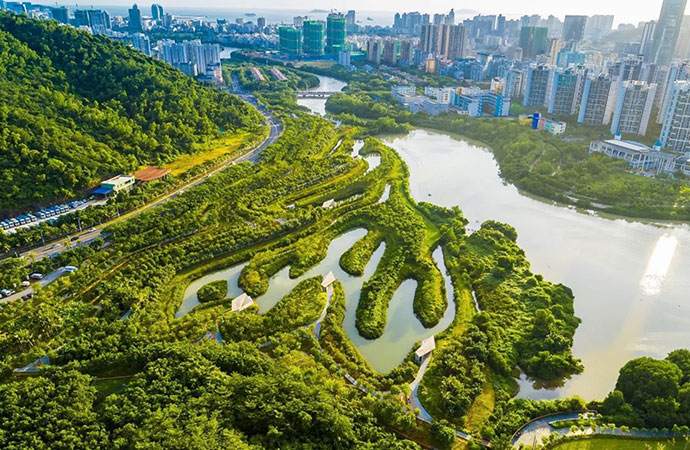
Sanya Mangrove Park in China, designed by landscape architect Kongjian Yu, Source: Turenscape
China has spent a decade and billions teaching its cities to absorb the might of the skies in our debilitating world.
Stand on Qian'an's renovated riverbank on a July afternoon and watch the rain arrive. It does not pool on the pavement. It does not gust sideways off concrete into gutters running brown with silt. It disappears, drawn downward through permeable stone, engineered soil and roots that have been planted with a deliberate patience for not fighting water, but to befriend it. Qian'an, a mid-sized industrial city in the northeast of Hebei province, has spent the last decade becoming a pioneer in nature based urban planning beyond the greenwashed promises of its contemporaries.
Their philosophy is disarmingly simple: distribute and retain water at its source, slow it as it flows away, clean it naturally, and adapt where it accumulates. This is the sponge city, a concept that has reshaped urban planning doctrine across China and, increasingly, the world. First proposed by landscape architect Kongjian Yu, who drew on five millennia of monsoon-adapted farming wisdom, the idea reached state policy in 2014. By 2015, 30 pilot cities were designated. Today, 70 cities are active participants, and an estimated $1 trillion in investment is planned by 2030.
Whether those trillions will hold back a warming sky is the consequential query left for ecosystem service experts the world over. On September 23, 2025, Yu Kongjian tragically died in a plane crash over the Pantanal wetlands of Brazil, a landscape deemed the pinnacle of sorbents for atmospheric carbon.
The Architecture
The grammar of a sponge city is written in layers, written for what Frank Herbert would assume is the utopic realisation of society. At street level, pavements made of permeable concrete, honeycombed at the microscopic scale - allow rain to pass where conventional asphalt would sheet it off. Beside them run bioswales: shallow, vegetation-lined channels that look like landscaped median strips but function as slow-drain corridors, filtering pollutants (and rain-dissolved aerosol chemicals) through its network of adventitious and fibrous root systems. This also enables drawing the stormwater horizontally rather than surging it downhill. The layers of rich soil provide the filter, and also a carbon sequestering manifold.
Above the buildings, green roofs hold substrate gardens that absorb the first, most dangerous surge in any flood sequence. Below, engineered wetlands and retention ponds, sometimes dressed as parks, sometimes functioning nakedly as basins, allowing for the capture of what the roofs could not.
The thermal arithmetic of all this greenery is not incidental. Concrete and asphalt absorb and retain heat, often making cities 0.5-4°C hotter during peak sun hours. This is exacerbated in highly urbanised metropolitan areas, leading to the urban heat island (UHI) phenomenon. Chinese cities have lost ground to urban heat islands at a rate of 0.44°C per decade in their densest corridors; across the Yangtze River Delta, average daytime surface temperatures exceed rural surroundings by 1.20°C.
This, consequentially means that every percentage point of additional urban tree cover, as a 2024 meta-analysis published in Sustainable Cities and Society found, reduces surface temperature by approximately 0.10°C. The report, using data from China's 2000-2020 period effectively provides a spine for the bioswale. In other words, a bioswale is both a drain and a coolant.
Bangladesh, which occupies the world's largest river delta at barely a metre above sea level, loses between 20 and 25 percent of its territory to seasonal inundation in a normal year. As Chattogram and Sylhet floods displace millions every half-decade, the question of whether a nation built entirely of silt might learn from one that has spent a decade rearranging its stone is not, in any sense, rhetorical.
The Horizon
The programme began with 16 cities in 2015, grew to 30 by 2016, and now encompasses 64 active construction zones from Shenzhen's subtropical coast to Harbin's permafrost margin - the largest coordinated experiment in urban hydrology ever attempted. The architecture of its aspirations recalls from novelist Italo Calvino's Invisible Cities: each participant city a different unit imagining how habitation might finally make peace with water. Marco Polo might have been appeased with the endeavours himself.
Then came Zhengzhou. On July 20, 2021, the city recorded 201.9 millimetres of rainfall in a single hour - shattering sixty years of measurement and exceeding by nearly tenfold the threshold its sponge infrastructure had been designed to absorb. The toll: around 398 confirmed dead, $18.9 billion in losses, 14 drowned in the subway tunnels. A subsequent state investigation revealed that over half of the city's 19-billion-yuan sponge budget had been spent on landscaping rather than drainage and pump capacity. The sponges had been calibrated to historical distributions in a climate that was busy rewriting them, et voila! - the antics of climate change. A sponge engineered for the statistical average cannot drink a once in a century storm, erratic and, now more than ever, ever-so-common.
Logically, by the Chinese register, what the next iteration of the project demands is a nervous system. AI-driven hydrological management and digital twin frameworks that bake the Saint-Venant magic of river physics directly into models that predict. Neural nets can now generate flood inundation nowcasts within the 0-24 hour window when emergency decisions carry the most weight. These adjust the underlying city pump operations and water's overland retention gates dynamically before the surge arrives. The window is being tested for a 5-6 day lead time, with China pioneering open access early warning infrastructure.
Elsewhere around the world, the ones to take notice are: Singapore's Active, Beautiful, Clean Waters programme, which naturalised a 2.7-kilometre concrete canal in it Bishan area into a meandering river threaded with sensor grids, reduced the city-state's total flood-prone area from 56 to 29 hectares between 2010 and 2019. Berlin's repurposed Tempelhof airfield, left deliberately open, functions in heavy precipitation as a distributed retention basin for the city's overwhelmed sewers.
Los Angeles is ahead of the curve with democratisation of the initiative. The city's water managers were ready and waiting. Like other urban areas around the world, in recent years LA has been transforming and replacing impermeable surfaces, like concrete, with permeable ones. It has also built out "spreading grounds," where water accumulates and soaks into the earth.
With traditional dams and newfangled spongy infrastructure, in February 2024 alone, the metropolis had captured 8.6 billion gallons of storm water, enough to provide water to 106,000 households for a year. For the rainy season in total, LA had accumulated 14.7 billion gallons.
What Bangladesh Could Absorb
Bangladesh does not merely endure water. It has, for centuries, negotiated with it - and lost that negotiation increasingly often as upstream deforestation, a subsiding delta, and sea-level rise compounding the monsoon's native severity. Traditional flood management relied on embankments and polders that, over decades, constrained sediment flows, encouraged settlement inside residual risk zones, and quietly degraded the wetlands that historically absorbed peak discharges.
In Amitav Ghosh's The Hungry Tide, set in the Sundarbans where land and water are formally indistinguishable, a character observes that the delta has always kept its own score. The infrastructure has been miscounting for fifty years. The sponge city concept offers Bangladesh not a model to replicate but a logic to adapt.
Three interventions stand out. First: the legal protection and active restoration of Dhaka's network of khals - historic urban canals that managed storm surge before they were progressively encroached upon and built over. Second and more sound: the integration of AI-driven early warning into city drainage management, so that when the 24-hour precipitation forecast is severe, gate and pump operations begin moving before the flood does. IGOs operating in the country like RIMES (Regional Integrated Multi-hazard Early-warning System), headquartered in Thailand, further this cause with their current baseline projects. Third: mandatory permeable surface standards in new construction across rapidly urbanising Dhaka, Chittagong, and Sylhet fringes, where impervious cover is expanding faster than any drainage investment.
The World Bank's B-STRONG project - $270 million committed in May 2025 for flood resilience across 1.6 million people - is a foundation. Whether it becomes a model or a memorial depends entirely on the planning doctrine that follows it.
The sponge city is not utopia. Kongjian Yu knew that, which is presumably why he spent his life in wetlands rather than conference halls. It is, rather, the nearest thing urban engineering has produced to what Kim Stanley Robinson calls "a good enough future" - not the abolition of risk, but a negotiated coexistence with it. In a world where the sky has become statistically unreliable, cities that learn to drink seem, at minimum, the rational place to begin.
Shoumik Zubyer is a researcher at the Bangladesh Atomic Energy Commission, the Space and Environment Research Centre and a science correspondent.
A Independent Newsweekly
© Copyright 2026 | Designed by ARK Reepon & Developed by Cosmos Group Software Team






Leave a Comment
Recent Posts
Is the international community ...
A spate of downgraded economic projections, from Bretton Woods to Mani ...
A Childhood Lesson in Arithmet ...
As children, we learned a simple mathematical rule: if we know the pri ...
Indian authorities launched a major security crackdo ..
Police dispersed garment workers from the Azampur ro ..
Why Saudi Arabia has struggled to defend itself agai ..
Iran-backed Houthis strike Saudi oil company Aramco’ ..