


Featured 2
Solar Lights Bring Safety and Hope to Forest-Edge Villages in Mongla Upazila, Bagerhat District


An Independent Newsweekly





Featured 2
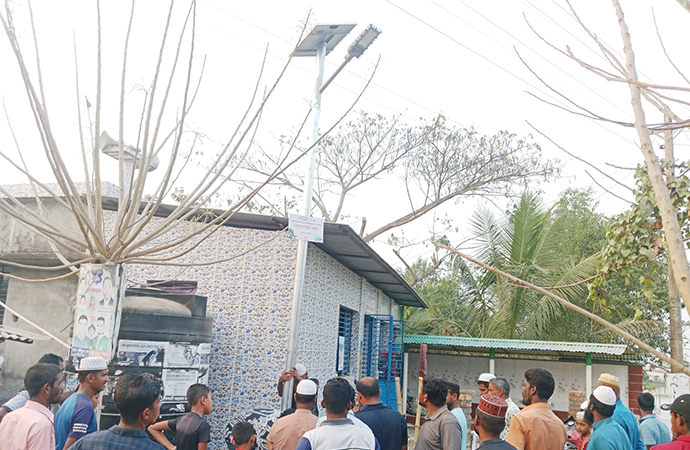
A shared step toward safer nights: community members in Joymoni gather around a newly installed solar light at the forest edge. Photo: WildTeam
WildTeam has started installing solar lights in forest-edge villages of Mongla as part of the continuation of its community-based Sundarbans conservation programme, and 10 solar lights were installed in South Chila and Burburia day before yesterday, said a press release. The installation follows the recent launch of WildTeam's Improved Cooking Stove (ICS) Distribution Programme at the WildTeam Conservation Biology Centre (WCBC) in Joymoni and is being implemented in the same programme geography in Chandpai Range, including Joymonir Ghol, South Chila and Burburia.
The solar lighting intervention is being introduced as a practical night-time safety and conflict-risk reduction measure in forest-edge areas where visibility remains low and human-tiger conflict risks increase after dark. Solar lights are being installed at vulnerable points to create illuminated deterrent stretches so that tiger movement toward village areas can be reduced, communities can detect risks earlier, and emergency response can be safer and more organised. Locations are being prioritised using previous human-tiger conflict patterns and local risk information.
The need for stronger protection measures in these villages is linked not only to community safety, but also to broader conservation risks in the Sundarbans landscape. Poaching and illegal killing remain major threats to tigers and their principal prey species, while the forest-edge setting and night-time movement create vulnerabilities that require better vigilance, information sharing and community engagement. In this context, improved lighting at selected points is expected to support safer local movement after dark and strengthen the overall protective environment around village edges.
Local residents have already started describing the immediate importance of the installation. One villager said fishermen and other villagers often fear using dark village roads at night, and that solar lights would help them move more comfortably and with less fear. Anju Begum of Burburia said, "Sometimes our cattle are at risk at night as the Sundarbans is just opposite across the river. A tiger took my cow a few years ago. We used to forbid our children from going outside after dusk. Now that the solar lights are installed, I feel more confident about the safety of our cattle and our children."
Bijoy Biswas from Joymonir Thota said, "During cyclones and other natural disasters, the whole area goes under water and there is no electricity. On a new moon night, it becomes dark like a grave, and it is impossible to distinguish the end of the village from the river boundary. These lights will help us identify the last border of the village and help us navigate better during disaster periods."
The Chandpai Range forester said the initiative is highly necessary because government resources cannot cover all risky or human-tiger conflict-prone points at once. He noted that many roads remain outside lighting coverage, especially forest-edge and riverside stretches, and that several jetties and boat stations also remain dark. He added that WildTeam's solar lighting support, alongside government efforts, is very helpful for both forest protection and community safety.
The solar light installation complements the clean-cooking initiative already launched in Joymoni, which aims to reduce fuelwood use and dependency on the Sundarbans through improved cooking stoves. The two actions are designed to work together: ICS support helps reduce household pressure on forest resources, while solar lighting helps improve night-time safety and conflict preparedness in vulnerable locations.
This initiative builds on proven results from earlier work under the Integrated Tiger Habitat Conservation Programme (ITHCP), implemented with support from German Cooperation through KfW and IUCN, in the Satkhira Range, where baseline-to-endline assessments recorded reductions in household fuelwood use and solar lights were installed at high-risk points with positive community feedback. With those evidence-based lessons, the programme is now being scaled up in Mongla's forest-edge villages.
The current initiative is supported by Echotex and Echoknits, a Bangladesh-UK joint venture. WildTeam plans to install 50 solar lights over the next five years, including the 10 already installed this year. In addition, monitoring will be conducted to measure the outcomes of the solar lights in the villages, including their effects on night-time safety, movement, and conflict-risk reduction.
The recently installed 10 solar lights mark an early step of a broader phased plan. In the coming period, additional activities are expected to be rolled out gradually under the same programme framework, including beneficiary training and support for improved stove use and maintenance, monitoring of fuelwood reduction and solar light effectiveness, community awareness and outreach through local platforms such as BaghBandhu and TigerScouts, village forums and conservation events, and strengthened support for local response systems to improve preparedness in wildlife emergency and human-tiger conflict situations.
The broader programme also envisions livelihood support for selected forest-dependent households and continued strengthening of community-based conservation learning and outreach systems in the Chandpai landscape, so that conservation gains are linked with practical benefits for local people.
WildTeam expressed gratitude to the Forest Department, local administration and community stakeholders for their continued support, and noted that active participation from forest-edge communities will be essential to ensure that the combined clean cooking, solar lighting and community engagement measures deliver measurable and lasting conservation outcomes in the Sundarbans.
A Independent Newsweekly
© Copyright 2026 | Designed by ARK Reepon & Developed by Cosmos Group Software Team





Leave a Comment
Recent Posts
Is the international community ...
A spate of downgraded economic projections, from Bretton Woods to Mani ...
A Childhood Lesson in Arithmet ...
As children, we learned a simple mathematical rule: if we know the pri ...
Indian authorities launched a major security crackdo ..
Police dispersed garment workers from the Azampur ro ..
Why Saudi Arabia has struggled to defend itself agai ..
Iran-backed Houthis strike Saudi oil company Aramco’ ..