


Essays
Calcutta Kebabs and Christmas Cake Zeena Choudhury

An Independent Newsweekly




Essays
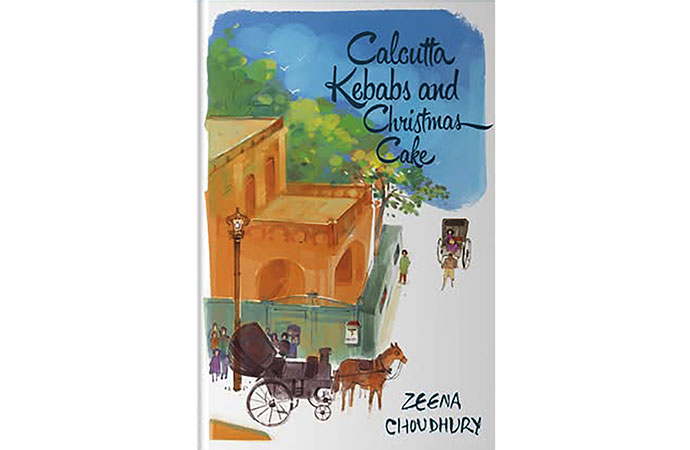
In the capital city Calcutta, 7 Park Lane is the domestic domain. "7 Park Lane, Calcutta was a corner house behind the Nawab of Murshidabad's palace...7 Park Lane is etched in memory like a beloved sepia photograph...It was a world apart from the disciplined confines of Loreto Convent, Darjeeling." 'Zeenie' (nickname) spent the years 1946 to 1951 at the hill-station; returning to 7 Park Lane for her winter break. The order was founded in 1609. I attended Loreto Convent in Nairobi, Kenya in the mid-1960s for my A-level studies.
Zeenie's innate curiosity while coming of age and her embedded close interaction in the lives of her extended family, both young and old; form both the framework and content of her autobiography. The book's title reflects the city and the symbolic presence of Zeenie's two Queens; Her Nanna is the landlady and her maternal grandmother who resides upstairs at 7 Park Lane. Maggie is the other loving grandmother residing downstairs. Thus we have 'Kebabs from upstairs and Christmas Cake from downstairs.'
Her first visit downstairs results in the following welcome: "So you are the pretty princess who climbed the convent walls and escaped." I giggled quite pleased, then beamed. I loved her from that instant. "I am Zeena from upstairs. I introduced myself and curtsied. Nanna send some food. She hopes you will like the kebabs..." Thus we have our first introduction to Zeenie. She describes herself in the 'Dramatis Personae' innumerable pages later; as "Narrator and 'Princess of Park Lane'; observant, mischievous and tender-hearted."
Following the sudden demise of Grandpa Georgu, Maggie's husband, Zeenie hurries downstairs. "Again, I performed "my show-off" curtsey and apologised, "Oh, I am so sorry. I am not wearing black or white." "Come, little Zeena-I will put a black bow in your hair, and from now on, I am your downstairs Grandma Maggie. You are my princess granddaughter, Zeena, who has come all the way from her convent school in Darjeeling to be near me, to share my grief, and to love me." At this, my tears trickled down- Maggie handed me her beautiful lace handkerchief, which I set aside, reluctant to spoil its spotless beauty. I wiped my tears with my hands."
Nanna's dressing table "had three large mirrors. 'The central mirror was fixed, while the other two could swivel outward and inward in a semicircular motion. The table was big enough for me to kneel on...I called them "the Three Zeenas'" My mirror friends were my closest confidantes, sympathisers, and most of the time, my loyal supporters!...I cried copiously, running to the Three Zeenas to see how I looked. They looked sad their eyes brimming with tears!" To add insult to injury, "I heard Reaz (her brother say) "Nanna, she is at it again - in front of the three mirrors acting out the death scene."
The 'Princess of Park Lane' is a cheeky charmer perfecting the art of performing deep curtsies and a well-practiced wink or two; as the following extracts amusingly and touchingly depict. "The most notable man at Lower 7 Park Lane was 'Sunburnt"-yes, that was what he was called...I soon discovered he was 7 Park Lane's very own Rhett Butler, our Clark Gable. I had recently watched Gone with the Wind, and, like everyone else, was captivated by Clark Gable...Every time we met, we would re-enact the final scene of Gone with the Wind. I was, of course, Scarlett O'Hara he was my Rhett Butler - we would both giggle, and then I would say, "Rhett, Rhett. You're not leaving me?" He would reply, "Frankly, my dear, I don't give a damn," and then I would sigh and say, "After all, tomorrow is another day." Another memorable scenario is at a Christmas party. Zeenie recognises Santa Claus as none other than 'Sunburnt.' She administers double winks across the room. In return, she receives double Christmas presents.
Listed in 'Dramatis Personae' is Master Moshai.' "Master Moshai, to put it simply, was my "bestest" friend - he ranked just below Nanna and Maggie...With him, a walk was history, poetry, theatre. We critiqued films and jatras, hummed ragas and popular choruses, studied Zainul Abedin's famine drawings and Jamini Roy's folk saints, debated everything and dared to form opinions." His name was Dipankar Chakrabarty. "Dipankar" - deepa (lamp) + pankar - (bearer) - fitted him to a T - fitted him to perfection! One who carries light - symbolically, it represents wisdom, enlightenment, guidance and inner brightness! Now, we get the essence of the cheeky child Zeenie reaching out as an adult; the author Zeena. His wife is Memdidi.
Zeenie's gifted photographic memory which she inherited from her mother results in charming vivid narratives. Simultaneously, Zeenie also relates frank details of family members and other painful adult encounters. An invitation to Memdidi and Master Moshai's 30th anniversary of their very first meet in Brighton on 19th January 1920; as well as a Brahmo Samaj prayer meeting was attended by the 7 Park Lane residents. Amongst much merriment, "I noticed...He was his usual cheerful self...though Memdidi wore a tight smile...To Nanna, she had confided the sad truth about her three miscarriages; that, due to medical complications, she would never be able to bear a child."
Seated at the piano, Memdidi "sang in plaintive tones:
Shokatore oi kandiche shokole, shono! Shono! Pita!
Ja kichu paay, haraye jaay, na mane shantona"
"Roughly, it translates:
"Oh Father! Hear our cries of despair
Whatever we receive we seem to lose,
Leaving our hearts inconsolable!"
"Memdidi's utterly inconsolable look will forever remain with me in my memory! Late at night, "Nanna spoke in tight whispers, clutching the phone. "Oh no! Master Moshai...it just cannot be!...Mira has killed herself." A heart-rending experience for a sensitive child to witness.
A contrasting exposure for Zeenie is the arrival at 7 Park Lane of Nana Sahib (her maternal grandfather). "He arrived in a black taxi that pulled up with a thud -just like our hearts...The whole house seemed shrouded in gloom, despite the bright winter sunshine outside....I felt so suffocated that I tiptoed down the stairs to Maggie...and cried for Nanna, who looked so sad....How dare he come back to 7 Park Lane - Nanna's house - after pushing her aside to make way for his third wife? I absolutely detest Nana Sahib - with his bald, sallow face and a nose that runs a mile. Please, please - can't I stay with you until he leaves?" Maggie replies "...I think this is the time for you to be her special guardian angel, always by her side." At a tender age, Zeenie is exposed to harsh realities of life and the deep pain endured by a loved one.
Moving on to Calcutta's cityscapes steeped in history and rooted in heritage; Zeenat evolves into a compulsive researcher. All her childhood locations come alive with distant memories; as she provides the reader with adulthood research. We read of her familiar and favourite places; providing us with the rich background of its founders in a historical and cultural context. One is transported to an era; a Calcutta in the 1940s with its cosmopolitan composition of inhabitants and their life-styles.
"St. Lawrence De Souza's Old Age Home (1914) was part of Loreto House's commitment to community service. It was situated on Dharamtola Street one side of the 'White Town...the door opened, and there stood Maggie's Aunty Phyllis! (Maggie once explained to me that only the "pukka" English used the word "Aunt," While the less "pukka" ones said "Aunty." It's interesting how one remembers these little bits of information!" One is never too young to learn as did Zeenie. Neither too old to learn, as did this reviewer!
Cultural and religious rituals of Eastern and Western origin: Muslims (Sunni and Shia), Buddhists, Jews, Hindus (of every caste), Christians (Anglicans, Catholics and Protestants) appear. Zeenie's accounts of these exposures include descriptions of gastronomic spreads; all in good taste.
No book on Calcutta may omit Park Street. In the author's words, "Park Street was the pulsating nerve centre of Calcutta, known in colonial times as Shaheb Para, or the Englishmen's neighbourhood. Park Street dates back to 1760 when Calcutta was the capital of the British Empire in India." Zeenie's regular treats at Flurys Tea Room occurred often with Granny Maggie. It opened in 1927 run by a Swiss Couple. Across the street Trincas Tea Shop opened in 1939. As the years passed; "Trincas jazzed up its repertoire and food fare, transforming itself from a tea room into a cool café, where it was a 'must' to be seen in the sixties and seventies. Then there was Peter Cat, Blue Fox, Mocambo (where every smart girl wanted to be proposed to!)" and Moulin Rouge for its naughty cabarets - ones with an oomph (vital energy and sensual appeal)" All remain habitual haunts.
"A wedding lunch took place at "The Grand!... a hotel that played a memorable role in all our lives." Today, Oberoi runs Grand Hotel; still grand. The wedding cake was from Nahoum in New Market. "It was started by Nahoum Mordecai, a Baghdadi Jew in 1902. Its popularity lingers on.
So do the contents of Chapter 14 'Visit to Nizam's, Faluda and Kathi Rolls.' "Great Eastern Hotel, itself with its 100 rooms and a department store combined" had Zeenie recall "Another of Sunburnt's amusing stories...' To quote Rudyard Kipling, 'a man could walk in at one end, buy a complete outfit, a wedding present, 'seeds' for the garden, have an excellent meal, a burra peg (double measure of spirits), and if the barmaid was agreeable, walk out at the other end, engaged to be married.' Run-down for years, Lalit Group revived it and remains 'Great.'
Chapter 53 - 'College Street' "was Calcutta's iconic Boi Para or Book Centre...It was said of any book that if you couldn't find it in College Street, it didn't exist." It remains a bibliophile's haunt; to be followed by a stop-over at The Coffee House. A recent revisit to the eminent Presidency College failed. Security measures prevent visitors. Earlier, I was able to visit the alma mater of my late father.
Sometimes memories are best left alone; as my husband and I discovered in a visit to Metiabruz in late 2025. Our visit to Lucknow in 2003 has left us with vivid memories of 'How it Had Been.' Zeenie relates her family's visit to Metiabruz, the final resting place of the Awadh Royalty, who was deposed as ruler of Lucknow by the British administration. She informs us that "This invitation was accompanied with a lot of khushamdid (welcome), adab (bowing of the head) and full display of Lucknow tehzeeb and adah as we entered ...: A vivid description of the namaz ghar follows: "The entire roof was covered with deep pink Madhumalti creepers which crept down the spines of the glass walls. The entire namaz ghar was nothing less than an exotic poem!" That was then.
Our drive to Metiabruz is best forgotten. It was a rackety ride; all the way to a destination unknown at road-side stops. No knowledge of the palatial cultural court the exiled ruler of Awadh had set up in his assigned habitation. Finally, we were told of the Imambara, his burial place. Two elderly guardians guided us to a gated namaz ghar; through which we spotted from a considerable distance, a further gated enclosure where lay the grave of the Nawab of Awadh.
'Calcutta Kebabs and Christmas Cake' comes to a close on page 568. That is the text. Then follows an 'encyclopedia' of 25 pages of 'Dramatis Personae'; Glossaries (General) and (Theme) ie. Food and Drink, Clothing and Ornament, Places and Institutions, Religion and Ritual, Music and Performance, Transport and Things and Language and Social. Family photographs dating from the 1930s to 2026; add faces to the narrative. Genealogies follow. Close to six hundred pages, the book qualifies for the remark by C.S. Lewis; British author (1898-1963). "You can never get a cup of tea large enough or a book long enough to suit me."
Raana Haider is the author of 'India: Beyond the Taj and the Raj', University Press Limited (UPL) Dhaka, 2013.
A Independent Newsweekly
© Copyright 2026 | Designed by ARK Reepon & Developed by Cosmos Group Software Team




Leave a Comment
Recent Posts
UNGA presidency: A significant ...
No matter how you look at it, Dr Khalilur Rahman's election as pre ...
On the trail of the Asian Wild ...
The conflict between humans and elephants has reached an extreme level ...
Electricity prices were hiked
Bishwajit Goswami’s work travels to Brooklyn, New Yo ..
The Intelligence That AI Is Missing
The One Man Who Could Give Trump Middle East Peace