


Column
We should document our 40s generation in Kolkata

An Independent Newsweekly
Column
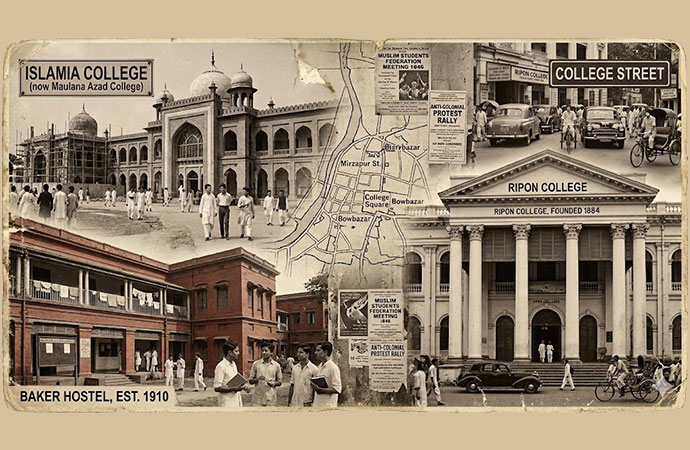
My father was born 107 years ago in 1919 a world away in time and space. He spent the first decade in various parts of Noakhali and Barisal his home zone but by the time he hit double digits, he was travelling with his oldest sister's family who sort of raised him. They travelled to different parts of colonial Bengal as her husband, an educationist, was working for various institutions till he ended up as the Director of Public Education of the Government of Bengal and was posted in Kolkata.
His "Calcutta" days
My father passed his Matric from Park Street High School, graduated from Islamia College and studied at Calcutta University. Later he joined the Calcutta metropolitan police force before he caught a thief in a banker's home which was his big break. He got an offer of a job in that bank and happily switched to being a banker which became his life long career.
So, Calcutta or Kolkata as it's now called is where my father grew up really in every sense. In every way it's the premier city of pre-1947 Bengal that produced the children, especially the male children who had gathered there from all over Bengal to study and prepare for their later life and careers.
Baker Hostel
My father's fondest memories were about the days spent in the Baker Hostel, the residential cave/ hostel for Muslim students studying in Kolkata. My father, though had a room in his sister's home, had moved there and made friends with many who mattered in our history. They mattered not only then as the new members of a brigade that was pumping blood into the movement for a newly emerging post- colonial state but who later on played more significant roles in the successful Bangladesh movement leading to 1971.
A few names will suffice to showcase the time and people of that era. My father's roommate was Justice Abu Sayeed Chowdhury, the first President after 1971. Another hostel mate was Kh. Mustique Ahmed, who became the President after the assassination of Sk. Mujib. And Sk. Mujib himself was 2- or 3-years junior down the college class rung and fellow resident. So much of our history was happening there whose inheritance now is what we have as an independent state.
Politics, state making and the city
These educational institutions played a crucial part in the production of the psyche that sustained them through the political crisis of late 40s as the region hovered for membership of not one but three states- India, Pakistan and (United) Bengal.
In the end, in 1947 my father and his friends became a part of a "Pakistan", something very few of them wanted. They didn't accept that verdict and the movement to produce a new and independent state as per the Lahore Resolution of 1940 began almost immediately.
It's not an accident that so many of that crowd, whether activists or supporters, belonged to one of several Kolkata based institutions. And here is the catch. All these political conversations, activism, secret meetings to birth a new state Bangladesh whose capital is Dhaka didn't happen on the shores of this city but far away in Kolkata or as it was then, Calcutta.
The irony is that the city in many ways shaped them and they had identified with the spirit and charm as well as its rigors but at the same time, they knew they were not in charge of the city and were tacit outsiders. They felt that the city they loved and let's face it most did, was not theirs at all.
It belonged to another group, a group that didn't go to Islamia College or Ripon College or shared rooms in Baker Hostel. So when 1947 came and Calcutta was not their home to be, it caused a tear in their heart that never really healed and that is why whether its Sk.Mujib or my father or another resident, the rage against both India and Pakistan was so high.
Memories of East Bengal in India
Most of them were from what was East Bengal between 1905-11 and were producing their future in what was basically West Bengal's capital so to speak but essentially it was the Centre-Margin conflict that was at play. And the souls who were populating the streets of Kolkata's educational heritage of my father's kind had become very historically significant.
They were redoing and even dismantling a comparatively ancient world of traditional states which existed as part of the North Indian domination framework. They tried and did make one single meta cluster impossible-India.
Next, they tried to create the first East Indian state or Bengali state - United Bengal - but failed. And as it happens in history so often, they became partly accidentally, part of a dysfunctional North India dominated construct -Pakistan in 1947. But here is the point- they successfully took it apart and produced the first independent non-North Indian state in the region- Bangladesh-in 1971.
Now that, if you consider the matter historically, is truly significant even in the very long term and these people who walked the corridors of Islamia College, Ripon College or Presidency and largely from East Bengal were truly of the same important variety. However, we haven't got any comprehensive history of them or even a proper memorial volume of such a lot. They deserve it. Wonder, how we can develop an organised cluster of such a history.
A Independent Newsweekly
© Copyright 2026 | Designed by ARK Reepon & Developed by Cosmos Group Software Team




Leave a Comment
Recent Posts
Is the international community ...
A spate of downgraded economic projections, from Bretton Woods to Mani ...
A Childhood Lesson in Arithmet ...
As children, we learned a simple mathematical rule: if we know the pri ...
Indian authorities launched a major security crackdo ..
Police dispersed garment workers from the Azampur ro ..
Why Saudi Arabia has struggled to defend itself agai ..
Iran-backed Houthis strike Saudi oil company Aramco’ ..