


Column
Making peace with the multiple histories of 1971

An Independent Newsweekly

Column
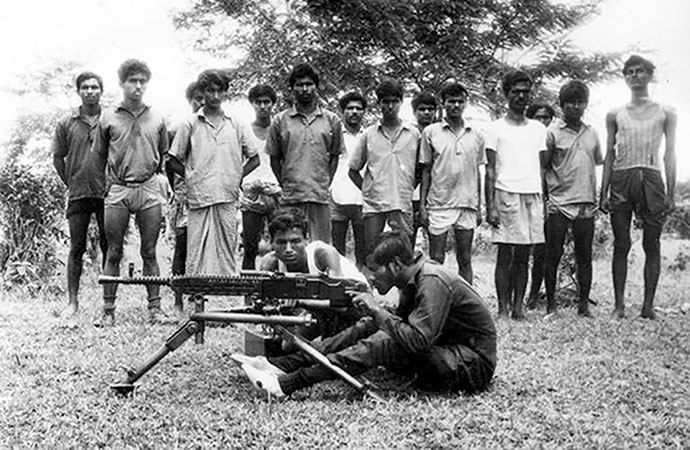
Freedom fighters Training, 1971. Photo: Collected
In few zones of the world is history so debated and fought over as in Bangladesh. It's also interesting that the fight occurs without any regard for facts. This would sound very odd and contradictory unless one realizes the purpose of "history" in Bangladesh to the ruling class is not about creating educational spaces and information dissemination but legitimizing regimes.
It's interesting how in the last 54 years Bangladesh has gone from extreme veneration to dubbing the 1971 war as a treasonous act. It stands today in a limbo where various interpretations exist offering a wide menu of histories to pick from. The key issue is that the debates are not about history but a branch of any contemporary politics.
It's here that the key to the interpretation of history according to political convenience lies. The conflict over "history" rather than its dissemination is about control over State power. This is because 1971 history is seen exclusively as state making history rather than the struggle of all the spaces and forces, particularly the social force which the State chooses to ignore. So all the confusion and contradiction is about who can claim the credit or deny it most vehemently hence can then claim the legitimacy to rule over the Statist space.
Society doesn't bother about State history because their history is not about power but survival and ultimately prevailing socio-economically. It's ironic that although society is not discussed and all attention is on the State or the formal construct, it's the informal which dominates Bangladesh economics.
The best indicator of social/informal dominance is that 85% of the people make their livelihood from the informal sector while only 15 % are part of the formal. As it happens, our academic and institutional researchers' belong to the smaller 15% which is why that is constantly in the news while social or informal history is ignored or forgotten, often deliberately.
Mainstream and historical stream
Country, State and society are three different realities. Country includes both but State and Society are different in function, purpose and roots. States are constructed while societies are organic emerging over time. One comes into being when s ruling classes emerge which want to control the rest of the producing systems and mechanism for the same. It happens when there is enough surplus to justify spending money to control using managers. However they are not water tight realities.
Societies come into existence as soon as humans need each other to survive either socially or economically or environmentally to prevent a security threat or any such situations. Over time they evolve into more sophisticated constructs but one is formal and another is informal with their identity, being and most importantly history located in their own distinct and different space. It's connected but not the same.
What happens or happened in South Asia is the marginalization of social history and supremacy of State history as the ruling class supported by its elite functionaries have claimed the state as synonymous with people and society. Statist political history is not only the dominant narrative but the only narrative.
It means supremacy of the political institutions and its arms such as the army, the bureaucracy and the rest of the official world is historical. The reason behind such efforts is to produce a single or monolithic stream of history denying others any role which in turn justifies higher privileges for the elite class.
What happened in Bangladesh in 1971?
Essentially three forces were in operation as part of counter -attacking the Pakistanis from March onwards more actively, which began way before in various stages of history. To this is added the 'Independence Declaration' debate, which is one of the more significant yet largely misunderstood debates.
Few events testify to the contending claimants of the State forces as the civilian political cluster fights the military cluster, the two contending claimants for state power. Its not usual for the military to claim supremacy over the political but as one was regularly deposed by another and is a regular participant in the claim for state power, this is inevitable. It also means that the State as an institution is not fully formed or functional as one would have thought.
However, this debate dominates politics just as does the "how many were killed "debate. The 3 million shaheed debate is not about the number but who makes it and who counters the claim and by doing so diminishes the clout of the claimant. In other words, it's not if 3 million were killed or not but who is saying that it happened so and enhancing or reducing the right to claim state power.
It's not a matter of historical knowledge seeking but claiming the right or contesting the claimant. The claimant can say that it led the effort against such a horrific enemy and came out victorious and those opposing them therefore have no moral right to do so. The opponents can say, if the number is not accurate, the claim is also false.
Statist history is largely about facts of convenience to claim or continue in power. This tradition continues till today and the current crop of politicians are no different while constructing a history of politics. It's not about history but politics of state power. Very few are interested in such debates and it faded soon after 1971 as members of society struggled to survive in a post war crisis.
The social dimension
Bangladesh had a period in the war of 1971 when everyone more or less occupied a common space. This was in the immediate aftermath of 1971 after the crackdown by the Pak army on March 25 and lasted till end April in 1971. It resulted in immediate resistance from all over Bangladesh and every segment, formal, informal and in-betweens were involved. It's the united phase of multi-sectoral alliance. However, after the end of April with the fall of Kushtia, this phase ended.
By that time, the Mujibnagar government was established in Kolkata, the formal military forces were also in India and Bangladesh was in occupation. Hence the division between the formal and the informal became wider.
However as Pakistanis were to discover and have admitted indirectly, their lack of preparations to counter resistance after the March crackdown was a situation they were not ready for handling. In many cases they had to enter the villages not just to "pacify" resistors but also secure food and rape occurred in such situations too.
It was of course inevitable but the universal level of resistance including participation of the villages not always in direct combat but support and supply as well and the consequent violence were beyond politics. It basically ensured that villagers too would become part of the war that followed, from resistance to independence.
"Niyomito bahini" and "Gonobahini"
Two distinct realities emerged including in the division of warriors. One was the regulars who were linked directly to the State and included the army members who had joined Bangladesh and the later graduates. BDR, police, professional armed forces etc made up the regulars and were dubbed the "Niyomito Bahini," the formal part of the war linked to the State.
Thousands of civilians also went over to India to training camps and after a few weeks of training under Indian commanders, returned to the villages and conducted various guerilla operations. The cities were also active, though less so, and included the well-known "Crack Platoon" that conducted a series of operations in Dhaka. These were all dubbed as "Gonobahini" by the Mujibnagar government. In many ways this signifies the two different trajectories of the war united by a common enemy.
The third force would be those who were non-formal forces such as the Quaderia Bahini in Tangali, Hemayet Bahini in Borishal, various Leftist bahinis in North Bengal, Narsingdhi, Khulna , Noakhali , Sylhet etc. While some were pro-AL, others were anti-AL to passive allies. They were not connected to Mujibnagar but were linked while others were on their own. However, they all fought against Pakistan.
The most mentioned such force is the Bangladesh Liberation Forces (BLF), more popularly known as the "Mujib Bahini" - who were composed of AL student and youth activists but the force itself was run by the Indians outside Mujibnagar control. They were less friendly with the Tajuddin Ahmed government from the very first and reflected internal divisions within the party.
In other words, even within the armed sections, there were multiple streams at work and each constituted different roots and sources of historical narratives.
3 lenses to look back
Our monolithic narratives of 1971 change with every regime, but the monolithic history model doesn't change. We see that one singular narrative replaces the other singular narrative. However, the diverse nature of society, the weak and inner conflicted state and the existence of informal and formal spaces even within and without these spaces themselves makes a dominantly agro-society very diverse. The village sustained the 1971 war because while the cities were easily pacified, with many people dependent on the Pakistan state for economic survival, the villages were in those terms relatively "free", besides suffering in the extreme. They were anti-Pakistani but interestingly not political statists or even particularly 'patriotic', by those terms.
In a survey we conducted in three districts (2013) - Magura, Faridpur and Barisal, on what prompted many villagers to take up arms, we found the following main citations given as causes:
i) We wanted to take revenge for what we had suffered or family or clan members had
ii) If we didn't fight them they would take our women away
iii) Pakistanis and razakars have killed and raped in many places so to survive we must learn to fight.
iv) We are facing oppression from the Shanti committees and many who were opposed to the Sangram Committee now want revenge.
v) We want to make Bangladesh independent so that we can live in peace
This shows that Statist aspirations were not the major factor in motivation but survival instincts, which included revenge, were. Rural politics were also a factor as power shifted several times in the late 60s to the 70s. Most or almost none cited political reasons but social realities.
Although many were trained by BD and Indian state forces, their return to the social space meant they acted based on social and rural realities, not Statist principles. It's no accident that most repression, killing, rape and the rest occurred in the rural areas. So did most resistance acts to the Pakistan forces. In a way, 1971 was more of a rural than urban reality though the State was an urban construct.
The international dimension was another factor which has a separate dimension linked to other politics.
Within the armed conflict space we also find a significant difference between the formal warriors with their regular supply chain, access to training - officers' training- in India, opportunity to retreat to safety across the border, etc. These are standard regular warriors of a formal Statist army.
The guerillas however were sustained by society and institutions, both informal. Those who assisted, without whom no guerilla operations would be possible, did so voluntarily with no ability to be safe making their war significantly or fundamentally different from the regular war though it involved more actions , more people and greater historical impact. Hence the military history of 1971 is not monolithic either.
A formal frontal war and a people's and guerilla war are different and therefore have different histories. The formal war is also linked to international politics, positions and situations while the people's war was internal and almost all fought within the boundaries of Bangladesh.
The people as without, the people within
The war produced one of the largest numbers of refugees, running into millions. They were almost all Hindus, the only group which suffered violence for their identity. But our research shows that the objective of Pakistan was not to conduct a ethnic cleansing but India cleansing, Pakistan's permanent enemy. All Hindus were considered Indians, a Statist identity and by all other indicators, it was a war between two states -India and Pakistan- as far as the two were concerned.
No one was killed for being a Bengali. They were targeted as resistors, protestors, militant slum dwellers, political activists etc but not as Bengalis in any of the killings. The conflict for them was the State so for Pakistan it was the threat to its statehood that it was trying to resist and saw after 1970 the end of their false dream of a singular central state built through the denial of the Lahore resolution of 1940. So it was not a tri state war rather than a nationalist or ethnic war.
Hindus have always been marginalized in Pakistan and so had little activist role to play but by creating refugees and in so many numbers who described their harrowing experiences to the world as refugees in India , Pakistan was portrayed as the "genocidal" country which lost all support despite its role in the pro-US side of the cold war.
It created pro-Bangladesh sentiments, sympathy for India for supporting so many refugees and ultimately the justification for military intervention as it was clear that an economically weak country like India could not permanently house so many people so war against Pakistan was seen as justified for the sake of world stability that was being threatened by the influx.
Thus the Hindu population also has a different history altogether in 1971. Just like women.
Our own "Troubles" (Gondogol)
The world of "gondogol" or troubles was generally used by ordinary rural people who experienced 1971 as the most wretched year of their life. This word was considered very "disrespectful "by the AL as it held no Statist, not even political connotations. It simply referred to a year of great distress. That sums up most succinctly how it was perceived by the majority.
However, in any nationalist political narrative particularly when it's about States, everything is about politics and not society and its experiences. Statists can't accept or perhaps understand an alternative narrative which is society centric. As a result, most such narratives are lost and no preservation attempts made although it's the historical narrative of the overwhelming majority.
There are many such streams and sub-streams which find no space and if in deviation from the Statist narrative, it is ignored such as the history of the Adivasis or the historical victims such as the Urdu speaking population caught between three warring states.
The narrative battlefield
In the end, any event like 1971 which involves State making, social turmoil, armed violence, extreme inhumanity and humanity both, mega production of cross-border refugees and global politics at both military and diplomatic levels won't produce one history. The ideological constructs were many and enmity was as complex as alliance making at the global to the household level.
Thus there were many histories at play and State making was only one of them. Bangladesh remains largely a country with a very weak state construct so many years after 1971 while the informal social space has strengthened immensely constituting 85% of all economic transactions at least.
The fact is obvious that while the State gets the credit, history is at play everywhere. Which is why, a single or monolithic narrative of 1971 is not just a methodological error but has over time become a tool for political control. It's not just in the absolute monopoly of AL in claiming the credit for 1971 but in the extreme stage at the absolute denial of 1971 as a historical event at all levels.
History is always multiple but the ruling classes are by definition Statist so production of monolithic narratives is a necessity of political power claiming not historiography.
One 1971, many histories.
A Independent Newsweekly
© Copyright 2026 | Designed by ARK Reepon & Developed by Cosmos Group Software Team



Leave a Comment
Recent Posts
A commendable intervention by ...
A struggle for local dominance in the Chittagong Hill Tracts, specific ...
How close is the Amazon to a ‘ ...
While Brazil’s presidential candidates have not made policy of t ...
Another shipment of highly radioactive uranium fuel
Harmony: Diplomatic community joins Durga Puja celeb ..
What to know about the Ebola outbreak that has sprea ..
Brazil election: Trump’s ‘Donroe Doctrine’ faces its ..