


Column
After Forty-Seven Years of Hostility, Peace Beckons in the Gulf

An Independent Newsweekly


Column
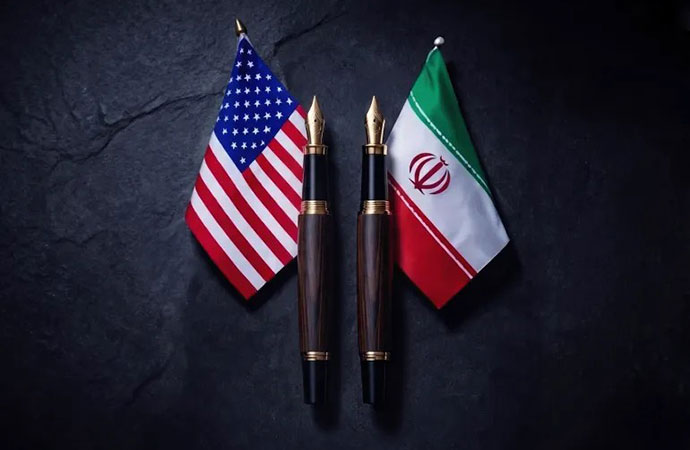
Image: Collected
Only a few days ago, President Donald Trump was calling Iran's leaders "scumbags" and "crazy bastards." He described Supreme Leader Ali Khamenei as one of the world's most evil men and threatened devastating military retaliation.
Today, the same president has signed a memorandum of understanding with those very leaders in the hope of ending nearly half a century of hostility between Washington and Tehran.
Whether the agreement ultimately succeeds or fails, the reversal is extraordinary.
Language of confrontation
For forty-seven years, the United States and Iran have viewed one another almost exclusively through the language of confrontation. Diplomatic relations disappeared after the 1979 Islamic Revolution. Economic sanctions became routine. Military confrontation, proxy wars and mutual threats replaced dialogue. Few imagined that the American president who withdrew from the Obama nuclear agreement and ordered the killing of General Qassem Soleimani would one day become the architect of a new opening toward Tehran.
Yet that is precisely what has happened.
Critics immediately denounced the agreement as an American surrender.
Supporters see something entirely different: a calculated gamble that an imperfect peace is preferable to another Middle Eastern war.
Why the Critics Are Angry
On the surface, the criticism is understandable. The agreement appears to grant Iran substantial immediate benefits. Washington has agreed to suspend its naval blockade, begin lifting sanctions, facilitate the return of frozen Iranian assets and support an international fund to help rebuild infrastructure damaged during the conflict.
Iran's obligations appear far more limited. It has agreed to reopen the Strait of Hormuz, continue negotiations over its nuclear programme and reaffirm that it will never acquire a nuclear weapon.
To many observers, the balance appears lopsided. The conservative New York Post summarized the criticism in a single headline: "Iran Gets Everything. America Gets Nothing."
Several Republican lawmakers questioned why Washington would reward a government it had only recently described as the world's foremost sponsor of terrorism.
Israeli leaders have been equally uneasy.
If one judges the agreement solely by the number of immediate concessions extracted from each side, the critics have a powerful case.
So why did Trump sign it?
The answer, I suspect, has less to do with Iran than with economics. Trump himself offered an important clue during the G-7 summit.
"I don't want to end up like Herbert Hoover," he remarked.
At first glance, the comparison seemed puzzling. It was anything but.
Herbert Hoover's presidency became synonymous with the Great Depression. Whether fairly or unfairly, history remembers him as the president who presided over one of the greatest economic catastrophes of modern times.
Trump clearly understands the political consequences of a similar crisis.
The conflict had already begun disrupting shipping through the Strait of Hormuz, one of the world's most important energy corridors. Prolonged instability threatened higher oil prices, renewed inflation and slower economic growth-not only in the United States but across much of the world.
With congressional midterm elections approaching, that may have represented a greater political danger to Trump than the prospect of negotiating with Iran.
The president has often viewed foreign policy through an economic lens. Unlike many traditional hawks, he tends to measure success not simply by military victories but by their impact on American prosperity.
From that perspective, reopening Hormuz, calming energy markets and preventing another regional war may have appeared worth paying a considerable diplomatic price.
There may also be a broader strategic calculation.
Throughout his political career, Trump has repeatedly argued that America should not become trapped in endless Middle Eastern conflicts. His rhetoric has often been bellicose; his instincts, however, have usually been transactional. He has consistently questioned whether prolonged military confrontations serve American interests.
The agreement reflects that philosophy.
Rather than pursuing maximalist objectives such as regime change or the complete dismantling of Iran's strategic capabilities, Trump appears to have narrowed his ambitions to a single overriding goal: preventing Iran from acquiring a nuclear weapon while avoiding another costly war.
Can the Agreement Survive?
The agreement's greatest challenge may not come from Tehran. It may come from Jerusalem.
Prime Minister Benjamin Netanyahu has spent much of his political career arguing that Iran represents an existential threat to Israel and that sustained pressure-not accommodation-is the only realistic strategy. The new memorandum rests on a very different assumption: that Iran cannot simply be isolated forever but must eventually be integrated into a more stable regional order.
That is a proposition many Israelis find difficult to accept.
Netanyahu has therefore responded with remarkable caution. Publicly, he has avoided a direct confrontation with Trump. Privately, however, Israeli officials have reportedly expressed deep frustration over both the agreement itself and the manner in which it was negotiated.
Israel's greatest leverage lies not in Washington but on the ground. A renewed military confrontation with Hezbollah in Lebanon-or another escalation involving Iran-could quickly unravel the fragile diplomatic process before it has a chance to mature.
Trump appears well aware of that danger. His administration has made clear that preserving the ceasefire and preventing further escalation are now essential to the agreement's survival.
Nor is Israel the only uncertainty.
If Iran violates its commitments or refuses meaningful international verification of its nuclear programme, the agreement could collapse almost as quickly as it was signed. Trump himself has warned that military action remains an option should diplomacy fail.
Peace, in other words, remains a possibility-not yet a reality.
Why the Gulf Is Quietly Hopeful
Perhaps the most revealing reactions have come not from Washington or Tehran but from the Gulf. No region has more at stake.
Saudi Arabia, the United Arab Emirates, Qatar and the smaller Gulf states have lived for decades under the shadow of Iranian power. None harbours illusions about Tehran's regional ambitions.
Yet years of conflict have taught them another lesson. Permanent instability is even more dangerous.
Their prosperity depends on open shipping lanes, predictable energy markets and investor confidence. Every missile fired across the Gulf threatens not only national security but economic transformation itself. That helps explain why Gulf governments welcomed the agreement with cautious optimism.
Their enthusiasm is not rooted in affection for Iran. It is rooted in a simple calculation: stability is better than perpetual crisis.
One Gulf newspaper captured that sentiment by arguing that the region should celebrate the fact that it is discussing peace rather than preparing for another war.
That observation deserves attention. Outside powers often view the Middle East through the lens of ideology or military strategy. Those who actually live in the region increasingly view it through the lens of stability.
Giving peace a chance
When Richard Nixon travelled to Beijing in 1972, many Americans believed he had rewarded a sworn adversary while receiving remarkably little in return. Only later did the opening come to be seen as one of the defining diplomatic achievements of the Cold War.
The Iran agreement may never deserve comparison with that historic breakthrough. Or it may.
For now, the agreement deserves neither uncritical celebration nor instant dismissal.
It deserves the chance to succeed.
A Independent Newsweekly
© Copyright 2026 | Designed by ARK Reepon & Developed by Cosmos Group Software Team





Leave a Comment
Recent Posts
Is the international community ...
A spate of downgraded economic projections, from Bretton Woods to Mani ...
A Childhood Lesson in Arithmet ...
As children, we learned a simple mathematical rule: if we know the pri ...
Indian authorities launched a major security crackdo ..
Police dispersed garment workers from the Azampur ro ..
Why Saudi Arabia has struggled to defend itself agai ..
Iran-backed Houthis strike Saudi oil company Aramco’ ..