


Business
The Bengal Precipice of the Shipbreaking Industry


An Independent Newsweekly



Business
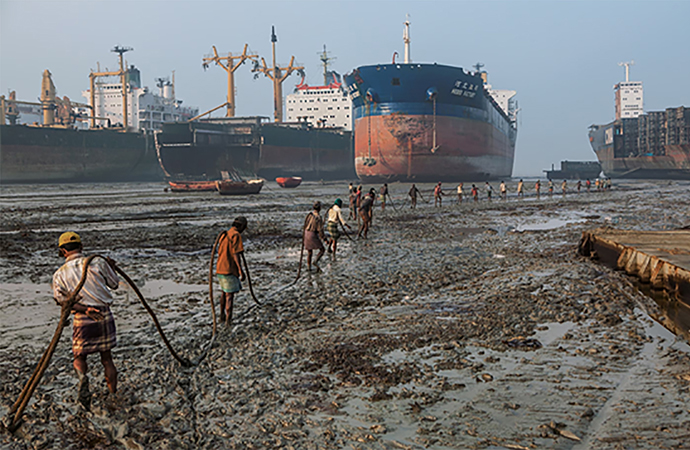
‘Beaching a ship’ From National Geographic
Upon arrival at the Ferdous Steel Ship Recycling Industry (FSSRI) establishment at Sitakunda, the Master's cohort from University of Dhaka had found the air had turned - vaguely metallic, the kind of smell that makes an ecotoxicologist reach instinctively for caution. All in blue hues of the skies, and fading southwesterlies from the bay.
Rusted colossuses lying on their side, workers the size of ants scaling the hull with blowtorches. It was a theatre of industrial metabolism - the last rites of ocean giants from foreign states.
"It's where steel is borne from the bones of the sea, and the soil quietly drinks the poison," quipped Dr. Afrose Sultana Chamon, the practicum course supervisor from the Department of Soil, Water and Environment at DU. Under her helm, this was a routine toxicology assessment tour for the cohort.
Bangladesh's shipbreaking industry is simultaneously magnificent and monstrous, an economic lifeline strung across a tightrope. The Sitakunda coast in Chattogram is where the world sends its dying ships, and where Bangladesh extracts something vital from their carcasses. Pumping an estimated $10 billion into the national economy as per the Bureau of Statistics (BBS); Daily Star reports corroborate that the yards along this 20-kilometre coastal strip dismantle anywhere between 110 and 254 ships annually.
While the invoice rendered to the environment remains staggeringly unpaid, a tentative green horizon remains in limbo, one that may or may not arrive on time.
The Art of Ship Disembowelment
Shipbreaking, stripped of its romanticised industrial mystique, is exactly what it sounds like: the systematic dismantling of end of life vessels (ELVs) into recoverable materials, chiefly steel scrap. But the process is far more consequential than a junkyard with ocean access.
The Sitakunda-Faidjurhat strip visited by the DU cohort operates on a large scale, consistent with the area's role as Asia's major ship-recycling hub. Even without laboratory assessment on the soil and water, the evidence was legible to the senses - a persistent petrochemical film on the surface of tide pools, discoloration of the sediment ranging from rust-orange to dead grey.
The industry has become a major contributor to the development of Bangladesh's national economy, supporting the steel, shipbuilding, furniture, building construction, machinery and electrical industries since the 1980s.
Using cutting torches, crews dismantle each vessel from the top down. Plate by plate, deck by deck, in shifts that extend through the night. Steel panels are winched and dragged ashore, sorted by grade, and fed back into the economies of construction and manufacturing. Chief engineers at the yards note that the recovered materials serve industries as varied as furniture, building construction, and electrical manufacturing - and, perhaps unexpectedly, jewellery fabrication from recovered copper and brass fittings.
In the language of environmental chemistry, they are chemical archives of the industrial age. Their hulls are insulated with asbestos. Their electrical systems carry polychlorinated biphenyls. Their ballast water holds residual fuel oils, and anti-corrosion paint systems contain tributyltin and lead compounds that leach directly into the sediment upon grounding.
Board-level personnel at the facility described asbestos discarding as "field protocol 101"
Bulk carriers, oil tankers, and container ships arrive at the premises, operating across a 48,640 m2 facility at Bhatiyari, Sitakunda. Ferdous holds certifications under ISO 9001:2015, ISO 14001:2015, ISO 45001:2018, and ISO 30000:2009, in addition to full HKC compliance verified by the Indian Register of Shipping.
FSSRI's publicly stated HSEQ framework mandates structured hazardous materials handling at every stage of the recycling process flow, including containment, cleaning and discarding, repurposing, documentation and auditing. Whether these standards hold consistently under commercial pressure remains a legitimate question. What is not in question is that they represent a structural departure from the industry's historical norm.
Hull of a Deal
Bangladesh has recently discovered significant magnetite iron ore reserves, primarily in Dinajpur's Hakimpur upazila, with estimated reserves of 625 million tons. Discovered by the Geological Survey of Bangladesh (GSB), the ore is found at depths ranging 1300-1750 feet. It offers potential to reduce imports for the steel industry, with further exploration ongoing as of 2026.
The iron concentration recorded is extraordinary by global standards. The iron percentage in the Hakimpur mine is 60%, while in most comparable mines elsewhere in the world it remains below 50 percent. To contextualise that figure: geology literature establishes that the typical grade at which a magnetite-bearing banded iron formation becomes economically viable for extraction is roughly 25% iron.
Despite the mining opportunities, the country has a meaningful economic contributor that it cannot write off on account of a geologic report. In a country with no existing hard-rock mining infrastructure, sitting atop thick unconsolidated sediment, will demand engineering solutions that Bangladesh has never attempted at scale.
The water table, seismic sensitivity of the delta, and sheer depth of overburden present challenges that open-pit mining cannot resolve. Underground extraction, as such practised at Sweden's Kiruna mine, remains the most plausible model for extraction at Dinajpur, but at considerably greater capital cost. The contribution to the domestic production by the shipbreaking industry can therefore not be termed peripheral.
Why the Hull
Bangladesh did not choose this industry so much as inherit it. Selected by the cold logic of capital: cheap labour, a tidal coastline apt for beaching (essentially stalling ships at the beach), and, for decades, minimal regulatory friction. The returns have been extraordinary. In 2023, Bangladesh alone recycled more than 45 per cent of the world's ships by gross tonnage. The Chittagong yards collectively dismantle approximately 200 large vessels annually - two in every five ships broken worldwide. The recovered steel meets 60 per cent of Bangladesh's domestic needs, in a country where domestic iron ore refining remains, for now, a geological ambition rather than an industrial reality.
Since Bangladesh ratified the Hong Kong Convention in 2023, the number of HKC-compliant yards has grown to 13, with 15 more undergoing transformation. Mohammad Taslim Uddin, managing director of KR Ship Recycling Yard, framed the ambition plainly: "We want to secure stewardship among our pioneers, and become a global hub for ethical ship recycling." (FSSRI) is the country's largest HKC-compliant facility, certified under ISO 9001, 14001, 45001 and 30000, has led that charge. When the DU cohort visited Ferdous's Bhatiyari facility for soil, water and plant sampling from polluted surroundings, the cooperation was unconditional. Senior personnel including Meah Mohammad Asaduzzaman (COO), Md. Ismail (HSEQ Manager), Chief Engineer - engaged the cohort to explain their supply chain transparency and industry projections.
The cohort's field reports found that drainage infrastructure was well maintained; oil-bearing wastewater collection was operational and sophisticated in a particular Chinese register of efficiency. It was, in the most literal sense, a yard attempting to mean what it certifies.
Life-cycle assessments confirm that secondary steel rebar from ship scrap avoids approximately 1,965 kilograms of carbon dioxide equivalent per tonne against primary production. At national scale, that translates to an estimated 4.5 million tonnes of avoided carbon dioxide emissions annually - a figure that compliant yards cite, not without justification, as an environmental credential, though it amounts only to the carbon intake of 93 mature trees, annually.
Employment, formal and informal, runs into the hundreds of thousands when linkage industries are counted.
Survival in Sitakunda, however, has always carried a price paid in lives. On 7 September 2024, an explosion at SN Corporation, a certified green yard - killed six workers. A Ministry of Industries investigation found the yard responsible; it was fined Tk26 lakh and ordered to halt operations for three months. This was not a relic of the industry's lawless past. Fazlul Kabir Mintu of the Ship-breaking Workers Trade Union Forum was characteristically unsparing: "In the first six months of this year, 16 accidents were reported. Many yards are yet to fully implement the minimum wage."
A 2023 Human Rights Watch report documented systematic toxic waste dumping and a global intermediary network designed to circumvent export regulations. A 2017 occupational health study found over one third of workers suffering preventable asbestos-related complications. Heavy metal concentrations in the Sitakunda intertidal zone continue to exceed both WHO and national standards at every sampled station.
Reform, though, is measurable. Annual worker fatalities fell from 15 between 2005-2020 to 9.4 between 2021 and late 2024. As of June 2025, only HKC-certified yards may legally operate in Bangladesh.
Workers at FSSRI receive full PPE, regular health screenings - including lung function, ECG, blood and skin tests, as well as ongoing hazard training. Engineering controls are installed at identified risk points, and each incident triggers a root-cause analysis to prevent recurrence.
The shore is still stained. But it is being studied, regulated and, in the yards that have chosen compliance over convenience, slowly scrubbed.
Shoumik Zubyer is a researcher at the Bangladesh Atomic Energy Commission, the Space and Environment Research Centre and a science correspondent.
A Independent Newsweekly
© Copyright 2026 | Designed by ARK Reepon & Developed by Cosmos Group Software Team






Leave a Comment
Recent Posts
Birth Pangs of a Nation
As the nation turns 55, we are confronted once again with the difficul ...
What we know about diplomatic ...
U.S. President Donald Trump on Thursday threatened Iran with devastati ...
‘She was a natural athlete’: Coach recalls Zaima Rah ..
Concentrating on global irregularities
Repatriation of Rohingyas to Myanmar only viable sol ..
India looks forward to working closely with Banglade ..