


Reportage
A Time For Sovereignty


An Independent Newsweekly

Reportage
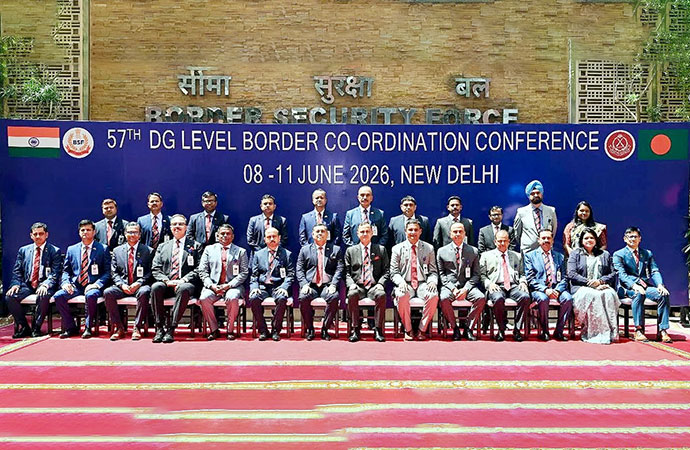
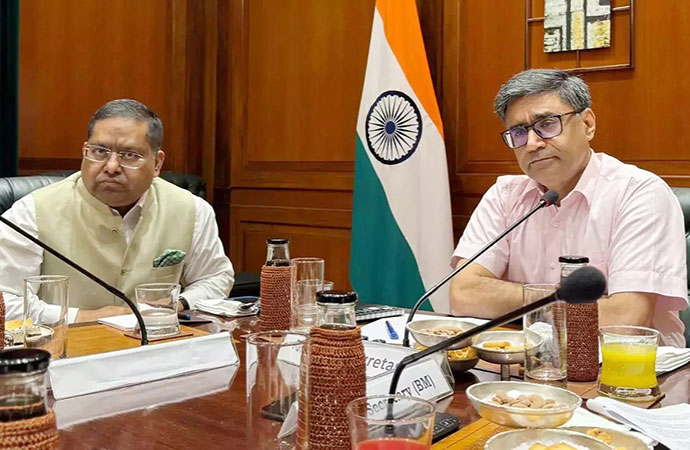
Officials pose for a photograph as the 57th BGB-BSF DG level meeting in New Delhi, India, June 9, 2025. (BSF)
Since May 2025, the Indian Border Security Force has renewed its resort to 'push-ins' - a sad and desperate last resort, when you yourself probably lack the capacity to organise a formal deportation or repatriation process.
It all started in the remote Chittagong Hill Tracts district of Khagrachari, where what was then reported as 80 Indian nationals were pushed into Bangladesh on May 6, apparently after labelling them as Bangladeshis.
According to Border Guard Bangladesh sources, BSF pushed 27 people into Bangladesh through the Shantipur border and another 23 through Achalong Para of Taindong Union. Besides, 30 people were pushed in through the Ruposhi Para border of Panchhari Upazila.
The group who were pushed in were residents of Gujarat state in India, and Muslims. They are able to speak both Gujarati and Bengali. It was learned that they were brought from Gujarat to Tripura state by two separate flights. Later, they were pushed into Bangladesh by BSF members.
The illegal entry is believed to have occurred via remote forest routes along the Raisyabari and Natun Bazar border areas of Udaipur district in Tripura during the early hours. Those detained said that members of the 114 BSF Elkepara Camp escorted them across the Shantipur border. Before crossing, they were blindfolded and forced to walk for nearly an hour inside Bangladeshi territory, they alleged.
That of course was still during the tenure of the interim government. Talking to reporters at the Ministry of Foreign Affairs, National Security Adviser Dr Khalilur Rahman said any push-ins should be done in a formal channel and Bangladesh's position is to welcome only its citizens with sufficient proof.
"This needs to be done in a formal channel," he said when a journalist wanted to know his comments referring to media reports. Indeed, Dhaka would seem to have moved little from its stated position at the time, and that is no surprise of course, with Dr Khalilur Rahman now serving as the foreign minister, in the elected BNP-led government that succeeded the interim.
A consistent position
Director General (DG) of BGB, Major General Mohammad Ashrafuzzaman Siddiqui, said in those early days even, that the "recent push-in incidents" at the border orchestrated by India were "well-planned" and "despicable". Besides, they were a violation of human rights, he said after the meeting of the Advisory Council Committee on Law and Order at the Secretariat. Home Affairs Adviser Lieutenant General (Retd.) Md. Jahangir Alam Chowdhury was present.
He said for those who are Bangladeshis, BGB is trying to repatriate them to their respective areas. "Among them, 39 Rohingyas were found. They were registered with our Rohingya camp, but somehow they escaped. We have sent them back to the camp."
The BGB DG said, "One of the alarming things is that some Rohingyas were found who are refugees of the UNHCR (United Nations High Commissioner for Refugees) in India, they are registered there. We also have their ID cards."
They should have been kept in the country where the refugees are. "We have found five such refugees. We want to inform everyone through our Foreign Ministry that this is a violation of human rights."
That was the start of a wave of push-ins that would last at least 8 months, and see over 2000 individuals pushed across. It would also see BGB and Bangladeshi citizens living in the border areas develop an extraordinary bond, extremely strong too, that would often band together to foil some of this foul play.
Around a week to ten days after that first push-in, BGB and locals reportedly resisted an attempt by BSF to push 750 people into Bangladesh through the border in Brahmanbaria district - leading to a tense situation along the borders between the frontier guards throughout an entire night, said locals.
It was learned that Indian law enforcers had detained over 600 people in the states of Tripura and 148 in Rajasthan during a countrywide crackdown, with New Delhi claiming that most of them were Bangladeshis and Rohingyas. The BSF reportedly took the detainees to a bordering area to push them into Bangladesh through Singarbil border of Bijoynagar upazila of the district.
Being informed, the BGB took position while locals also gathered along the border to resist the push-in. Local union parishad member Mamun Chowdhury said the BSF was forced to go back when the BGB and locals took position along the border.
Upazila Nirbahi Officer Sadhana Tripura said, "Situation is now normal along the border. The push-in attempt by the BSF has been resisted by the BGB and locals. All have been still at alert."
Lt. Col Jabbar Ahammed, commandant of the BGB-25 Battalion, said they took a cautious position after being informed about the possible push-in, and curious locals also gathered at the border.
Nights like these have not been rare in the border districts and their villages, since the political changeover of August 5, 2024. In a more recent incident, while the rest of the nation was celebrating Eid ul Adha in the traditional way, BGB with support from Bangladeshi villagers in Lalmonirhat district foiled BSF's attempt to push in 57 people into Bangladesh through six different border points on May 28.
Lt Col Mehedi Imam, commanding officer of Lalmonirhat BGB Battalion, said, "The BSF has failed in their push-in attempt. These people are currently in the zero line of the border on the Indian side. They are Indian citizens from Assam and they wish to return to their country."
According to BGB sources, 13 individuals were brought to the Choratari border of Durgapur in Aditmari upazila, 24 people through three border points of Hatibandha upazila, and another 20 through two border points in Patgram upazila.
In response to the incident, a company-level flag meeting between BGB and BSF was held at around 12:30pm at the Choratari border of Durgapur BOP in Aditmari upazila. No agreement was reached during the meeting, and the BSF personnel returned to Indian territory after promising further discussions, said BGB.
Later, at around 2pm, another flag meeting was held.
"Talks are on-going with the Indian BSF, and multiple rounds of flag meetings have been held," Lt Col Mehedi added. Still nothing was resolved. And the respective governments seemed unable to take on board, the severity of the situation.
Frontier watchers' summit
The BGB-BSF Director General-level conference serves as the highest-level bilateral platform for discussions on border management and cooperation between the two neighbouring countries. DG-level talks were held annually from 1975 to 1992, but then made biannual in 1993, with both nations alternating as hosts in their respective capitals. The 56th session was hosted in Dhaka in August 2025, and the 57th was held earlier this month, in New Delhi, from June 8-11.
Bangladesh and India once again took different positions on the ongoing 'push-in' attempts by India at the director general-level talks, between the border forces of the two countries in New Delhi. While Bangladesh termed such attempts illegal, inhumane and a violation of international law, India maintained that it is repatriating illegal foreigners according to its domestic laws and established procedures.
The main discussions took place on the second day of the 57th BGB-BSF Director General-level conference. Alongside the push-in issue, the meeting prioritised taking effective measures to stop the killing, injuring and torture of unarmed Bangladeshi citizens at the border. Both sides presented their respective positions on various border-related issues.
BGB Director General Major General Mohammad Ashrafuzzaman Siddiqui presented Bangladesh's stance in a written statement during the four-day conference. BSF Director General Praveen Kumar explained India's position in his remarks.
A joint statement released by the BSF following the border conference noted that both sides reaffirmed their commitment to maintaining peace and stability along the Bangladesh-India border.
They agreed to further strengthen coordinated patrolling, enhance surveillance, increase real-time information sharing, and bolster joint efforts against cross-border criminal syndicates.
The joint statement noted that the conference included detailed discussions on effectively preventing cross-border crimes-including the smuggling of narcotics, weapons, counterfeit currency, gold, and other contraband-as well as curbing illegal border crossings and human trafficking.
The delegations from both nations also discussed border killings, incidents related to illegal, inadvertent, or forced border crossings, the construction of border infrastructure, the implementation of the Coordinated Border Management Plan, confidence-building measures, and the need for closer cooperation to tackle newly emerging security challenges.
Additionally, both border guarding forces reiterated their joint resolve to adopt a policy of zero tolerance against cross-border crimes, insurgent activities, and any actions that disrupt border security. The statement added that both delegations have reached a preliminary agreement to hold the next Director General-level conference in Dhaka in November this year.
According to BGB headquarters data, between May 7, 2025, and January this year, the BSF pushed 2,479 people into Bangladesh over eight months. Among them, 120 were Indian nationals. However, attempts at push-ins along the border increased again from May this year.
This was the first meeting between the chiefs of the two border forces since the BJP came to power in West Bengal. Following the change in government in May, the BJP administration led by Chief Minister Suvendu Adhikari launched a 'detect, delete and deport' or 'Three-D' campaign. The drive is reportedly aimed at so-called Bangladeshi nationals living in the state without valid documents. Adhikari, a man-mountain of communal fervour, provocative rabble-rousing and rank chauvinism, has even claimed in the media that at least 4,880 "infiltrators" have been sent back to Bangladesh.
Stances on the 'push-in' issue
According to diplomatic sources in New Delhi, the heads of the BGB and BSF outlined their respective positions on the 'push-in' issue during their meeting.
Sources said the BSF director general's remarks mirrored the stance held by the Indian Ministry of External Affairs over the past year. India maintained that action regarding illegal foreigners, including Bangladeshi nationals, is being taken in accordance with domestic laws and procedures. They asserted that illegal individuals from Bangladesh are being repatriated by following both Indian laws and the existing bilateral mechanisms between the two countries.
Justifying the handover of over 2,800 Bangladeshis to the BGB, the BSF claimed that the Indian border force is operating strictly within established procedures.
As always, the BSF once again raised the issue of handing over lists of illegal individuals to Bangladesh for repatriation. They alleged that once a list is provided to Bangladesh, the process gets stuck in prolonged delays. In this context, the issue of providing such lists over the past five years was also brought up.
In response, the BGB strongly articulated why 'push-ins' are illegal. Bangladesh argued that these actions violate human rights and humanitarian procedures and fail to follow existing international law.
Bangladesh maintained that it remains committed to bringing back its citizens from any country, including India, once their citizenship is verified. However, this must be done through proper legal channels, respecting human rights and international humanitarian standards.
Therefore, there is no scope for unilaterally forcing people across the border. Such acts are illegal. Bangladesh also raised serious questions regarding the attempt to push people across the border at night.
Bangladesh also addressed the BSF's allegations of delays in the verification process, specifically highlighting the steps and measures taken by Dhaka since May 2025 to expedite the matter.
The meeting's agenda also included curbing the smuggling of drugs, weapons and other prohibited goods from India to Bangladesh, preventing human trafficking, ending border violations and addressing the construction of unauthorised infrastructure, such as barbed-wire fences, within 150 yards of the international border.
International Law on Dhaka's side
The United Nations has called on Bangladesh and India to resolve the issue of "push-ins" of people across the border through dialogue and respect for human rights.
"I think it is incumbent on the two countries to work out this issue through dialogue and full respect for people's human rights and human dignity," said UN Secretary-General's Spokesman Stéphane Dujarric during a press briefing in New York on Thursday, responding to a Bangladeshi journalist's question.
On Wednesday, Bangladesh Home Minister Salahuddin Ahmed told parliament that Border Guard Bangladesh (BGB) had prevented 36 push-in attempts by India's Border Security Force (BSF) since the West Bengal assembly polls. He added that 2,369 people had been pushed into Bangladesh since August 5, 2024, with 2,175 handed over to police stations, 11 returned to BSF, and 183 pushed back.
Human Rights Watch (HRW) also accused Indian authorities of forcibly expelling ethnic Bengali residents, mostly Muslims, from West Bengal to Bangladesh without due process. In a statement, HRW said actions by BSF and BGB's efforts to block entry had left dozens of families stranded in the border's zero line.
Urging India to stop brutal expulsions, HRW said both Bangladesh and Indian governments should ensure that border management never again comes at the cost of basic human dignity. The New York-based rights body said the Indian authorities are forcibly expelling 'ethnic Bengali residents, mostly Muslims' from West Bengal state, to Bangladesh without basic due process.
"No one, whatever their nationality, should be left to spend nights in an open field between two lines of armed border guards," said Meenakshi Ganguly, deputy Asia director at Human Rights Watch.
Ganguly said the Indian authorities are cruelly dumping families into Bangladesh or leaving them stranded at the border, ignoring their basic human rights.
"The government (of India) should stop unlawfully expelling people, ensure procedural safeguards, engage with Bangladeshi authorities to verify citizenship, and end this dismaying animosity toward Muslims."
The HRW statement took note of Bangladeshi reports that they (BGB) have foiled 21 attempts by the BSF to push more than 200 people, including children, into Bangladesh's border districts.
It also noted the election of Suvendu Adhikari, his frequent use of the term "Bangladeshi infiltrators", as well as his claim of having forced nearly 5,000 people "to go back."
HRW interviewed nine people who witnessed Indian border security troops bring groups of people to the border at night and push them through cuts in the barbed wire fencing into Bangladeshi territory.
In several cases, Indian border guards eventually allowed people to return after the Bangladesh border force denied them entry, it said in a statement.
Just ahead of March elections in West Bengal, India's election commission had carried out a hurried and controversial revision of voter lists that dropped over nine million names, triggering threats of detention and deportation, said HRW.
A flawed and discriminatory citizenship verification process in Assam state in 2019 had already left over 1.9 million people stateless and thousands of Bengali-speaking residents of the state have been held in detention centers, while many were expelled unlawfully.
The BJP chief minister in Assam, Himanta Biswa Sarma, has repeatedly lashed out at Bengali-speaking Muslims in the state, calling them "illegal immigrants." Recently he said: "We take them to a convenient location near the border, and literally push them across the border. Now, such an atmosphere has been created in Assam that several illegal Bangladeshis have started going back on their own."
Indian officials contend that numerous Bangladeshis are living in India illegally and have offered to help them return voluntarily. Genuinely voluntary repatriation, including with assistance, is compatible with international human rights standards, but India should not coerce repatriation or forcibly expel people, the HRW said.
"Nor should they, as some of those interviewed allege, strip them of documentation, money, and personal belongings."
Bangladeshi authorities have said they will not accept people pushed across the border outside legal channels, insisting that any returns must follow proper verification and established repatriation procedures, according to the HRW.
Leaving people without food, water, shelter, or medical care may amount to cruel, inhuman, or degrading treatment, it said. The Indian government should ensure access to fundamental procedural safeguards for anyone subject to expulsion.
This includes access to full information about the grounds for deportation, the right to legal representation, and an opportunity to appeal a decision to expel them.
Expelling or stranding children violates the Convention on the Rights of the Child, which obligates states to respect children's right to preserve their nationality and prohibits their arbitrary deprivation of liberty.
India and Bangladesh have bilateral mechanisms that provide for verification of nationality and orderly transfer of nationals. Indian authorities' circumvention of these procedures has repeatedly left people trapped between two border forces in conditions that violate their fundamental rights, Human Rights Watch said.
A Independent Newsweekly
© Copyright 2026 | Designed by ARK Reepon & Developed by Cosmos Group Software Team





Leave a Comment
Recent Posts
Mosque in my memory
Recently, I saw a pamphlet published by the Islamic Foundation which s ...
Why the fastest-growing Ebola ...
The Ebola outbreak in eastern Congo is now the fastest-growing one in ...
US reimposes its blockade on Iran after Tehran’s att ..
Oil Shocks Are No Longer So Shocking
Bangladesh urged to build AI capacity, strengthen di ..
Metamorphosis: Bishwajit Goswami on Art, Nature and ..