


Featured 2
Chips in Skulls and a Nervous Revolution


An Independent Newsweekly







Featured 2
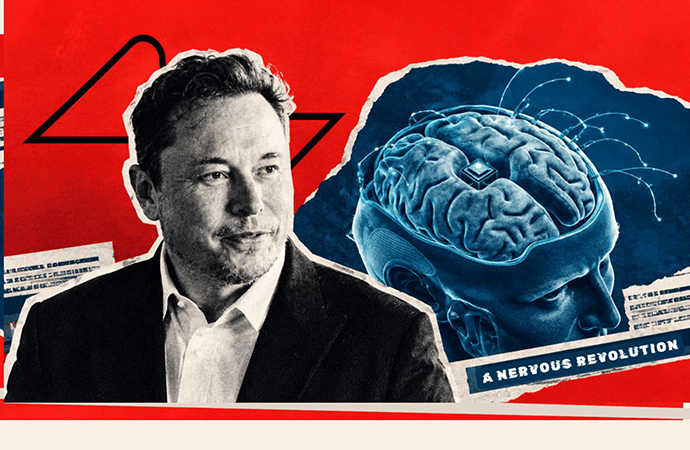
Image by: Shoumik Zubyer
Neuralink has announced mass production of brain-computer interfaces for 2026. What was designed to liberate the paralysed may be creating a new frontier for us mere sapiens, laden with fears - and one built on data mined from the mind.
On 16 September Neuralink posted a video of a man named Kenneth Shock telling his wife he loved her, without moving his mouth. A coin-sized implant in his skull, fitted in January for the company's VOICE trial, recorded the firing of neurons as he tried to speak, and software rebuilt that activity as audible words in a reconstructed voice. Neuralink called the moment "a beautiful surprise".
Clips like this are how Neuralink announces its science. They are also how it sells itself, and in 2026 the selling has taken on an industrial edge.
This quiet steamroll started on New Year's Eve 2025, Elon Musk made an announcement that should rock everyone's world from BlackRock to Shenzhen. Writing on X that Neuralink would "start high-volume production" of its devices in 2026 and move to an "almost entirely automated surgical procedure", with a robot pushing electrode threads straight through the dura, the tough membrane wrapping the brain, instead of peeling it back like the norm for 30 years. Investors had already paid handsomely for that promise, putting $650 million into the company in mid-2025 at a valuation of about $9 billion. Musk once suggested more than a thousand people might carry implants by this year, but by June the count stood at 26. This bioethical storm is no longer science fiction.
Neuralink's public story began with a pig in August 2020, in California, when Musk walked on stage with his signature gait and giddy dance. The cameras panned to a pen holding Gertrude, a sow carrying an implant. The scientists controlled her movements remotely, as she snuffled for food with the crackle of neurons linked to her snout. Researchers at Brown University had shown monkeys steering cursors with brain implants back in 2002, so the novelty lay in the wireless link and the livestream audience. But then they stepped up in April 2021, when a macaque called Pager played the video game Pong with its mind.
The animal work drew fire from the Physicians Committee for Responsible Medicine, an advocacy group which said implanted monkeys suffered infections, paralysis and brain swelling before being euthanised. A US Department of Agriculture review in 2023 found no breaches beyond one incident Neuralink had reported itself in 2019. The US Food and Drug Administration rejected the company's first request to test in people in 2022, citing the lithium battery and the risk of threads migrating through brain tissue, then approved human trials in May 2023.
Factory brains
The competition Musk is building his Neuralink factory against is concentrated in China, and its industrial heart is in the south. Shenzhen, the city that assembles much of the world's phones and drones, hosted the national brain-computer interface (BCI) expo in 2025, where officials announced fresh funding. Guangdong province has since set a target of a BCI industry worth "tens of billions of yuan" by 2030, with Shenzhen and Guangzhou as twin hubs, and Beijing's national plan, issued in July 2025, asks for "two to three globally dominant companies" by the same date. That is also precisely the grossly successful playbook China used on solar panels and electric cars.
Chinese firms are already selling devices: in March China's National Medical Products Administration cleared Neuracle's NEO, a Shanghai-made device that rests on the brain's surface without penetrating it, for commercial sale, the first invasive BCI approved anywhere. Surgeons fitted the first paying patient on 14 July. Li Yuan, rotating chief executive of Beijing's state-backed NeuCyber, is candid about the gap. "The benchmark for Beinao-2 is Neuralink," he told reporters in March. "I have to say, [there is] about three years' lag because they have over 20 patients using it already."
Noland Arbaugh is the person who made this possible to imagine. In January 2024, neurosurgeons working with Neuralink performed the first human implant of the company's device, called the N1 Link - a coin-sized chip, roughly 23 millimetres across, that replaces a small section of skull bone and sends ultra-thin electrode threads into the tissue beneath. Electrodes, in this context, are the listening instruments, they sit near the brain's individual messaging cells and detect the electrical pulses. Within weeks, Arbaugh was playing video games, browsing the internet, and posting on social media; all with his focused thoughts. "I was not expecting it to be as good as it is," Arbaugh said in an interview. "There were moments when I realised - this is a much bigger deal than I thought it was."
By September 2025, twelve people worldwide had received Neuralink implants, each of them living with severe paralysis. The company expanded its trials to the United Kingdom, Canada, and the United Arab Emirates. That is a considerable leap in operations from Gertrude, one might add.
More than ten thousand people are now reportedly on Neuralink's waiting list.
Meet Mira
Consider a hypothetical patient using this tech. She is 41, a former schoolteacher with motor neurone disease. In 2031 a robot fits her with an implant in 20 minutes. Within a month she types faster than she ever did with her hands. By the second year the decoder knows her better than her husband does, having learned the signature of her frustration, the flicker that comes before a word she is about to abandon and the pattern that appears whenever she sees her daughter's photograph. It all sounds very Black Mirror-esque, but much like the exponential boom in silicon intelligence, the provenance of this scenario may root back to mere science fiction, until it becomes reality.
Her insurer pays for the hardware, while the decoding software, updated nightly from the cloud, belongs to the manufacturer, and so do the models trained on her. When she changes insurers, the new one asks for her "engagement data". When she lingers on an advert for running shoes she will never wear, the system logs a spike of interest, and nothing in her contract stops the company selling that observation to third party buyers.
The data a Neuralink device generates can, researchers warn, reveal cognitive and emotional states that individuals themselves may not recognise as personal information.
Whose head is it, anyway
Mira is invented, but her contract terms are close to the real ones. In 2024 the NeuroRights Foundation, chaired by Columbia University neuroscientist Rafael Yuste, examined the privacy policies of 30 companies selling consumer headsets and earbuds that read brain activity. Twenty-nine appeared to have access to users' neural data with no meaningful limits, and 29 could in practise pass it to third parties. Those gadgets read coarse signals through the scalp. An implant that decodes attempted speech records something much closer to intention.
The law protecting such data is patchy. Colorado became the first US state to class neural data as sensitive personal information in 2024, and California, Montana, Connecticut and Vermont have since passed versions of their own. The federal MIND Act, introduced in September 2025 by senators Chuck Schumer, Maria Cantwell and Ed Markey, would merely ask the Federal Trade Commission to study the problem, and lawyers at Davis Wright Tremaine wrote in May that it had stalled and probably would stay stalled in an election year. Data gathered inside a clinical trial is protected by health-privacy rules, which thin out once a device goes on general sale or the data is stripped of names. China's 2030 roadmap concentrates on common technical standards and a complete domestic supply chain. Whichever country ships the most chips will in practise write the defaults for everyone else.
Kenneth Shock's loving words from the mind to the speaker are by all accounts, an example of the extraordinary feats of human ingenuity. Recordings like the one that produced them make up the 50,000 hours the company now uses to train its next decoder, and to court its next customers.
Rene Descartes once said that the one thing he couldn't doubt was his thinking, albeit he never had to read the terms and conditions of his parable as it applies to brain chips. Once big tech's neural engines can spot a craving before you notice it, the old riddle gets a marketing department. If you think something and an advert answers it, whose thought was it really? Asimov's "we can remember it for you wholesale," rings truer by the years.
Shoumik Zubyer is a science correspondent, and a Bioremediation researcher at the Bangladesh Atomic Energy Commission and Bangladesh Council of Scientific and Industrial Research.
A Independent Newsweekly
© Copyright 2026 | Designed by ARK Reepon & Developed by Cosmos Group Software Team





Leave a Comment
Recent Posts
The government passes the test ...
One of the cornerstones of the political earthquake Bangladesh witness ...
The government hiked the price ...
The government hiked the price of a 12kg cylinder of liquefied petrole ...
Police in France stand accused of using excessive fo ..
The India-Pakistan Cold War
A week on from DNCC’s eviction drive, Mirpur-10 rema ..
Equal Service, Unequal Pensions: Time for a Fairer S ..