


Culture
ART SG 2026: Reflections from SAW


An Independent Newsweekly

Culture
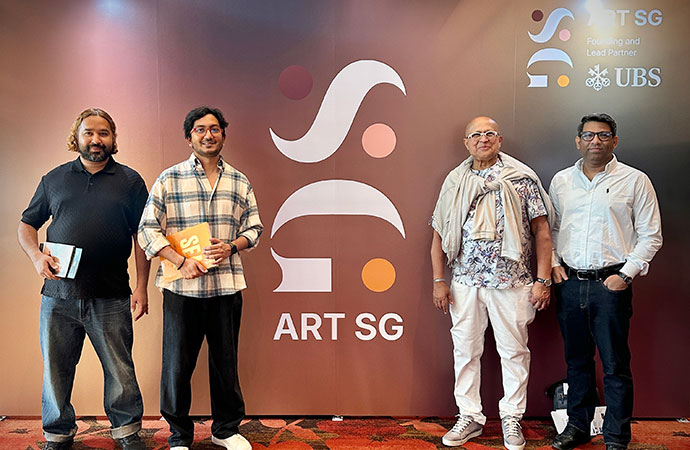
From left: Jamil Khan, Creative Producer of Gallery Cosmos and Cosmos Atelier 71, Sourav Chowdhury, Artistic Director, Gallery Cosmos & Cosmos Atelier71, Enayetullah Khan, Chairman of Cosmos Foundation and ARK Reepon, Chief Creative Officer of Cosmos Books
Singapore, for a brief moment, becomes an entire city-sized gallery. Earlier this year, I travelled there with Enayetullah Khan, Chairman of Cosmos Foundation; ARK Reepon, Chief Creative Officer of Cosmos Books; and artist Jamil Khan, to experience ART SG 2026 during Singapore Art Week. We approached it not merely as visitors, but as practitioners and organisers, observing how deliberate planning, curatorial vision, and institutional collaboration shape a city into a global cultural hub.
ART SG 2026 brought together over 100 galleries from more than 30 countries, reflecting Asia's increasing confidence in shaping international art discourse. A notable addition this year was "South Asia Insights," a specialised pavilion highlighting contemporary art from the Indian subcontinent and its diaspora. Participating galleries included Aicon, Gajah Gallery, Gallery Art Positive, Latitude 28, Nature Morte, Sakshi Gallery, Sundaram Tagore Gallery, and Vadehra Art Gallery. This initiative positions Singapore as a central node for Asian contemporary art, demonstrating that South Asian visual languages are gaining sustained global relevance.
Among the works that stayed with us, Anne Samat's It Feels Like Home... The Journey Continues (Wide Awake and Unafraid Series) (2026), presented by Marc Straus, stood out. Rooted in textile traditions yet conceptually contemporary, it explored memory, ancestry, and belonging. The material itself became a vessel of emotional history, quietly asserting that "home" is not fixed but continuously reconstructed.
Equally striking was Korean artist Lee Bae, who has spent over three decades developing a monochromatic, calligraphic vocabulary in charcoal. At Platform 2026, Johyun Gallery presented new paintings from his Brushstroke series alongside a large bronze sculpture, creating a spatial dialogue where plane and volume, gestural mark-making, and environment converged. The installation reminded us that abstraction can be simultaneously intimate and architectural.
Elsewhere, ART SG balanced technical mastery with conceptual inquiry. Fernando Botero's monumental sculptures transformed space into civic encounter; Hiroshi Senju's waterfalls conveyed stillness and impermanence through a delicate interplay of pigment and light. Antonio Santin's Arena (2025) blurred painting and objecthood through meticulous illusion, while Toni R. Toivonen's Peripeteia in Shades of Sulfur (2025), using brass and organic matter, confronted viewers with transformation, mortality, and the ethics of material.
Beyond the fair, Singapore Art Week activated the city with museum exhibitions, public installations, and participatory programmes. Botero in Singapore presented over 130 works-the artist's largest showcase and only Southeast Asian stop-while the National Gallery hosted Into the Modern: Impressionism from the Museum of Fine Arts, Boston, the region's largest exhibition of French Impressionism. Large-scale installations and projection mapping further blurred the line between curated space and urban life.
Singapore Art Week also unfolded across museums, art districts, and adaptive cultural spaces that demonstrated the city's long-term cultural vision. At the National Gallery Singapore, Light to Night 2026 transformed the civic district through projection mapping, installations, performances, and public programmes that encouraged audiences to engage with art beyond conventional gallery frameworks. Our visit to Gillman Barracks, a former 1930s military compound now reimagined as a contemporary arts cluster - reflected sustained investment in cultural infrastructure. Equally significant was Tanjong Pagar Distripark, an industrial complex repurposed into a major arts venue and a key site for the Singapore Biennale. Such thoughtful adaptive reuse reveals a curatorial pragmatism that merges heritage with forward-looking artistic production.
Returning to Dhaka, what remained was a larger realisation: cultural ecosystems are rarely spontaneous. Singapore exemplifies how vision, policy, and continuity of investment create a lasting artistic presence. For those of us engaged in building platforms, the lesson is clear - influence is not inherited or immediate; it is cultivated through patience, clarity, and the deliberate nurturing of artists, audiences, and institutions together.
Sourav Chowdhury, Artistic Director, Gallery Cosmos and Cosmos Atelier71
A Independent Newsweekly
© Copyright 2026 | Designed by ARK Reepon & Developed by Cosmos Group Software Team



Leave a Comment
Recent Posts
UNGA presidency: A significant ...
No matter how you look at it, Dr Khalilur Rahman's election as pre ...
On the trail of the Asian Wild ...
The conflict between humans and elephants has reached an extreme level ...
Electricity prices were hiked
Bishwajit Goswami’s work travels to Brooklyn, New Yo ..
The Intelligence That AI Is Missing
The One Man Who Could Give Trump Middle East Peace