


Column
The mega crisis in the banking sector and NBFI depositors


An Independent Newsweekly

Column
AI Generated Image
Most of the discussions in the media's financial and by extension political world today is around Islamic Bank, the big bash owned by S. Alam who was not the primary sponsor but became so through the auspices of the previous regime. It stated that the takeover was planned and not only was the original owner hanged for alleged war crimes but his assets were taken away by S. Alam and his sponsors who happened to be members of the ruling power elite.
The Islami Bank issue
Islami Bank is famously popular among the Bangladeshi migrants' workers and was the largest remittance deliverer before its fall. Many deposited monies as it was perceived to be more Islamic /pious than other banks. With a Jamaat leader as its owner and its brand as "Islamic" it had a huge advantage in selling the bank as the right one to simple money senders. While the ownership has changed, the pattern has not significantly changed. Meanwhile, the political party Jamaat-e-Islami is at least emotionally and strategically involved as can be understood from their words including in the parliament.
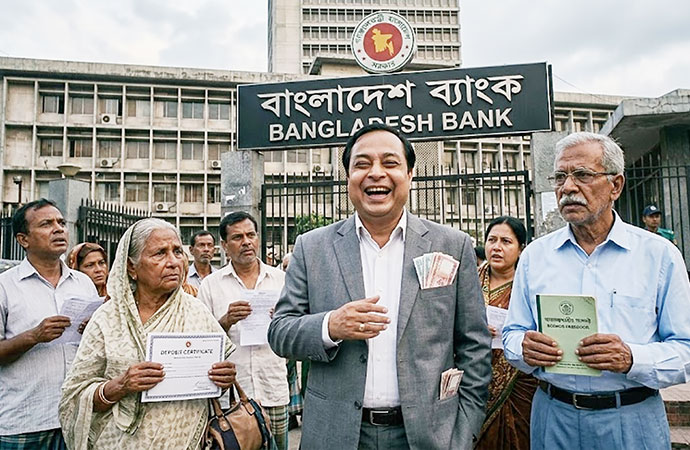
What however captures public media space and attention are the regular protests, meetings, processions, controversies and so on around the Islami Bank by the depositors. Bangladesh Bank, basically serves as the official brand of the government's financial regulatory mechanism. However, there seems to be serious public doubt about the capacity of the Bank to resolve and handle such issues.
The NBFI closure and repayment of depositors' mess
The NBFI mess -let's call it by the popular brand people use - Haldar syndrome- epitomises the liberty of theft, collusion among thieves across the board and extreme inefficiency. And in all three Bangladesh Bank and its officials were allegedly involved. Haldar didn't do it alone but did so not just with the political protection which he naturally got in return for sharing the loot but BB officials also as primary reports have said. It had gone on for at least seven years and in each step, it was the duty of the regulators to protect the depositor's interest which they didn't. Some didn't deliberately but BB lacks systemic efficiency massively.
While Haldar had accomplices inside the Bangladesh Bank, the institution itself didn't have the capacity to regulate effectively. That is why the banking sector is now pointed out as the weakest spot in the economic revival or whatever that the current government is desperately seeking.
While Haldar was in Bangladesh, he was never touched by the police, never inspected by the banking authorities and no action taken to rein in his larger NBFI sector. This could not be possible without collusion and Haldar bought it and escaped safely to Canada.
However, Canada felt unsafe so he went to India where he also tried low end ways to develop scams and schemes but ultimately ended up in jail. He is now out on bail. Deals can be made everywhere, one knows and India has no stake like Bangladesh because he was stopped before he could go far. In Bangladesh, he went as far as he could and was allowed to escape.
The Reserve Theft case
Although not yet fully official, various sources are suggesting that the Reserve theft from the Bangladesh Bank was a planned heist which not only involved BB officials but two Indian techies as well who were appointed by the Bank. It has tremendous political and popularity value and will grab public attention immensely. It's already in mainstream media and may soon become a major issue. Given this scenario the chances of this becoming a case of great convenience to many is high.
Which will get priority?
Both Islami Bank and the NBFI cases involve public depositors. The pressure that comes from Islami Bank depositors is backed by the remittance economy and a major opposition party. The Government has taken cognizance of all that so the problem will be resolved in the Sammilito Islamic Bank- sector. Plus, the authorities don't want any disturbance in any remittance related activities. Given the high number of depositors who come from a multi-class world and the fear that it may be interpreted as being "anti-Islami", the chances of this sector being dealt with urgency is high. 25 billion was recently lent.
The "reserve theft" case is a gold mine of political potential. Getting ex AL and India together fits any government of today's menu. So, it will be dealt with though it offers the least concrete returns as the money is gone, belongs to the GOB not the public and the accused are all gone from Bangladesh too.
Which will get the least priority?
It's the profile of the NBFI depositors that play a role. They are elderly -at least most- and belong to the non-political upper middle class, have no connections or clout and returning their money carries no benefit for the Bank or the government. If one looks at the ID of the depositors and how they are appealing to the GOB and BB to return their hard-earned white money, it shows why they can be safely ignored without any political consequences to consider.
What of course remains unaddressed is that the regulators mechanism due to political demands, general efficiency and collusion with elements like Haldar has been severely compromised though whether beyond help one can't say. That will neither be probed nor repaired so the chances of the banking sector becoming the source of financial and investment confidence will remain where it was before.
A Independent Newsweekly
© Copyright 2026 | Designed by ARK Reepon & Developed by Cosmos Group Software Team





Leave a Comment
Recent Posts
Mosque in my memory
Recently, I saw a pamphlet published by the Islamic Foundation which s ...
Why the fastest-growing Ebola ...
The Ebola outbreak in eastern Congo is now the fastest-growing one in ...
US reimposes its blockade on Iran after Tehran’s att ..
Oil Shocks Are No Longer So Shocking
Bangladesh urged to build AI capacity, strengthen di ..
Metamorphosis: Bishwajit Goswami on Art, Nature and ..