


Reportage
ICIMOD chief hails SANDEE’s 25 years of shaping South Asia’s environmental economics

An Independent Newsweekly




Reportage
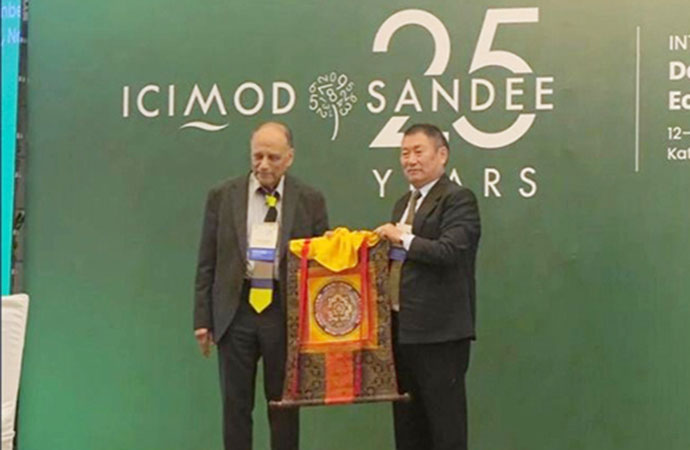
Network’s legacy of building regional research capacity, policy impact celebrated in Nepal
Appreciating the SANDEE's impactful 25 years journey, International Centre for Integrated Mountain Development (ICIMOD) Director General Pema Gyamtsho on Friday laid emphasis on continued joint efforts in the region to understand and respond to the nexus of poverty, development and environmental sustainability in South Asia.
"The South Asian Network for Development and Environmental Economics (SANDEE) has grown into a vibrant, indispensable community," said Pema Gyamtsho as SANDEE marked its 25th anniversary with a high-level three-day international conference that began at Himalaya Hotel on Friday.
The conference brought together experts and global thought leaders, including from Bangladesh, on the economic challenges of climate change, biodiversity loss, and sustainable development in one of the planet's most critical regions - the Hindu Kush Himalaya (HKH).
The network's legacy of building regional research capacity and policy impact is being celebrated as top global economists are charting path for the Hindu Kush Himalaya's future.
"Its work has fundamentally advanced how we understand and respond to the nexus of poverty, development, and environmental sustainability in South Asia. This foundation is non-negotiable for our future," said the ICIMOD DG.
For a quarter century, SANDEE, a flagship network of the International Centre of Mountain Development (ICIMOD), has methodically built a generation of scholars and policymakers across 10 countries in South Asia and the HKH.
Its conference, "SANDEE@25," served as both a celebration of this legacy and a urgent forum to address the accelerating environmental crises facing the region.
The conference is featuring keynote addresses from global luminaries, including Sir Partha Dasgupta, the renowned economist from Cambridge University, UK, known for his groundbreaking review of the economics of biodiversity.
Reflecting on SANDEE's unique model, Sir Partha said it has created friendships and collaborations across national borders that led to research which would be unthinkable elsewhere. "That is its lasting achievement."
The network's impact is quantified by its people.
SANDEE has cultivated over 2,000 alumni, who now serve as university vice-chancellors, deans, government advisors, and lead researchers, directly translating evidence into policy and practice across Afghanistan, Bangladesh, Bhutan, China, India, Maldives, Myanmar, Nepal, Pakistan, and Sri Lanka.
"This represents an investment with extraordinary high social returns," said Mani Nepal, SANDEE's Senior Programme Coordinator at ICIMOD.
For 25 years, he said, they have equipped researcher with economic tools to analyse environmental problems. "Today, that community is the backbone of informed policy in the region."
The conference focused on the theme, "Development, environment, and mountains," with discussion spanning biodiversity finance, forest restoration, climate adaptation and sustainable livelihoods.
The gathering also saw the launch of a commemorative volume, "SANDEE@25: Advancing environmental economics research and education in South Asia", documenting the network's journey and influence.
The participants said the network built over the past 25 years is now essential infrastructure for navigating the complex environmental and economic challenges of the next quarter century.
The Hindu Kush Himalaya (HKH) region stretches 3,500km across Asia, spanning eight countries - Afghanistan, Bangladesh, Bhutan, China, India, Myanmar, Nepal and Pakistan.
Encompassing high-altitude mountain ranges, mid-hills, and plains, the zone is vital for the food, water and energy security of up to two billion people and is a habitat for countless irreplaceable species.
It is also acutely fragile, and vulnerable to the impacts of the triple planetary crisis of climate change, pollution, and biodiversity loss.
The International Centre for Integrated Mountain Development (ICIMOD), based in Kathmandu, Nepal, is an international organisation established in 1983, that is working to make this critical region greener, more inclusive and climate resilient.
SANDEE is a research capacity and academic leadership development programme of the International Centre for Integrated Mountain Development (ICIMOD).
A Independent Newsweekly
© Copyright 2026 | Designed by ARK Reepon & Developed by Cosmos Group Software Team






Leave a Comment
Recent Posts
A Battle for the Soul of The N ...
Two disturbing incidents came to light this week, even as they went un ...
Dhaka seeks concrete measures ...
State Minister for Foreign Affairs Humaiun Kobir on Thursday urged Sou ...
Bangladesh Embassy in Ireland begins operations
Dinesh Trivedi stresses proper preparations before T ..
The Hope Deficit: Why Bangladesh’s Revolution Must M ..
Iqbal Bahar Chy: Finding freedom in the unplanned