


Column
Turner and Trump: A Painter, A President, And A Solemn Symbolism For The Global Scene

An Independent Newsweekly




Column

Decades ago, as a young diplomat, while visiting the National Gallery in London, I stood before "The Fighting Temeraire'' the masterpiece work of art by England's finest seascape painter Joseph William Maillord Turner. The painting stopped me. I was overwhelmed by so profound a message conveyed by so simple an interplay of colours. A great ship was being towed away by a small ordinary boat against the backdrop of a setting sun. It was both beautiful and sad. I felt that it was much more than about a large old vessel and a small modern ship, and the last rays of an evening sun bathing the blue waters. That painting taught me the incontrovertible veracity of the law of nature the fact that power passes!
Last week I viewed it once again. It was at a time of a fortuitous coincidence. The day's headlines carried the tidings of disastrous midterm election results of President Donald Trump's Republican Party in the United States. Before me on the walls of the Gallery I could see a great ship being towed away. The newspaper in my hand was telling me that a mighty nation seemed to be pulling back. The parallel at once struck me as remarkable. It was as if the the painting had come to meet an eternal reality.
What Turner's work shows is a proud warship on its final journey. The 'Temaraire' was the hero of the Battle of Trafalgar. But its glorious days had ended. It was now old and useless. A small, dark steamboat was pulling it, its mast bereft of sails, to the breakers. The sun in the background was about to set on the old era, and a pale moon was rising. The lesson was clear. Glory fades, and power shifts. Turner painted it in 1838 when Britain's naval supremacy was passing. The industrial revolution was upon us then. just as the age of Artificial Superintelligence is imminent now. It was about transition, and its travails.
Turner's symbolism is rich. The sunset suggests the end of an epoch. The moon stands for a new beginning, faint but felt. The steamboat is slow, and plain. It is also the future. The great sailing warship is grand, but helpless. It is also the past. The river is history. It carries everything away.it is in constant movement, in a perennial state of flux. As the classical Greek philosopher Heraclitus had said, no one can step into the same river twice. The painting speaks to empire, memory and mortality. It underscores that all glory is transient, and none lasts forever!
Now look at the United States of America. The midterm results came as a rebuke addressed by the people at the incumbent administration. Voters demanded a check on Presidential power. The message that came through was dazzlingly clear. The country wanted balance. It wanted limits. It wanted a pause. At the same time, even before these polls, America was already retreating from the world. It had withdrawn itself from many international organisations. It had been pulled back from climate action and global health. It was turning away from multilateralism.it appeared to be stepping back from the stage it once built. There is a bright side to this in domestic politics. It was a demonstration of people's power, which is the key to a democratic system. The US, symbolises as The Temeraire, has the potential to return to render service again, of another kind, not necessarily of a battleship.
The next two years will mean that a restrained Chief Executive will be in the on the domestic scene. The House of Representatives, with its majority of Democrats, will be unlikely to apportion funds for any of the forever wars, including the one with Iran, or financing any renewed conflicts. The Senate Democrats with their numbers can block key senior appointments, judges, diplomats and executives. The oversight functions of the Congress will also increase. There will be more summons and hearings into alleged corruption, and attempts at impeachments. President Trump and his team will be constrained in operations. Despite Mr. Trump's stated intention to act as "Mr. Veto", the prospects of a Republican disaster in the bid for the White House in 2028 Presidential polls would surely invite greater circumspection, and a tad more docility.
And what of the world beyond, in the meantime? In the run up to 2028, the world order will change. The US interest in the promotion of democracy and human rights will decline even further than in the first two years of the Trump Administration. America will stop trying to lead a "value-based system", and will continue in its transactional interactions with the world placing American interests first. It will focus on making practical deals with China, its near peer adversary, and Beijing will quietly agree on who controls what. They will avoid war over Taiwan or the South China Sea. Trade and technology disputes will be managed carefully so that neither side loose too much.
Europe will be busy with its own problems, and social upheavals. Many countries will have to contend with strong nationalist parties, fiscal and financial issues, and debates over immigration. As a result, other parts of the world will be left to handle their own affairs. The European Union and NATO will struggle to act in cohesion to confront Russia, as over Ukraine. The old imperial powers like Britain, France, Spain and Portugal will have to redefine their relationship with their former colonies, and as retired imperial powers would need to deal with the influx into their current territories of their earlier subjects, to whom they had once pledged equality. France, for instance.
The regions will have to largely fend for themselves. The State systems would still operate. But without any global big-power policing, the rule will be even more Darwinian, with survival assured for only the fittest. If there is a single local pre-eminent power, it will need to provide the "public goods" such as Russia in the former USSR region. In regions like the Middle East, the Palestinian issue will remain central and unresolved in the near future, pitting Israel against many Arab States and Iran. In Arab nations where the State is weak, nonstate actors like Hamas and Houthis will act on behalf of the people of their weak governments with ineffective formal armies. In South Asia the dangerous rivalry between two nuclear powers, India and Pakistan will continue unabated, not only due too their bilateral territorial disputes such as over Kashmir, but also for influence over fellow South Asian nations like Bangladesh and Afghanistan.
Come December, the United Nations will have a new Secretary General. But with depleted resources, and due to lack of consensus on requisite institutional reforms, he or she will remain largely powerless. It will be an anarchic world, as Professor Hedley Bull had predicted. States, some with challenged and differentiated sovereignties, will have evolved their own club-rules to coexist with one another. These predictions are for the next couple of years, till new leaderships emerge in key states which might alter the nature of rules and patterns of international behaviour.
To conclude, a few words on how, not just the US, but all nations, relate to Turner's "The Fighting Temaraire". The painting is a meditation on time. Everything ends. Everything changes. The sun sets on the old order. But the moon signals that a new day is already on the horizon. Our world must try to prepare to meet it, and to be able to do so with grace.
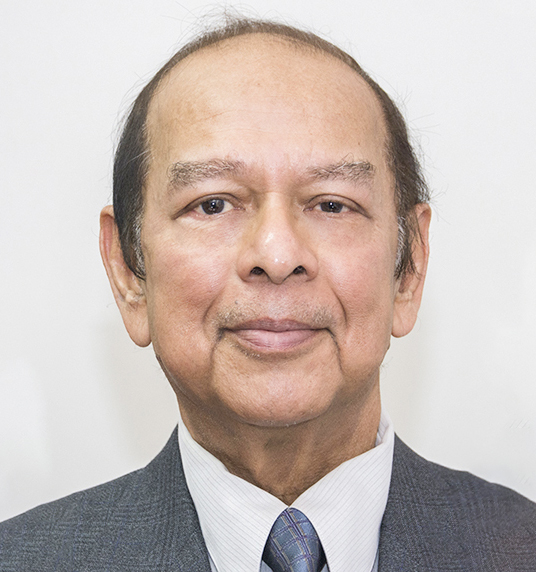
Ambassador Iftekhar Ahmed Chowdhury (Rtd.) PhD, President, Cosmos Foundation. Former Foreign Advisor, Bangladesh Caretaker Government (2007-2009)
A Independent Newsweekly
© Copyright 2026 | Designed by ARK Reepon & Developed by Cosmos Group Software Team







Leave a Comment
Recent Posts
Shenzhen was no Yalta: The Lim ...
The meeting between US President Donald Trump, Russian President Vladi ...
For the first time, UN’s highe ...
In a landmark judgment, the United Nations’ top court ruled Thur ...
DFC engagement to mobilise private investment, advan ..
France to celebrate French Week in Dhaka; André Malr ..
The Roots of Macron’s Failure
The Silver Lining of a Data-Center Slowdown