


Column
Beyond Industrialisation: Can Human Capital Exports Become Bangladesh's Next Growth Engine?


An Independent Newsweekly





Column
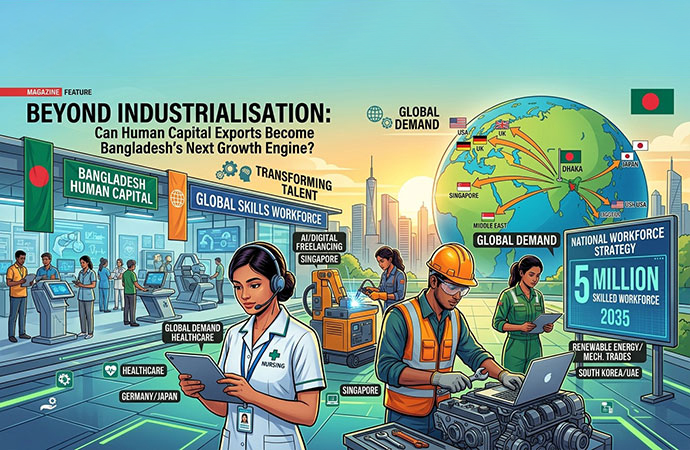
Bangladesh faces a growing employment challenge. Each year, millions enter the labour market, while domestic job creation struggles to keep pace. Industrialisation, foreign investment and entrepreneurship remain vital, but they cannot absorb the entire workforce in the foreseeable future. The country therefore needs a broader nation-building strategy-one that transforms its demographic dividend into globally competitive human capital and positions Bangladesh as a leading supplier of skilled talent to the world.
A Challenge Bigger Than Unemployment
The employment debate often focuses on creating jobs. The bigger challenge is preparing people for them. Each year, hundreds of thousands of Bangladeshis enter the labour market, while industrial growth and investment struggle to keep pace. With automation reshaping work and FDI remaining limited, Bangladesh must look beyond conventional job creation and focus on equipping its workforce for opportunities emerging both at home and abroad.
Bangladesh Already Has the Foundation
The encouraging reality is that Bangladesh is not starting from zero. The country already possesses:
• More than 100 Technical Training Centres (TTCs).
• Polytechnic institutes across the country.
• Bureau of Manpower, Employment and Training training facilities
• Technical and vocational institutes
• Skills for Employment Investment Programme and other workforce development initiatives
• Private-sector training providers.
• Growing digital learning platforms.
The challenge lies in integration, coordination and strategic direction. Many institutions train workers. Few are linked directly to future global labour market requirements.
The Global Opportunity
Global labour shortages are growing as Europe, Japan, South Korea, Singapore and parts of the Middle East face ageing populations and shrinking workforces. Demand for healthcare workers, caregivers, technicians, construction workers, logistics personnel and digital service professionals is set to rise. Future reconstruction efforts following conflicts or natural disasters may further increase demand for skilled manpower. Countries able to supply trained, certified and job-ready workers will gain a significant advantage. Bangladesh must prepare now to seize these opportunities.
A National Workforce Mobilisation Strategy
Bangladesh requires a National Workforce Mobilisation Strategy led by the government and supported by all relevant stakeholders. The objective should be ambitious: To transform at least five million Bangladeshi youth into internationally employable skilled professionals by 2035. This strategy should rest upon six pillars.
Pillar One: Labour Market Intelligence
A permanent National Labour Market Intelligence Centre should be established. Training must be driven by demand, not assumptions. Its responsibilities would include:
• Forecasting global labour demand.
• Identifying future skills shortages.
• Monitoring demographic trends.
• Assessing reconstruction and infrastructure-related employment opportunities.
• Guiding national training priorities.
Pillar Two: Skills Revolution
International certification should become mandatory wherever possible. Training institutions should focus on future-oriented sectors:
• Construction and infrastructure.
• Renewable energy.
• Electrical and mechanical trades.
• Nursing and healthcare assistance.
• Elderly care.
• Hospitality and tourism.
• Artificial intelligence support services.
• Digital freelancing.
• Cybersecurity.
• Logistics and supply chain management.
Pillar Three: Women's Workforce Advancement
Women represent nearly half of Bangladesh's population. A national workforce strategy that excludes women would effectively ignore half of the country's human capital. Dedicated safety, financing and placement mechanisms should accompany these programmes. Special emphasis should be given to:
• Nursing.
• Caregiving.
• Hospitality.
• Digital services.
• Language-based remote work.
• Education support services.
• Healthcare assistance.
Pillar Four: Government-to-Government Partnerships
Bangladesh should aggressively pursue labour agreements with countries experiencing workforce shortages. Such agreements reduce migration costs, improve worker protection and ensure quality employment opportunities. Particular attention should be given to:
• Japan.
• South Korea.
• Germany.
• Singapore.
• Saudi Arabia.
• UAE.
• Qatar.
• Malaysia.
Can Bangladesh Army Play a National Role?
The Bangladesh Army could play a valuable supporting role in a national workforce development programme. Its proven strengths in organisation, training, discipline and large-scale project execution could help accelerate implementation. Rather than replacing civilian institutions, the Army could support district-level Workforce Development Centres, provide leadership and discipline training, assist in project management, train trainers and strengthen quality assurance and certification systems. As it has contributed to national priorities such as infrastructure development, disaster response, education and immunisation, the Army could similarly support the preparation of a globally competitive workforce.
Workforce 2035: A National Vision
Bangladesh should adopt clear national targets. By 2035 the country should aim to achieve:
• Five million internationally certified workers.
• 40% female participation in advanced skills programmes.
• A training centre in every district aligned with international standards.
• Language training facilities nationwide.
• Expanded government-to-government labour agreements.
• A substantial increase in skilled migration and remittance earnings.
• A structured programme for returning workers to become entrepreneurs and trainers.
Nation Building Through Human Capital
Every generation faces a defining national challenge. For one, it was freedom; for another, food security. Industrialisation and poverty reduction followed. For Bangladesh, the next frontier is human capital development. The country's greatest resource is not minerals but its people. If government, educational institutions, industry and training providers can unite behind a common vision, millions of Bangladeshis can become contributors to both the national and global economy. The future will belong not to nations with the most resources, but to those that prepare their people best. For Bangladesh, that preparation must begin now.
Major General (Retd) Md Nazrul Islam is a former executive chairman of BEPZA, a retired Major General of the Bangladesh Army, and a PhD researcher on technology, workforce transformation, and industrial competitiveness.
A Independent Newsweekly
© Copyright 2026 | Designed by ARK Reepon & Developed by Cosmos Group Software Team





Leave a Comment
Recent Posts
Mosque in my memory
Recently, I saw a pamphlet published by the Islamic Foundation which s ...
Why the fastest-growing Ebola ...
The Ebola outbreak in eastern Congo is now the fastest-growing one in ...
US reimposes its blockade on Iran after Tehran’s att ..
Oil Shocks Are No Longer So Shocking
Bangladesh urged to build AI capacity, strengthen di ..
Metamorphosis: Bishwajit Goswami on Art, Nature and ..